An Introduction to Basic Chemicals and Their Vital Roles
What are basic chemicals? Dive into this simple breakdown of foundational compounds, how they function, and why they remain vital to modern society and life.
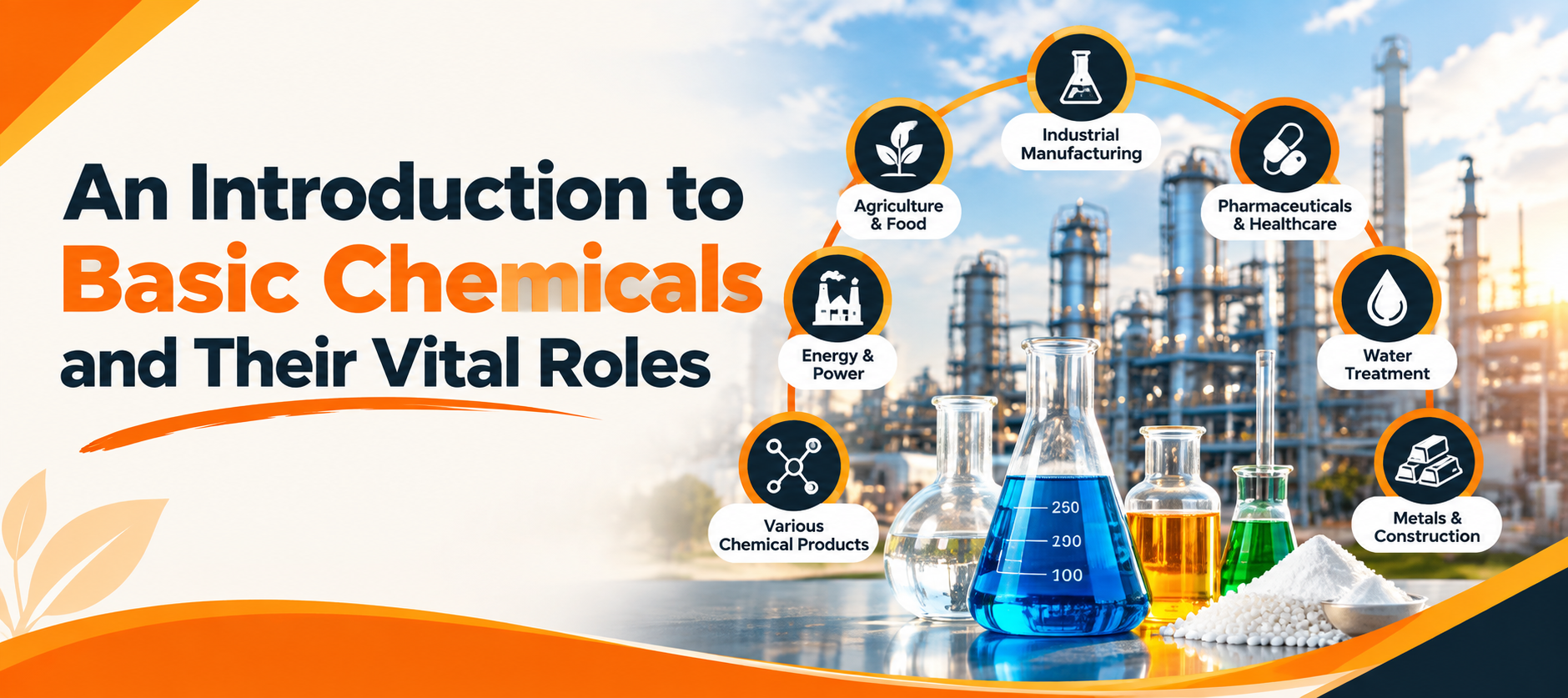
Introduction:
Look around your home and workplace or in your city and you will find chemicals everywhere. Whether you are talking about the detergent to wash clothes or the materials you use in construction. Same as water treatment and agriculture everything is connected to chemicals. Therefore countless everyday products that depend on chemicals are produced on an industrial scale.
Basic chemicals are the foundation of many of these daily-use products.
But what are basic chemicals? Why are these chemicals so important to modern industry?
So basically those basic chemicals are generally produced in large quantities. While they help serve as fundamental raw materials for the manufacturing of thousands of other products. These chemicals may not always be visible to consumers. But their impact is everywhere! They serve as cleaning products and in fertilizers as well. Where pharmaceuticals and industrial processes also rely on these chemicals.
Understanding the basic chemicals industry is so important. Therefore, the understanding of these chemicals is one of the foundations of the modern economy.
What Are Basic Chemicals?
Basic chemicals are also known as commodity chemicals. Because these chemicals are those substances that are manufactured on a large industrial scale. While they are also used as raw materials or processing agents in other industries as well.
Basic chemicals are often produced in large volumes and have broad industrial uses. Unlike highly specialized chemicals that are specially designed for specific applications.
Examples include:
1) Hydrochloric acid
2) Chlorine
3) Hydrogen peroxide
4) Sodium bicarbonate
5) Soda ash
6) Caustic soda
7) Sulfuric acid
8) Ammonia
9) Ethylene
These chemicals form the starting point for numerous downstream products and industrial processes. Same as they play the vital role in some types of commodities.
For example, caustic soda is widely used in chemical processing, textiles, pulp and paper, water treatment and cleaning products. Soda ash is important in glass manufacturing, detergents and various chemical processes.
Categories of Basic Chemicals:
The basic chemicals industry covers a broad range of products, but they can generally be grouped according to their chemical properties and industrial applications.
1) Acids
Acids are widely used in chemical processing and metal treatment. While some acids are used in water treatment and the manufacturing industry as well.
Examples of acids include hydrochloric acid and sulfuric acid which are the most famous ones.
2) Alkalis
Alkaline chemicals are important in the neutralization process. While they are also used in the cleaning and manufacturing processes.
Caustic soda and sodium bicarbonate are common examples of alkaline chemicals.
3) Industrial Gases and Halogens
Chemicals such as chlorine play an important role in water treatment and sanitation. Where the chemical manufacturing industry also uses it.
4) Oxidizing Chemicals
Hydrogen peroxide is an important oxidizing agent used in multiple applications. Where it ranges from bleaching and cleaning to water treatment processes. While its industrial processing uses are not hidden from anyone.
5) Inorganic Chemicals
Soda ash and various salts are important raw materials for glass and detergents. While other manufacturing industries also use these chemicals.
The boundaries between these categories can overlap, but together they illustrate the enormous range of applications covered by basic chemicals.
Importance of Basic Chemicals:
Why are basic chemicals so important to us?
Because they are the main building blocks of the modern manufacturing industry.
Many industries cannot operate without a reliable fundamental chemical for idustrial raw material supply.
1) Manufacturing
Therefore chemical manufacturers use basic chemicals to produce more specialized compounds. They also produce chemical-based materials and formulations from them as well.
2) Agriculture
Chemicals are very essential in modern agricultural field. Because some chemicals are used in fertilizer production, some in crop protection and some in agricultural processing.
3) Water Treatment
Chlorine and related compounds like chemicals are widely used in water and wastewater treatment.
4) Construction
The construction sector relies indirectly on basic chemicals through various products. Especially glass, cement additives and some coatings use basic chemicals. While some plastics, insulation and synthetic materials also rely on these chemicals.
5) Food and Beverage
Food processing and sanitation involves with a variety of major chemical products. This may include cleaning agents and processing chemicals as well.
6) Textiles
The textile industry uses some of these chemicals for bleaching and dyeing purposes. While finishing and other manufacturing processes are also included in them.
This broad industrial dependence explains many things about chemicals. That's why some chemical price changes can ripple through multiple sectors of the economy.
Zarea's Basic Chemical Products:
For businesses that depend on reliable industrial inputs, sourcing the right chemical products is an important part of supply-chain management.
Zarea provides access to a range of chemical products used across industrial and commercial applications.
1) Hydrochloric Acid
Hydrochloric acid is a strong inorganic acid that is widely used in industrial processing. While it also uses in metal treatment and chemical manufacturing. Or in the pH adjustment of water as well.
Its applications vary according to concentration, purity and industry requirements.
2) Chlorine Granules — 25 kg
Chlorine-based products are widely associated with sanitation and water-treatment applications worldwide.
Chlorine granules can be used in appropriate water-treatment and disinfection processes. Because it's subject to the manufacturer's instructions and applicable safety requirements.
3) Hydrogen Peroxide Korea 50% — 30 kg
Hydrogen peroxide is a strong oxidizing chemical used in industrial applications. This may include bleaching and certain water-treatment processes. Where the oxidation process also relies on this chemical.
50% concentration of hydrogen peroxide is a high-strength industrial product. Therefore it requires appropriate handling, safe storage and safety controls before use.
4) Sodium Bicarbonate LCI (Metha Soda) — 25 kg
Sodium bicarbonate is commonly known as baking soda. Although it's an industrial-grade material. Yet it is also used in a variety of commercial applications as well.
It can be used in food-related processing where the appropriate grade is specified as well as for cleaning. Where some chemical processing and other industrial applications rely on it.
5) Soda Ash Light LCI — 50 kg Packing
Soda ash or sodium carbonate is an important industrial chemical as well.
It is widely used in glass manufacturing and in detergents. But, water treatment and some chemical production industries also use it.
The designation of "soda ash light" generally refers to its physical form and its bulk density. As compared to a different chemical substance.
6) Caustic Soda Sitara — 25 kg Packing
Basically caustic sodais chemically known as sodium hydroxide. Because it's one of the most widely used industrial alkalis.
It is used in chemical manufacturing and textiles. Where as pulp and paper, water treatment, cleaning formulations and various industrial processes are also used with it.
Because Caustic soda is a highly corrosive chemical. That's why proper protective equipment and handling procedures are essential.
Examples of Basic Chemicals in Daily Life:
Basic chemicals may sound like purely industrial products, but their influence extends into everyday life.
Consider a few familiar products.
Glass windows and bottles can depend on soda ash during manufacturing.
Cleaning products can contain alkaline chemicals. Or these products use these chemicals in manufacturing. This may include sodium hydroxide which contains alkalis.
Water treatment systems use chlorine-based chemicals. While these chemicals can control harmful microorganisms present in the water.
Paper products involve chemical processing at multiple stages.
Textiles and clothing depend on chemical processes for bleaching, dyeing and finishing.
Even products that appear completely unrelated to chemistry often have a basic chemical somewhere in their supply chain.
Global Production and Basic Chemicals Market Trends:
The global basic chemicals market is closely connected to the manufacturing and construction fields. Where agriculture and energy fields are also connected with it according to consumer demand.
Large-scale producers manufacture these commodity chemicals in enormous volumes. Because these chemicals make production efficiency and energy prices controllable. Additionally transportation and raw-material availability are critical factors for these chemicals.
Chemical demand can rise alongside industrialization and urbanization. Because growing economies require more construction materials and manufactured goods.
The industry is highly cyclical at the same time. Therefore economic slowdowns can reduce industrial chemical demand. While an increase in energy prices can significantly affect the production costs of energy-intensive chemicals.
Global supply chains also play a major role in the chemical industry. Disruptions in the transportation or their production capacity can affect chemical prices. While limited raw materials and energy supplies can affect chemical availability.
Therefore monitoring the basic chemicals market can help with procurement planning. Same as risk management can help businesses purchasing chemical commodities supply-chain.
Environmental and Sustainability Challenges:
The basic chemicals industry plays an essential economic role, but it also faces significant environmental challenges.
Many chemical manufacturing processes require substantial amounts of energy. Depending on the production pathway and energy source, this can contribute to greenhouse-gas emissions.
Other concerns include:
1) Industrial wastewater
2) Air emissions
3) Hazardous waste
4) Resource consumption
5) Packaging waste
6) Chemical spills and accidental releases
As environmental regulations become more demanding, chemical manufacturers are investing in cleaner technologies, energy efficiency, waste reduction and improved process control.
The concept of a circular economy is also becoming increasingly relevant. Instead of treating materials as disposable inputs, manufacturers are exploring ways to recover, recycle and reuse resources.
The Future of Basic Chemicals:
The future of the basic chemicals industry will be shaped by a combination of demand, technology and sustainability.
Chemical manufacturers are increasingly exploring ways to reduce energy consumption and carbon emissions while maintaining competitive production costs.
Digital technologies can also improve manufacturing efficiency. Sensors, automation, predictive maintenance and advanced process-control systems can help factories monitor operations more accurately and reduce waste.
Another important trend is the development of alternative feedstocks and lower-carbon production pathways.
However, the transition will not happen overnight. Basic chemicals are deeply embedded in global manufacturing, meaning the industry must balance environmental goals with the enormous demand for affordable raw materials.
Wrap Up:
Basic chemicals may not always have the visibility of consumer brands, but they are among the most important building blocks of modern industry.
From hydrochloric acid and caustic soda to hydrogen peroxide, soda ash, sodium bicarbonate and chlorine-based products, these materials support an enormous range of manufacturing and commercial activities.
The basic chemicals market will continue to evolve as industries demand greater efficiency, reliable supply chains and more sustainable production.
For businesses, understanding the basic chemicals industry and basic chemicals products is more than a chemistry lesson. It is an important part of understanding how modern supply chains work.
Ultimately, the story of basic chemicals is a story of transformation: simple chemical building blocks entering one process and emerging as the materials, products and technologies that shape everyday life.
FAQ's:
What are some common basic chemicals?
Common basic chemicals are the foundational building blocks used to manufacture thousands of everyday items. Some of the most widespread examples include sulfuric acid (used in fertilizers and batteries), ethylene (the basis for everyday plastics), sodium hydroxide/caustic soda (used to make soap and paper), and ammonia (essential for agriculture).
What are the main types of chemicals?
In the commercial chemical industry, chemicals are generally divided into three major categories based on how they are produced and sold:
1) Basic Chemicals (Commodity Chemicals): Produced in massive quantities at a low cost, serving as raw materials for other industries (e.g., petrochemicals, polymers, and basic inorganics).
2) Specialty Chemicals: High-value, low-volume chemicals sold for what they do rather than what they are, such as advanced adhesives, food additives, and colorants.
3) Fine Chemicals: Pure, highly specific chemical substances produced in small batches, primarily used as the active ingredients in pharmaceuticals and biotechnology.
What is the most popular chemical?
From an industrial standpoint, sulfuric acid (H₂SO₄) is the most widely produced and utilized chemical in the world. It is often called the "King of Chemicals" because it is a universal indicator of a nation's industrial strength. If you are talking about everyday human life, water (H₂O) is universally the most essential and popular chemical compound on Earth.
What are the top 5 industrial chemicals?
By global production volume, the top five heavyweights of the industrial sector are:
1) Sulfuric Acid: Primarily used to create agricultural fertilizers.
2) Nitrogen: Extensively used as a blanketing gas to prevent explosions and keep food fresh.
3) Ethylene: The primary ingredient for creating plastic packaging, bags, and bottles.
4) Oxygen: Crucial for medical therapies, steel manufacturing, and rocket propellants.
5) Ammonia: The core component of nitrogen-based crop fertilizers that sustain global food supplies.
What are some examples of industrial chemicals?
Industrial chemicals span a massive range of uses across manufacturing. Standard examples include:
1) Solvents: Acetone and ethanol, which dissolve other substances in paints, nail polish removers, and cleaning agents.
2) Gases: Liquid nitrogen for flash-freezing food and compressed oxygen for welding.
3) Plastics raw materials: Propylene and vinyl chloride, used to create everything from car bumpers to PVC pipes.
4) Alkalies and Acids: Hydrochloric acid for steel pickling and caustic soda for refining aluminum.