Best Solar Panels in Pakistan – Types & Efficiency
Find the most efficient solar panels in Pakistan. Compare N-Type vs. P-Type technology, heat tolerance, and top brands like LONGi and Jinko to cut your bills.
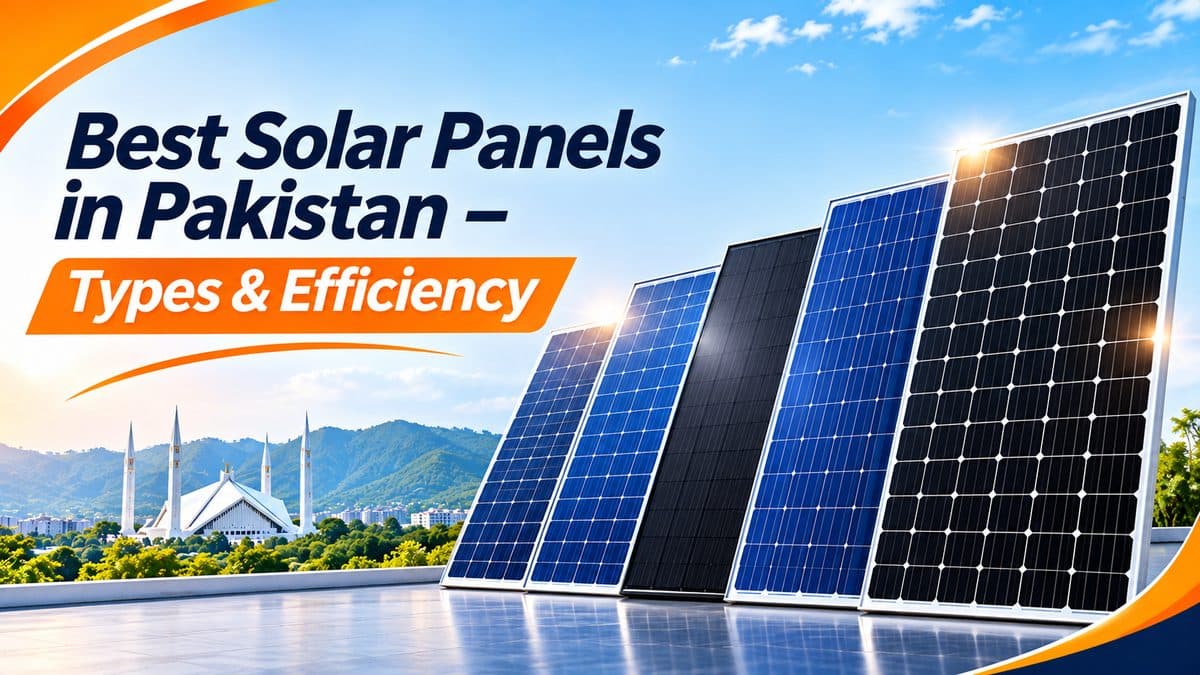
Introduction:
What is the first thing that comes to your mind when you see your electricity bill? Of course you think of millions of rooftops from Lahore to Karachi that are turning deep blue and black from solar panels. Because switching to solar is no longer a luxury choice for you if you live in Pakistan today. Basically it is the survival against soaring grid tariffs and unpredictable power outages that is necessary.
Imagine you are standing at a solar market or scrolling through dozens of dealer quotes on social media. It can feel overwhelming for you. Because every vendor claims that their solar plates are the "original A-grade" ones. While they are also throwing around many buzzwords like N-Type, TOP-Con, and Tier-1. Your system will quietly slash your bills for the next 25 to 30 years if you choose the right module today. Otherwise if you choose a poor module, your power output will nose-dive every time the summer season's mercury crosses 45°C.
We have broken down the best solar panels in Pakistan to help you make a confident investment. How do modern cell technologies compare with solar panels? What do you actually need to check before paying a single rupee from your savings for panels?
Best Solar Panel Brands in Pakistan:
Global engineering matters most just as much as local warranty support when shopping for the top solar panel in Pakistan. Because Pakistan's climate is brutal for electronics. Therefore, scorching summers in Multan and Lahore and thick dust layers all test a panel's endurance. Additionally Pakistan's heavy monsoon and humidity always test these solar panels' performance.
A handful of global giants dominate the Pakistani market currently. Because their panels are built for harsh environments and carry official distribution networks across major cities as well. This includes:
1) LONGi Solar
Well-known globally solar panel makers that are famous for their monocrystalline innovation. LONGi's Hi-MO series is famous for its structural strength and anti-dust framing. Additionally it also has back-contact efficiency which makes it an excellent choice.
1) Popular Series: Hi-MO X10 (640W–650W)
2) Cell Technology: N-Type HPBC 2.0 Bifacial
3) Efficiency: 23.5% – 24.4%
4) Approx. Rate/Watt (PKR): PKR 43.75 – 45.00
5) Approx. Panel Price (PKR): PKR 28,200 – 29,250
Here you can purchase this panel from zarea: Longi Solar Panel
_2026-11-17_10-45-14.jpeg)
2) Jinko Solar
This is one of the highest-selling solar panel brands in Pakistan. Jinko's Tiger Neo line offers exceptional heat tolerance and widespread availability. These qualities make this brand a smart choice for both household and commercial use.
1) Popular Series: Tiger Neo (585W–635W)
2) Cell Technology: N-Type TOPCon Bifacial
3) Efficiency: 22.6% – 23.2%
4) Approx. Rate/Watt (PKR): PKR 43.00 – 45.00
5) Approx. Panel Price (PKR): PKR 25,600 – 29,300
Here you can purchase this panel from zarea: Jinko Solar Panel
3) Canadian Solar
Canadian Solar Panels are engineered for heavy-duty weather resistance. Additionally Zarea also highly recommends you these panels for their panels' quality and efficiency. Canadian Solar is a favorite for both residential rooftop and commercial net-metering projects.
1) Popular Series: TOPBiHiKu7 (585W–610W)
2) Cell Technology: N-Type TOPCon Bifacial
3) Efficiency: 22.5% – 23.0%
4) Approx. Rate/Watt (PKR): PKR 44.00 – 45.00
5) Approx. Panel Price (PKR): PKR 29,000 – 30,350
Here you can purchase this panel from zarea: Canadian Solar Panel
4) JA Solar
JA Solar Panels are celebrated for delivering an unbeatable price-performance ratio. So basically their performance is tested during low-light mornings and hazy evenings. Particularly these panels stand tall in the Pakistani solar market for a reason.
1) Popular Series: DeepBlue 4.0 Pro (605W–610W)
2) Cell Technology: N-Type MBB Bifacial
3) Efficiency: 22.5% – 22.8%
4) Approx. Rate/Watt (PKR): PKR 40.25 – 44.00
5) Approx. Panel Price (PKR): PKR 26,600 – 28,550
Here you can purchase this panel from zarea: JA Solar Panel
5) Trina Solar
Trina Solar Panels are a pioneer in high-wattage 210mm wafer architecture technology. This means these panels are ideal when you want maximum power from a limited roof space. These qualities of these panels make them a unique choice for the middle class in Pakistan.
1) Popular Series: Vertex N (585W–700W)
2) Cell Technology: N-Type i-TOPCon Bifacial
3) Efficiency: 22.5% – 23.1%
4) Approx. Rate/Watt (PKR): PKR 40.00 – 44.00
5) Approx. Panel Price (PKR): PKR 25,500 – 27,400
Here you can purchase this panel from zarea: Trina Solar Panel
6) AIKO Solar
This company is a rising star in Pakistan's premium solar market. Because their panels push efficiency boundaries past 24% with All-Back-Contact (ABC) cells. This means that these panels provide exceptional performance for everyone. What do you want as a solar consumer?
1) Popular Series: Stellar ABC (620W–665W)
2) Cell Technology: N-Type ABC Back-Contact
3) Efficiency: 24.0% – 25.0%+
4) Approx. Rate/Watt (PKR): PKR 41.00 – 44.00
5) Approx. Panel Price (PKR): PKR 25,400 – 29,200
7) Astronergy
CHINT Group backs this company. Basically Astronergy offers reliable and budget-friendly N-Type bi-facial panels with strong anti-PID (Potential Induced Degradation) protection solar panels. In simple words, these panels are suitable for those people who want something different with a total unique perspective.
1) Popular Series: ASTRO N5 / TOPCon 4.0 (585W–630W)
2) Cell Technology: N-Type TOPCon Bifacial
3) Efficiency: 22.5% – 23.0%
4) Approx. Rate/Watt (PKR): PKR 40.50 – 44.00
5) Approx. Panel Price (PKR): PKR 24,000 – 27,700
Here you can purchase this panel from zarea: Astronergy Solar Panel
Types of Solar Panels – TOPCon vs PERC:
First, you need to look at the silicon cell structure inside if you want to understand why two 585W panels can perform differently on the exact same roof. Because the market comes down to two main technologies right now. This includes P-Type PERC and N-Type TOPCon solar panel technologies.
1) P-Type PERC (Passivated Emitter and Rear Contact): PERC technology has been the undisputed king of solar for nearly a decade. Because it adds a reflective layer to the back of the silicon cell to capture unabsorbed sunlight in a panel. While this technology is reliable and slightly cheaper upfront especially when you talk about this kind of solar panel. Basically PERC panels suffer from high light-induced degradation (LID) in their first year. This means those panels with PERC technology lose their efficiency faster yearly under extreme heat conditions.
2) N-Type TOPCon (Tunnel Oxide Passivated Contact): TOPCon is the modern gold standard in solar panel technology. Basically TOPCon cells eliminate boron-oxygen defects. This means these panels use negatively charged silicon doped with phosphorus and an ultra-thin oxide layer.
Why TOPCon wins in Pakistan:
1) Superior Heat Tolerance: TOPCon panels have a lower temperature coefficient (around -0.29% to -0.30%/°C compared to -0.35%/°C for PERC). In simple words TOPCon loses noticeably less electricity on a 50°C heated Pakistani rooftop.
2) Higher Efficiency & Bifacial Gain: TOPCon modules routinely hit 22.5% to 23.5%+ efficiency. Because these modules can capture 5% to 10% extra energy from the rear side when paired with a white-painted roof.
3) Slower Degradation: TOPCon modules degrade at roughly 0.4% per year. Therefore, these modules are giving you stronger generation 20 years down the road. While PERC technology solar panels lose around 0.55% of output annually.
(Note: Flagship lines like LONGi's Hi-MO X10 and AIKO's Stellar take the N-Type a step further. Because they use Back-Contact Cell technology. Therefore, these solar panels move all metal gridlines to the rear so the front absorbs 100% unobstructed sunlight.)
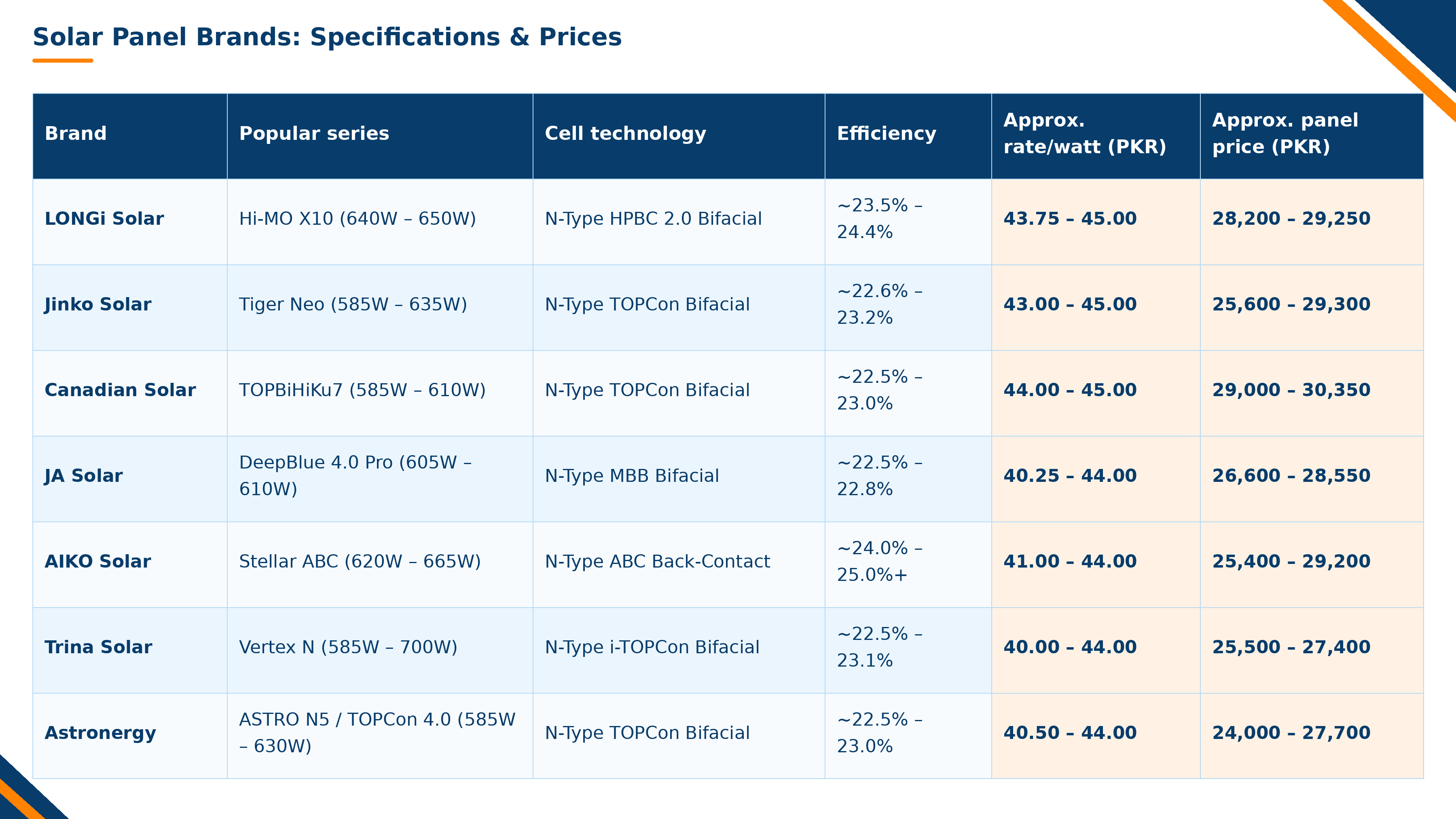
Top 7 Best Solar Panels in Pakistan (Comparison):
Below is a comparison of the top solar panels in Pakistan. This comparison is based on the current technology and efficiency ratings of these panels. Additionally we also consider the retail market rates per watt for these panels in comparison.
(Note: Prices fluctuate daily with USD-to-PKR exchange rates and importer stock).
How to Check Authenticity of Solar Panels:
Because solar demand in Pakistan is booming these days. Therefore, counterfeit, B-grade (factory-rejected), and smuggled non-documented panels frequently enter our market. That's why non-documented panels can also get rejected in your net-metering applications. Because every electric supply company including LESCO, K-Electric, or IESCO plays a vital role in our net-metering policies. This means you have to select or purchase solar panels very wisely.
Follow these four steps before letting installers mount your panels:
1) Scan for the Internal Barcode: Every genuine Tier-1 panel has a unique serial barcode that is laminated underneath the tempered glass. This barcode is never like just a paper sticker on an aluminum frame. So you just have to scan this barcode through your phone using the manufacturer's official mobile app. Or you can scan it through the company's website verification portal.
2) Demand the Import & Flash Test Documents: Ask your installer or buyer for the Bill of Lading (BL) and Goods Declaration (GD). Or you can ask him for the factory flash test report. This is an Excel sheet that matches your exact serial numbers to their factory-tested wattage.
3) Inspect the Physical Build Quality: Must look closely at the panels' silicon cells before purchasing them. Because genuine A-grade panels have uniform colors and razor-straight busbars on them. Additionally solar panels also have a neat silicone seal around their edges and zero micro-cracks on them. Because solar panels also do not have glue smudges or uneven cell spacing like defects, be careful.
4) Verify AEDB/NEPRA Certification: You must ensure the specific model number of the panel. Because every panel listed as approved for net-metering compliance in all over Pakistan.
The Future of Solar Panels in Pakistan:
Solar energy in Pakistan is rapidly shifting from an emergency backup measure to the backbone of residential and industrial power. With N-Type TOPCon and Back-Contact modules becoming the baseline standard, per-watt prices have stabilized at historic lows compared to just a couple of years ago.
Looking ahead, Pakistan's rooftop market is moving toward ultra-high-wattage 650W–720W+ bifacial panels paired with smart hybrid inverters and lithium-iron-phosphate (LiFePO4) battery storage. Even as net-metering policies evolve toward net-billing structures, high-efficiency solar remains the fastest-paying home upgrade in the country, typically recovering its full installation cost within 2.5 to 3.5 years.
The Bottom Line:
Finding the best solar panels in Pakistan comes down to balancing roof space, heat performance, and verified authenticity. Skip outdated P-Type PERC modules and invest in A-grade, documented N-Type TOPCon or Back-Contact panels from established Tier-1 brands like LONGi, Jinko, Canadian Solar, JA Solar, or AIKO. Verify every serial number under the glass before installation, pair your array with a reputable inverter, and you will enjoy clean, predictable power for decades to come.
Frequently Asked Questions (FAQs)
1. Which solar panel brand is best in Pakistan right now?
LONGi Solar, Jinko Solar, and Canadian Solar are widely considered the best solar panel brands in Pakistan due to their Tier-1 bankability, high efficiency, and strong heat resistance. For maximum efficiency in limited roof space, LONGi Hi-MO X10 and AIKO Stellar ABC lead the market, while Jinko Tiger Neo and JA Solar DeepBlue 4.0 Pro offer the best balance of price and reliability.
2. What is the current price of a 585W to 650W solar panel in Pakistan?
An A-grade, documented Tier-1 solar panel in Pakistan costs roughly PKR 40 to PKR 45 per watt, which translates to PKR 24,000 to PKR 30,350 per plate depending on the brand, wattage (585W to 650W), and cell technology. Non-documented or B-grade panels may cost PKR 3–6 less per watt, but they carry no official warranty and are often rejected for net-metering.
3. Which is better for Pakistan's climate: TOPCon or PERC solar panels?
N-Type TOPCon panels are significantly better than P-Type PERC for Pakistan's hot climate. TOPCon panels have a lower temperature coefficient (losing less power when rooftop temperatures exceed 45°C), deliver higher conversion efficiency (22.5% to 24%+), capture extra rear-side sunlight via bifacial glass, and degrade slower over a 25-to-30-year lifespan.
4. Are bifacial solar panels worth it for home rooftops in Pakistan?
Yes, bifacial solar panels are worth the investment for most Pakistani homes with flat concrete roofs. Because bifacial panels have tempered glass on both sides, they absorb sunlight reflected off the roof surface—generating 5% to 10% extra electricity when installed on elevated mounting frames over a white-painted roof.
5. How many solar panels are needed for a 5kW or 10kW system in Pakistan?
Using modern 600W N-Type solar panels, you need 9 panels for a 5kW system (5.4kW total capacity) and 17 panels for a 10kW system (10.2kW total capacity). Slightly oversizing the panel wattage helps compensate for dust accumulation and high summer temperatures in cities like Lahore, Karachi, and Multan.
6. How can I verify if my solar panels are original A-grade in Pakistan?
Check that the unique serial number barcode is laminated underneath the glass (not stuck on the frame) and scan it on the manufacturer's official website or mobile app. Always ask your installer for the Import Bill of Lading (BL), Goods Declaration (GD), and the factory Flash Test Report to confirm your panels are documented A-grade stock eligible for DISCO net-metering.
Here is the best place to Buy Solar Online in Pakistan