Biomass Briquettes: What They Are, How They're Made
What biomass briquettes are, how they're made, what 1kg costs, who buys them in Pakistan, and where to source them at wholesale rates.
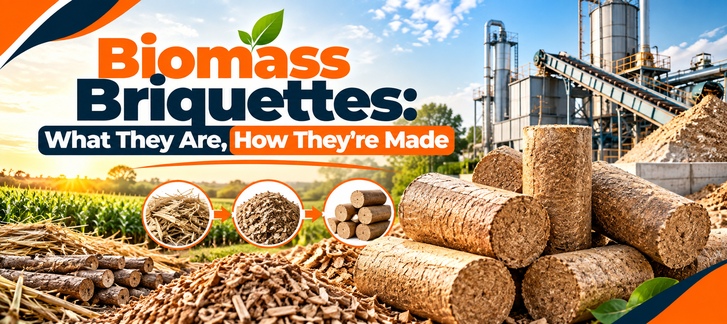
Quick answer: You know what a biomass briquette actually is? Just waste, pressed together until it holds a shape. Sawdust, rice husk, whatever's left over that nobody wanted to deal with.
Enough pressure and it sticks together on its own, no glue involved. That's really the whole trick. People burn them instead of coal or firewood in factory boilers, brick kilns, even at home for heating.
Drive past a rice mill or a cotton gin almost anywhere in Punjab or Sindh, and there's usually a small mountain of husk or stalks sitting off to one side. Nobody quite knows what to do with it, so it just piles up.
A briquette press turns that pile into something a factory boiler can burn on a schedule instead of a fire hazard waiting for a match. The idea behind it is almost embarrassingly simple. Squeeze loose material hard enough, and it holds its own shape. But that one simple trick has quietly changed how a lot of small industry sources fuel across South Asia.
This piece covers what biomass briquettes are actually made from, how the manufacturing process works step by step, what they tend to cost, who's really buying them, and where you'd go looking for a supplier in Pakistan.
What Are Biomass Briquettes Made Of?
Definition: Almost any dry organic waste can go into a press, honestly. Rice husk, cotton stalks, groundnut shells, sugarcane bagasse, wheat straw. These are the usual suspects, and they're cheap for a boring reason: there's just a huge amount of them lying around after harvest season, with nowhere else to go.
Wood waste is the other big source. Sawdust, offcuts from sawmills, scraps from small furniture workshops, the kind of material that used to just get swept into a corner and set alight at the end of the week.
Coconut shells, coffee husk, and waste paper show up too, though less often in what's produced locally in Pakistan. They run through the same presses without any trouble.
None of this is interchangeable, though. What goes into the block decides two numbers a buyer will always ask about before agreeing to anything. Calorific value, or how much heat comes off per kilogram, and ash content, or how much is left over afterward that someone has to clean out.
Ask anyone who has actually bought fuel like this before. The first real question is never Do you have briquettes. It's what they're made from.
How Biomass Briquettes Are Made
The process itself is mechanically simple. Getting a consistent, saleable product out of it is the harder part, and it comes down to controlling each stage carefully rather than any single clever trick.
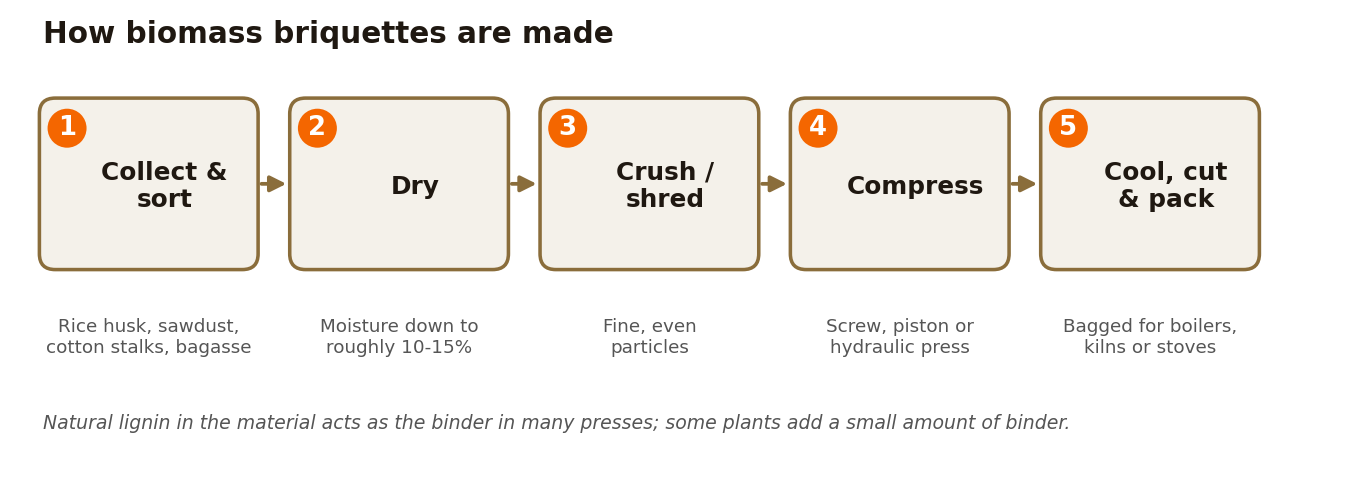
Collection and drying: Raw material is gathered and dried until moisture content drops to somewhere around 10 to 15 percent. Skip this step or rush it, and the material simply won't hold together under pressure; it burns poorly and smokes more than it should.
Size reduction: Larger pieces get shredded or hammer-milled down into small, even particles. Uneven particle size is one of the most common reasons a finished briquette cracks apart later, usually somewhere between the factory floor and the customer's boiler.
Compression: A screw press, piston press, or hydraulic ram shoves the material through a die, hard. There's a lot of heat generated in that process, enough to soften the lignin naturally sitting inside the plant fibres already. Once things cool back down, that same lignin sets again, and it ends up doing the job glue would otherwise do. Which is kind of the neat part: most of these briquettes don't need any added binder at all.
Cooling, cutting, and packing: The extruded log is cooled, cut to length, and bagged for transport.
Key Benefits of Biomass Briquettes
The environmental pitch is the one most people hear first. It's a fair one too. Burning a briquette releases carbon the plant already pulled out of the air while it was growing, so the net addition is far smaller than coal, and sulfur output usually comes in lower as well.
But that's rarely what actually gets an operations manager to switch suppliers. What does the job? It's more mundane than that. Waste that used to just be a disposal headache turns into either a product to sell or a fuel bill that shrinks.
A truckload of briquettes packs a lot more usable energy than the same volume of loose husk ever could, so transport cost per unit of heat drops noticeably too.
And because the size and moisture level stay consistent from one batch to the next, a boiler operator can actually plan fuel feed rates the way they would with coal. Loose biomass never really lets anyone do that reliably.
What Is the Price of 1 kg of Biomass Briquettes?
There's no single number I can hand you here. If a supplier quotes you an exact figure before even asking what raw material you need, what moisture spec, or how big the order is, that's a red flag, not a good sign.
In most South Asian industrial markets, bulk briquettes land somewhere between PKR 20 and 50 per kilogram. That's a wide range on purpose. Rice husk tends to run cheaper than sawdust.
Moisture and ash content push the number around too, so does briquette diameter, and honestly so does just how big the order is, since nobody prices a ten-ton order the same way they'd price ten bags.
Speaking of bags, if you're buying small retail packs for home use, expect to pay more per kilogram than someone ordering by the truckload. That's not suppliers
overcharging you. That's just how bulk pricing works everywhere.
Because this number moves with raw material costs and the agricultural season, treat the range above as a starting point for a conversation rather than a quote you can rely on.
For something closer to a real, current figure, Zarea's Daily Price page is a better place to look, or you can request quotes directly through the Agriculture Biomass category, where the numbers come from verified suppliers rather than an estimate written into an article.
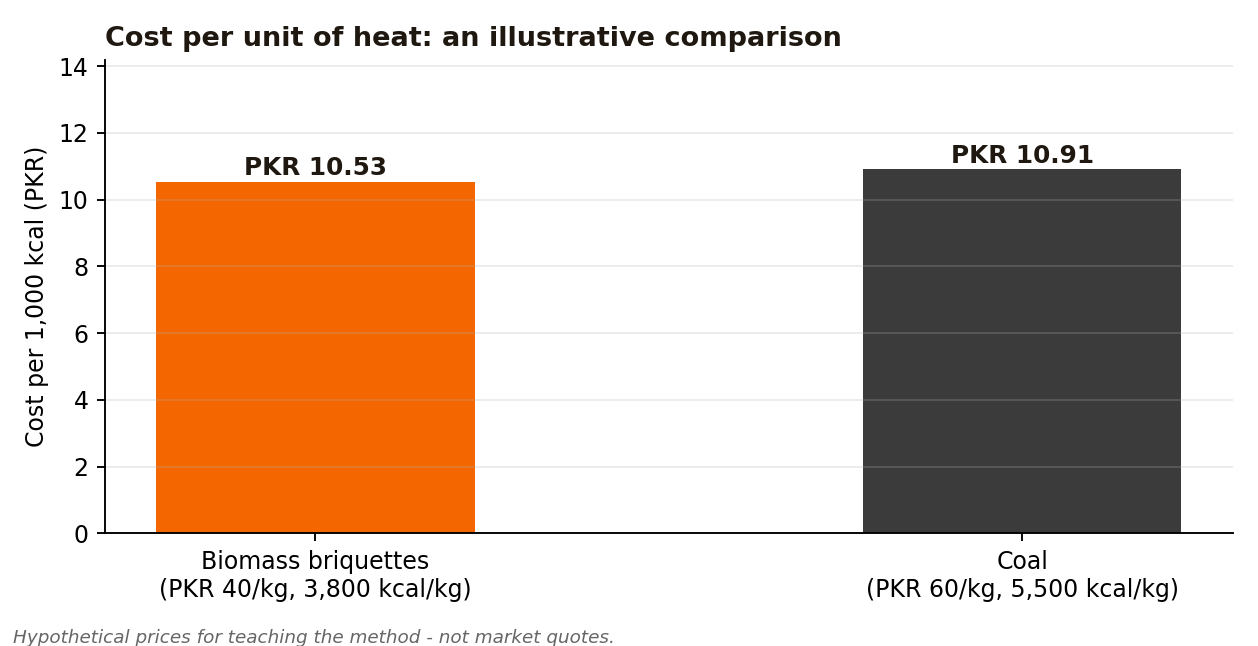
A more useful comparison than price per kilogram is price per unit of heat, since a fuel with a higher calorific value gets you more energy out of the same weight.
The chart below walks through that calculation with illustrative numbers, and it's worth running the same formula yourself with a real supplier's quoted price and calorific value rather than trusting any single published figure, including this one.
What Is the Profit Margin of Biomass Briquettes?
For someone actually running a briquetting plant, rather than just buying fuel for a biomass boiler, margin comes down almost entirely to one thing: how cheaply the raw material can be sourced.
Everything else is secondary. Published cost breakdowns for these plants usually put raw material at 40 to 50 percent of total operating cost. Utilities and power take another 25 to 35 percent. Whatever's left gets split across labour, maintenance, and packaging, and it isn't much.
Gross margins in that structure tend to land somewhere between 25 and 35 percent, according to published industry studies, with net margins closer to 10 to 15 percent once depreciation, financing, and the usual overheads come out.
Raw material cost is the biggest swing factor by a wide margin. Put a plant right next to a rice mill or a cotton gin, where husk or stalks can be had cheaply or occasionally for free as a byproduct, and it will run noticeably thicker margins than one that has to truck material in from further away.
Two things matter more than that headline percentage, though, when someone's actually deciding whether to build a plant. Is the raw material supply reliable across the whole year, given that most agricultural residue is seasonal by nature?
And is there already a buyer lined up for steady offtake, or is the plan to sell whatever comes off the line on the spot market and hope for the best?
Who Buys Biomass Briquettes?
Industrial demand is the bigger half of this by a wide margin, and it's spread across more sectors than most people expect. Textile mills and dye houses are
probably the most common buyer, using briquettes for steam in dyeing and finishing, usually as an easy way to cut coal costs without touching the boiler itself.
Brick kilns have been blending biomass in alongside coal too, partly because of emissions rules in some areas and partly, let's be honest, because it's just cheaper.
Food processing plants and paper mills burn through briquettes for everyday boiler steam. Cement plants use them as a supplementary kiln fuel, sitting alongside coal rather than fully replacing it.
On the smaller end, households in areas where firewood or charcoal has gotten expensive or hard to find also buy briquettes for cooking and heating. If it helps to work out which side of this you're actually on: are you looking at biomass briquettes as a manufacturing business, sourcing raw material and running a press yourself, or are you looking to buy finished briquettes as fuel for a boiler, kiln, or home?
The manufacturing side, covered above under supply and margins, is a genuinely different undertaking from simply placing a purchase order through a category like Coal or Agricultural Biomass, where a supplier has already handled production for you.
Where Can I Buy Biomass Briquettes?
In Pakistan, briquettes are usually sourced in one of two ways. Either directly from a local briquetting plant, typically located near a rice mill, cotton gin, or sawmill, or through a B2B marketplace that has already done the work of checking suppliers on quality and delivery.
Agriculture Biomass category lists wholesale biomass supply from verified sellers across the country, with pricing that reflects the current market rather than a fixed number sitting in a catalogue somewhere, which matters given how much raw material cost swings the final price.
If you're weighing briquettes against coal for a boiler conversion, it's worth comparing both side by side rather than deciding on price per kilogram alone.
Briquettes sit under Agriculture Biomass, coal listings are under Coal, and running both through the price per 1,000 kcal method covered earlier gives a fairer comparison than the sticker price.
Frequently Asked Questions
What is the price of 1 kg of biomass briquettes?
Usually somewhere between PKR 20 and 50 for a bulk industrial order, though I'd take that as a rough starting point rather than a quote. Rice husk versus sawdust changes it.
So does how dry the batch is, how much ash it leaves behind, even the diameter of the briquette itself. Order size matters too, a truckload prices differently than a few bags ever will.
Buying small retail packs for home use? Expect to pay more per kilo than an industrial buyer would. And since raw material costs shift with the harvest, honestly your best bet is checking a live number, Zarea's Daily Price page or the Agriculture Biomass listings, rather than trusting whatever range you read in an article like this one.
What is the profit margin of biomass briquettes?
Gross margins around 25 to 35 percent are typical, based on published cost studies of briquetting plants, and net margins drop to roughly 10 to 15 percent once financing, depreciation, and overheads are taken out.
The one thing that really moves this number is raw material cost, which usually eats up 40 to 50 percent of operating expenses on its own. A plant sitting near a cheap, steady source of rice husk or cotton stalks is simply going to make more money than one hauling material in from far away.
Who buys biomass briquettes?
Mostly industry. Textile mills and dye houses buying for boiler steam, brick kilns blending biomass in alongside coal, food processing and paper units, and cement plants running briquettes as a supplementary kiln fuel. There's a smaller household market too, mainly in areas where firewood or charcoal has gotten too expensive to rely on day-to-day.
Where can I buy biomass briquettes?
In Pakistan, briquettes can be sourced directly from a local briquetting plant, usually located near a rice mill, cotton gin, or sawmill, or through a verified B2B marketplace such as Zarea's Agriculture Biomass category, which lists current wholesale supply from vetted sellers instead of leaving you to source and qualify a supplier entirely on your own.
Wrap Up
Biomass briquettes aren't a complicated product once you strip away the marketing language. They're waste, dried, ground down, and squeezed hard enough to hold together, and that alone is enough to replace a meaningful share of the coal and firewood a lot of industrial buyers are still burning.
Whether that's interesting to you as a manufacturer chasing thin but steady margins, or as a buyer just trying to cut a boiler's fuel bill, the numbers only really mean something once they're checked against a live quote rather than a range printed in a guide like this one.