Commodity Broker: What They Do, Types & How to Choose
Looking for a trusted commodity broker online? Learn how online platforms work. Compare contract types and discover how to trade safely via regulated desks.
Introduction:
The global markets never sleep, and neither does the flow of the world’s most essential goods. Millions of barrels of crude oil change hands and ounces of gold are traded to hedge against inflation every day. Same as tons of wheat are bought and sold to feed world nations. But behind almost every single transaction sits. There is a critical intermediary one. The commodity broker.
Accessing these fast-moving markets required a massive network for decades. Same as these markets require immense capital and a direct line to a chaotic trading pit. Therefore the entire landscape has shifted today. The rise of commodity brokers online has democratized access to global trade. Whether you are a retail investor looking to diversify a portfolio. Or you are a business owner that is managing supply chain risks. Thus the digital trading floor is always open to you.
However, entering this space requires more than just capital. But it requires an understanding of how online commodities brokers operate. How to navigate regulatory frameworks? How to select a partner that aligns with your financial goals?
What is a Commodity Broker?
A commodity broker is a regulated individual that helps to exchange goods. Or it's a financial firm that executes buy and sell orders for physical goods. Or it's a company that has derivative contracts on behalf of their clients. They all serve as a bridge between everyday market participants. Because they are the major centralized derivatives that exchange goods.
Unlike equity brokers who deal in shares of companies, commodity brokers deal in tangible, real-world assets. These assets are generally split into four core categories:
1) Precious & Industrial Metals: Gold, silver, platinum, copper, and steel.
2) Energy: Crude oil (WTI and Brent), natural gas, heating oil, and gasoline.
3) Agricultural Commodities (Softs & Grains): Agricultural Commodities include wheat, corn, soybeans, coffee, sugar, and cotton.
4) Livestock: Lean hogs, live cattle, and feeder cattle.
Instead of physically moving crates of coffee beans or oil barrels into your garage, modern online trading heavily utilizes derivatives—primarily futures contracts and options. A commodity broker ensures your orders to buy or sell these contracts are executed instantly, accurately, and safely.
The Evolution of the Commodity Broker Online:
The transition from shouting in trading pits to clicking a button on a smartphone has completely revolutionized how commodities are traded. Choosing to work with an online commodity broker is a good idea. Because it could bring several distinct operational advantages for you.
1) Democratized Market Access
Commodities were a playground for institutional giants and commercial producers. But some ultra-high-net-worth individuals also trade goods. That's why online platforms allow retail investors to open accounts with relatively low minimum deposits today. The introduction of micro and mini contracts means you can trade smaller sizes of gold or oil without needing tens of thousands of dollars in upfront margin.
2) Real-Time Data and Analytics
An online commodity broker can provide you with a complete digital ecosystem. Because traders get access to real-time price feeds and interactive technical charts. They also provide you with historical volatility data and live macroeconomic news streams. This level of information and parity allows individual traders to make decisions. Because the same speed of decisions and data depth give you institutional desks.
3) Advanced Order Customization
Volatile markets require precise risk management. Online trading desks allow you to set advanced order types of commodities instantly. You can deploy stop-loss orders and trailing stops. But you can take profit levels and conditional orders that automatically execute. Especially when specific market triggers are met according to your desires. So it can protect you and your capital even when you are away from your screen.
Direct Comparison: Physical vs. Cash-Settled Commodity Trading:
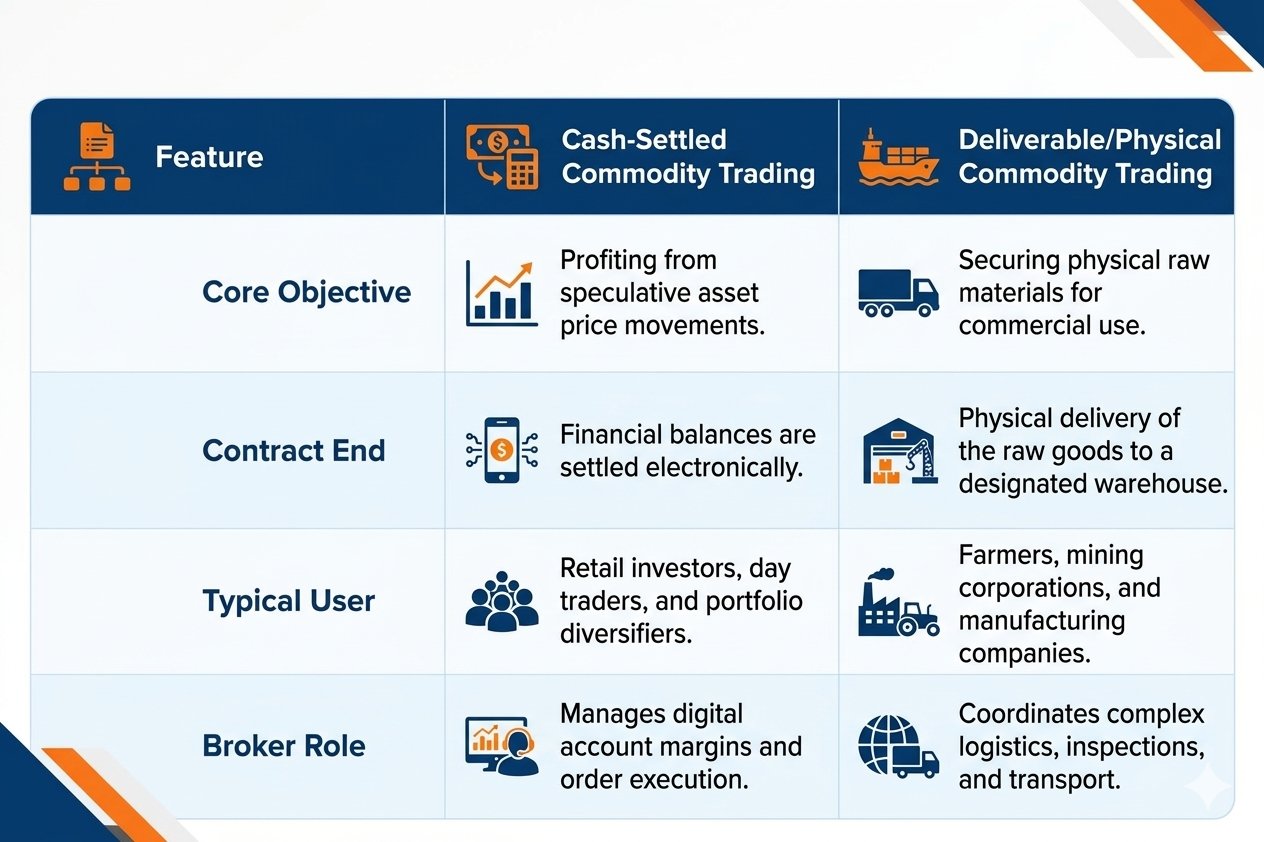
When trading through an online brokerage. Then it is vital to understand the structural difference between how commodity contracts conclude. Because most retail traders utilize cash-settled contracts. But they understand both paths are crucial for future commodity trade.
How Online Brokers Facilitate Risk Management:
The economic commodities market's primary purpose is not speculation. Because it is a hedge one. Commodities are highly volatile goods. Because they are tied to unpredictable real-world events like geopolitical conflicts. Or extreme weather patterns and shifting global commodity supply chains may also disrupt them. Therefore, online commodity brokers provide you with the necessary tools. So these tools help you to manage this risk through two main strategies:
1) The Art of Hedging
Imagine a commercial wheat farmer who is worried about a bumper crop. Because later that same year his crop will crash. Or his wheat crop price will fall before harvest time. Therefore, a farmer uses a commodity broker online to protect his income. Because brokers lock in a selling price via a futures contract today. Conversely, a bread manufacturer worried about rising wheat costs would buy futures to lock in a predictable purchase price.
2) Speculation and Liquidity
While hedgers want to avoid risk, speculators actively seek it out to generate profit. By taking the opposite side of the hedger's trade, speculators provide the essential liquidity that keeps the market moving smoothly. Online brokers cater heavily to speculators by offering leverage, allowing traders to control large contract values with a fraction of the total cash value held as margin.
Regulatory Compliance: Protecting Your Capital:
The commodities market involves high financial leverage and complex derivative instruments as well. Therefore, strict regulatory oversight is non-negotiable in the market. Trading through an unregulated or unauthorized entity exposes you to severe financial fraud. Or trading on an offshore platform also exposes you to counterparty risk as well.
1) United States: Brokers must be registered with the Commodity Futures Trading Commission (CFTC). Or it must hold membership in the National Futures Association (NFA).
2) United Kingdom: Trade Only on Financial Conduct Authority (FCA) authorized and monitored platforms.
3) Pakistan: Investors must open accounts exclusively with brokerage houses registered with the Securities and Exchange Commission of Pakistan (SECP). Or the brokers must be corporate members of the Pakistan Mercantile Exchange (PMEX) to trade legally.
Red Flags to Avoid When Selecting a Broker:
1) Guaranteed High Returns: Commodities are inherently volatile. Any platform or individual promising risk-free, fixed monthly returns is running a scam.
2) Pressure to Share Account Credentials: A legitimate broker provides the trading platform (like MetaTrader 5) but will never ask for your private passwords or trade on your behalf without a formal power of attorney.
3) Unusual Funding Requests: All regulated brokers require transparent banking transactions (bank wires, direct institutional deposits). Be aware of highly suspicious platforms. Because these platforms demand deposits via unregulated cryptocurrencies or cash apps. Or they request you to transfer your cash through informal money transfers.
Key Factors to Look For in an Online Commodity Broker:
Finding the right broker requires evaluating your trading style against what the platform offers. Keep these five criteria at the forefront of your research:
1) Regulatory Status: Ensure the broker you want to trade with must hold a valid license. As his license must authorize through the primary financial authority in your country.
2) Fee and Commission Structure: Analyze the cost per contract and any hidden deposits that could erode your profitability. Also analyze brokers' withdrawal charges and overnight swap fees for financial purposes.
3) Platform Stability: The trading platform should feature low-latency execution and seamless mobile accessibility. Or they must have real-time charting tools as well.
4) Available Asset Classes: Ensure that your broker offers a deep inventory of both local and international commodity contracts.
5) Educational Support: Top-tier brokerages invest heavily in their clients and have responsive 24/7 customer support desks. While they must offer you webinars and comprehensive trading guides for your help.
Wrap Up:
The evolution of online commodity brokers has broken down barriers to global trade. Because they give individual investors unprecedented power. This power is to interact with the world's core tangible economies. However, with all that accessibility comes responsibility for thorough research and disciplined risk management. So this responsibility comes with strict adherence to regulated platforms as well. If you want to secure the safety rails, so you must need to confidently navigate with volatility. Moreover you must align yourself with an authorized and transparent brokerage house. These initiatives are exciting the world of commodity trading to the next level.
FAQ's:
What does a commodity broker do?
A commodities broker makes it easier to acquire and sell primary or raw materials. This might contain animals, food, metals, and oil. On behalf of customers through physical contracts, options, and futures.
Which broker is best for commodity trading?
Your trading style and degree of expertise will determine which broker is ideal for commodities trading. Because Interactive Brokers stands out as the best option with minimal costs and worldwide access. The largest selection of commodities and CFDs is offered at CMC Markets.
1) Interactive Brokers: The best for direct exchange access, worldwide futures, and options with commissions that are comparable to those of a professional.
2) CMC Markets: With more than 100 commodities markets, CMC Markets is the best option for spread betting and CFD.
3) Pepperstone: Ideal for popular platforms like MetaTrader 4 and 5 and low-latency execution.
4) AvaTrade: The most user-friendly mobile platform for trading commodities CFDs in highly regulated markets.
What are the top 3 commodities?
West Texas Intermediate (WTI) crude oil, steel, and Brent crude oil are the top three commodities traded worldwide. Due to the fact that these commodities have the greatest global economic influence and volume.
Brent Crude Oil:
1) Utilized as the standard for fuel prices worldwide.
2) Mostly taken from the North Sea.
3) Propels the worldwide industrial, energy, and transportation sectors.
Steel:
1) Iron and carbon-based vital metal alloy.
2) Vital for building, infrastructure, and automobiles worldwide.
3) Fcts as the foundation for contemporary industrial growth.
WTI Crude Oil:
1) Acts as the main standard for US crude oil.
2) Extensively extracted in North America and Texas.
3) Renowned for its large daily trade volumes and great market liquidity.