Cotton Industry in Pakistan: Pioneering Excellence & Global Reach
Our marvellous cotton industry in Pakistan makes us one of the major cotton producers in the world. A tradition of best cotton in Pakistan.
Introduction to Cotton in Pakistan:
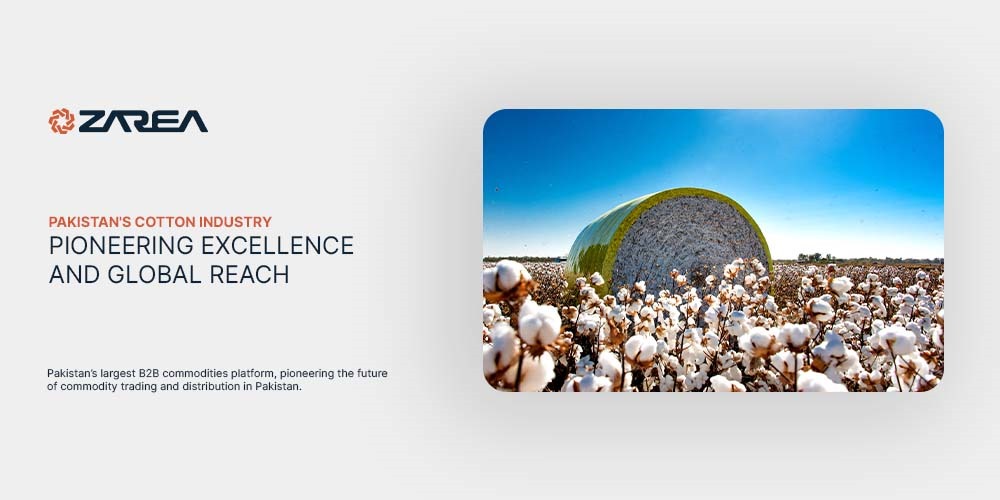
Cotton is considered “white gold” and has a privileged position in Pakistan’s agricultural production. Our marvellous cotton industry in Pakistan makes us one of the major cotton producers in the world. So, cotton connects the Pakistani economy at the national level. Indeed, the best area for this culture is found within the Indus basin, specifically between Punjab and Sindh, with conditions highly propitious to the growing of this plant due to soil and climate combination. Hence, cotton holds great relevance for the social life of Pakistani people.
At Zarea, We offer a diverse range of high-quality cotton, fulfilling domestic requirements while making Pakistani cotton a top choice internationally. Our commitment to quality supports local farmers and underscores our role in pioneering the future of Pakistan’s commodity trade on a global scale.
The Journey of Cotton: From Farms to Fabrics:
The life cycle of cotton in Pakistan surely provides an example of great diligence among the local farmers: after the sowing during spring months, much attention needs to be paid-after sowing-to water and application of pesticides and inorganic fertilizers for nearly five to six months before its harvest. Harvesting will begin in about five to six months, where cotton should be picked, processed, and prepared for sale. This complex process delineates the problems and perfection of Pakistani farmers in order to grow products that match up to the international standard.
The Future of Cotton in Pakistan: A Long-Term Outlook:
Overview of Cotton’s Role in Pakistan’s Economy
Economic Contribution: Cotton significantly contributes to Pakistan’s GDP, providing raw material for the extensive textile industry.
Geographical Spread: Predominantly grown in Punjab and Sindh, the crop’s productivity is hindered by various impediments despite favorable conditions
Challenges Facing the Cotton Sector
Reducing Cultivation Area: There’s a concerning trend of decreasing cotton cultivation areas in favor of other crops like sugarcane, driven by better returns and government incentives.
Climatic Vulnerabilities: The crop encounters risks from sudden climate changes, affecting both yield and quality.
Resource Scarcity: Challenges like water shortage, elevated input expenses (seeds, fertilizers, and pesticides), and limited availability of quality resources greatly impact production levels.
Pest Infestations and Diseases: Cotton plants are especially vulnerable to diseases such as the Cotton Leaf Curl Virus and infestations, which can severely impact harvests.
Technological and Management Interventions
Improved Seed Quality: There is an urgent demand for superior, disease-resistant cotton seeds.
Advanced Farming Practices: The use of contemporary agricultural methods and improved crop management strategies can boost both yield and quality.
Government Support and Policies: Efficient strategies concerning pricing, subsidies, and assistance for contemporary technologies are crucial for rejuvenating the cotton industry.
Future Projections and Predictions of Cotton
Area and Production: Although the land used for cotton farming is anticipated to experience a modest rise by 2025, total production and yield are likely to fall unless substantial measures are taken.
Impact on Economy: A decrease in cotton production may lead to significant consequences for the national economy and the well-being of farmers.
Strategic Recommendations
Policy Overhaul: There is an urgent demand for extensive reform in cotton policy that tackles pricing, subsidies, and support systems for farmers.
Water Management: Advancements in water management, such as the implementation of micro-irrigation methods, are essential due to the high water consumption associated with cotton agriculture.
Research and Development: Enhancing agricultural research and expanding services to address cotton-related issues will support the creation of sustainable farming practices.
Key Varieties of Cotton Found in Pakistan:
Traditional Varieties
Desi Cotton: Renowned for its extended staple length and quality fine fibers, Desi cotton is mainly cultivated in the southern areas of Sindh and Balochistan.
American Upland Cotton: Brought in from the United States, this type has been extensively grown throughout Pakistan because of its significant yield potential and suitability to different climatic environments.
Modern Varieties
Bt Cotton: These insect-resistant strains have been created to combat bollworm pests and have significantly boosted cotton production in the nation. Widely accessible well-known Bt cotton varieties include MNH-886, FH-142, CIM-443, CIM-506, and NIAB-Karishma.
High-Yielding Varieties: Created using advanced breeding methods, these varieties are designed to enhance yield potential. Instances consist of CIM-610, CIM-632, CIM-663, CIM-678, and CIM-785.
Drought-Tolerant Varieties: They have been cultivated for dry and semi-dry regions characterized by limited water availability. This would signify a significant advancement in guaranteeing the sustainability of cotton production in the most challenging environmental circumstances.
Annual Production: Pakistan’s Cotton Output:
Production Scale
Annually, Pakistan ranks among the top cotton producers globally, with the 2023-24 period marking a significant increase.
Total Production
The nation has generated 8.258 million bales, reflecting a 67 percent rise from last year’s output of 4.9 million bales, mainly fueled by a rebound from negative weather effects.
Producing Regions
The majority of cotton is still predominantly grown in the fertile regions of Punjab and Sindh, with these two provinces contributing almost equally:
Punjab’s Production: Approximately 4.158 million bales.
Sindh’s Production: Around 4.1 million bales.
Market Dynamics
Exports and Local Sales: 292,000 bales purchased by exporters and 7.478 million bales bought by textile mills.
Ginner Stock: 487,000 bales currently held by ginners, with 165 ginning factories operational.
Future Projections
Estimates suggest that total production might reach around 8.4 million bales, potentially increasing to 9.5 million bales including unregistered bales.
Impact of Climate
Production remains heavily dependent on climatic conditions; the recent increase in output follows a recovery from last year’s rain and flood impacts.
Market Fluctuations
Economic policies, global cotton prices, and domestic demand continue to play critical roles in influencing annual production levels, with recent trends showing an increase in cotton imports due to rising domestic prices and a shortfall in local production.
The Economic Impact of Cotton in Pakistan:
The economic importance of cotton in Pakistan is immense. More than a million farmers and workers are directly related to cotton industry in Pakistan. Even beyond agriculture, the role of cotton has reached into sectors of the textile industry, which happens to be one of the most extensive industrial groups of the country and indeed is the greatest foreign currency earner and source of employment. The amount it contributes through exports towards GDP indicates that cotton holds top priority in the national strategies regarding economics.
Varieties of Cotton Available on Zarea:
At Zarea, we value the diversity of our customers’ needs and try to answer with an appropriate variety range. Be it a specific staple length or a rich quality, we have them all covered on our platform. Here are the types of cotton available at Zarea:
Long staple cotton
Medium staple cotton
Short staple cotton
Organic cotton
Supima cotton
Pima cotton
For detailed descriptions and to explore our full cotton offerings, visit our website: Cotton Price in Pakistan.
Advancements and Innovations in Cotton Production:
These challenges have necessitated innovations like the release of genetically modified cotton seeds that are more resistant to pests and give higher yields. Technological changes in irrigation and crop management also go a long way in efficient production. These innovations will not only help in resolving immediate production challenges but also in long-term sustainability.
Conclusion – cotton industry in pakistan:
While we go forward with improvements in our practices and the implementation of innovative solutions, the future remains bright for cotton industry in Pakistan. And with a platform like Zarea to lead from the front and showcase our premium cotton to the world, we are well placed to achieve great things. We feel that it is only this commitment to quality and sustainability that shall put us at par with international standards and widen our reach in the world market.
References:
Cotton Production: Cotton Production in Pakistan – Wikipedia.org
Future of Cotton: Future of Cotton in Pakistan in 2025 – researchgate.net
Cotton Varieties: Cotton Varieties in Pakistan – ccri.gov.pk
Annual Production: Annual Production of Cotton in Pakistan – profit.pakistantoday.com.pk