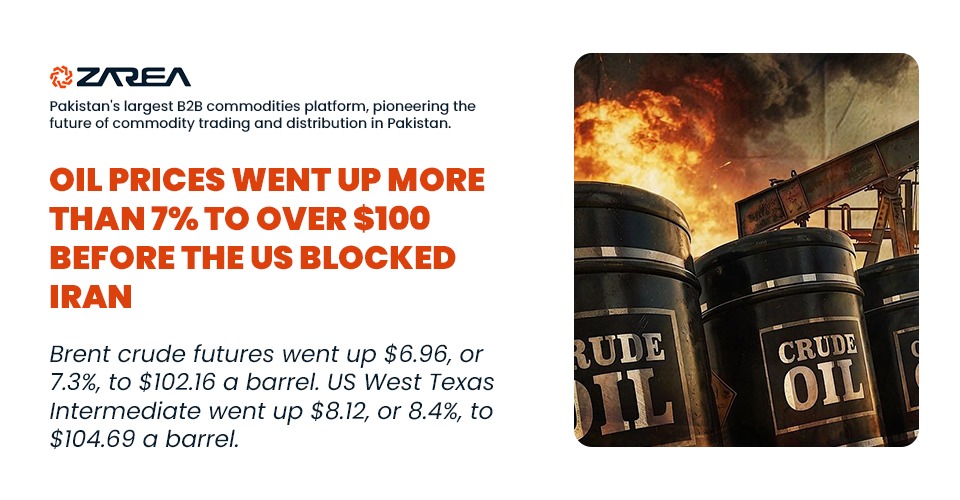
Oil Prices Went Up More Than 7% to Over $100 Before The US Blocked Iran
Brent crude futures went up $6.96, or 7.3%, to $102.16 a barrel. US West Texas Intermediate went up $8.12, or 8.4%, to $104.69 a barrel.
Introduction - Oil Prices Surged $100 Per Barrel:
Following the failure of Washington and Tehran to strike an agreement to end the conflict, oil prices surged beyond $100 per barrel on Monday as the US Navy prepared to stop ships to and from Iran across the Strait of Hormuz, a move that might limit Iranian oil shipments.
After closing 0.75% down on Friday, Brent oil futures increased $6.96, or 7.3%, to $102.16 a barrel by 04:30 GMT.
After losing 1.33% in the previous session, US West Texas Intermediate was up $8.12, or 8.4%, at $104.69 per barrel.
Context of the Surge:
Driven by the realization that a precarious two-week truce had probably failed, the price surge reversed a modest dip from the previous Friday.
1) Impact on Supply: Experts caution that a total embargo may limit Iranian shipments of up to two million barrels per day.
2) Global Impact: As investors considered the possibility of persistently high energy prices and inflation, Asian stock indexes, notably Japan's Nikkei 225 and India's Nifty 50, fell precipitously on Monday.
Market Reaction & Key Benchmarks:
As the market prepared for major disruptions in the Strait of Hormuz, a crucial chokepoint for 20% of the world's oil supply, the statement caused a severe worldwide supply shock.
1) Brent Crude: Reached $101.91 per barrel, up $6.71 (7.05%).
2) West Texas Intermediate (WTI): Reached $104.16 per barrel after rising $7.59 (7.86%).
3) Daily Volatility: After the discussions broke down, some sources showed intraday jumps as high as 14%.
Blockading on The Strait of Hormuz:
According to Saul Kavonic, head of energy research at MST Marquee, "the market is now largely back to conditions before the ceasefire, except now the US will block the remaining up to 2 million barrels per day Iranian-linked flows through the Strait of Hormuz as well."
President Donald Trump raised the stakes on Sunday by announcing that the US Navy will begin blockading the Strait of Hormuz after protracted negotiations with Iran failed to produce an agreement to end the conflict, endangering a precarious two-week ceasefire.
The U.S. Naval Blockade:
The U.S. Central Command made it clear that ships of any nationality entering or leaving Iranian ports would be the target of the embargo.
Start Time: On April 13, 2026, the blockage was supposed to start at 14:30 GMT.
Scope: It does not impact transit to non-Iranian ports, but it does include marine trade going to and from Iran in the Arabian Gulf and the Gulf of Oman.
Reasoning: "We're not going to let Iran make money by selling oil to people that they like," President Trump said, framing the action as a reaction to "illegal tolls" and Iran's ongoing nuclear activity.
In a rare admission of the possible political impact from his decision to attack Iran six weeks ago, he said that the price of petrol and oil may stay high through November's midterm elections.
According to Priyanka Sachdeva, a senior market analyst at Phillip Nova, "the mere threat of enforcement alone has been sufficient to re-price risk, demonstrating how vulnerable oil remains to geopolitical triggers."
The Return of The Triple Digit Pricing:
Due to severe geopolitical dangers in the Middle East, particularly with regard to Iran and instability in the Strait of Hormuz. So, Brent crude reached triple-digit prices in early 2026, often over $100 per barrel. Due to market uncertainty, American drillers are reluctant to boost output despite these high prices.
Sachdeva continued, "The return to triple-digit pricing, or the jump in a geopolitical risk premium that briefly faded during earlier ceasefire headlines, looks justified."
At 10 a.m. ET (1400 GMT) on Monday, US forces will start enforcing the embargo of all marine trade entering and leaving Iranian ports, according to US Central Command.
According to a CENTCOM statement on X, it will be "enforced impartially against vessels of all nations entering or departing Iranian ports and coastal areas, including all Iranian ports on the Arabian Gulf and Gulf of Oman."
It further stated that US forces would not obstruct ships passing through the Strait of Hormuz to and from ports outside of Iran.
Impact of High Prices:
Economy: Persistent triple-digit oil prices pose a danger to global consumer markets and inflation.
Production: Instead of making a quick, significant reinvestment in additional capacity, companies are adopting a "wait-and-see" strategy due to the high costs.
Market Dynamics: Due to the high prices, there is a "war premium" of around $15–$20 per barrel, which indicates that the structural supply/demand value is closer to $85–$90 per barrel.
According to IG market analyst Tony Sycamore, the action would essentially stop the supply of Iranian oil, compelling Tehran's supporters and clients to exert the required pressure to reopen the canal.
Iran's Revolutionary Guards Declaration:
Iran's Revolutionary Guards declared on Sunday that any military ships trying to go close to the Strait of Hormuz will be punished severely and decisively for violating the two-week US truce.
1) According to shipping statistics, three supertankers loaded with oil crossed the Strait of Hormuz on Saturday despite the impasse.
2) Since the ceasefire agreement was reached last week, these seemed to be the first ships to leave the Gulf.
3) According to shipping statistics on LSEG, oil tankers are avoiding the Strait of Hormuz in advance of the US ban on Iran.
Saudi Arabia's Statement:
Days after presenting an assessment of the harm done to its energy sector by assaults during the Iran conflict, Saudi Arabia said on Sunday that it has restored full oil pumping capacity through the East-West pipeline to about 7 million barrels per day.
1) Throughput Recovery: About 700,000 bpd of lost throughput were recovered after repairs were made to a pumping station that was struck by a drone on April 8.
2) Strategic Export Bypassing: By avoiding the unstable Strait of Hormuz, the repair enables Riyadh to continue quadrupling exports from Red Sea locations like Yanbu.
Resumptions in the Field:
With a recovery of almost 300,000 bpd, the offshore Manifa field has returned to full working capacity.
As of April 13, repairs at the Khurais field—an additional 300,000 bpd—were still in progress.
Effects of the Attacks:
Before Sunday's declaration, a Saudi analysis showed that the April 8–9 attacks had:
Reduce the amount of oil produced overall by 600,000 barrels per day.
damaged vital infrastructure in Yanbu Industrial City, the Eastern Province, and Riyadh.
Refineries at Ras Tanura and Jubail were among the important sites targeted.
Market Outlook:
Although this restoration offers a crucial "safety valve," yet analysts from websites like Investing.com point out that because of the continuing naval blockade. Also, with the unfinished repairs at the Khurais facility, there is still a sizable "war premium" in oil prices.
Final Thoughts:
The spike in oil prices on April 13, 2026, didn't tell a different story yet. A significant turning point in the world's energy crisis marked the failure of peace negotiations in Islamabad. As the United States moved from diplomacy to an aggressive naval blockade of Iranian ports. That's why the markets have essentially priced in a "war premium."
Until a new diplomatic or military solution is found, the existing state of affairs points to a protracted era of great instability and high energy costs.

_2025-11-24_18-05-11.webp)