Plastering: Types, Process, Sq Ft Calculation and Cost
Learn plastering in Pakistan, including types, cement-sand ratios, wall plastering steps, material calculations per sq ft, and the latest cost estimates.
Plastering is the layer of mortar, usually cement and sand, that turns a rough brick or block wall into a smooth, strong surface ready for paint or tiles.
It also shields the masonry from rain, damp, and wear.
Whether it lasts decades or starts cracking within a year usually comes down to four things: the mix, the thickness, the quality of the sand and cement, and whether anyone cures it properly.
This guide covers the types of plastering, the steps of wall plastering, how to do a plastering calculation in sq ft, what it costs in Pakistan, and which cement and sand to buy.
The worked numbers are shown so you can check them, and prices are dated snapshots. A site engineer should confirm the details for your own building.
Quick Answers
1) Thickness and mix: about 12 mm on interior walls (1:6 for dry rooms, 1:4 for stronger work), about 20 mm on exterior walls in two coats (1:4), and 6 to 10 mm on ceilings (1:3 or 1:4).
2) Material per 100 sq ft: about 41 kg of cement and 4 cft of sand at 12 mm and 1:4. One 50 kg bag covers roughly 120 sq ft.
3) Curing: keep plaster damp for at least 7 days. It’s the step most often skipped.
4) What to buy in Pakistan: OPC cement (SRC where soil or water is salty) and clean river sand such as Ravi or Chenab.
5) Cost in Lahore, 2026: about Rs 16 per sq ft in cement and sand at 12 mm and 1:4, plus labour of about Rs 28 to 38 per sq ft.
What is plastering and why does it matter?
In construction, plastering means applying a thin coat of mortar over brick, block, or concrete. It does several jobs at once.
1) Smooth finish. It evens out the rough face of brick and block.
2) Protection. It keeps rain, humidity, and temperature swings away from the masonry.
3) Durability. It adds a hard layer that resists wear and weathering.
4) A base for finishing. Paint, putty, tiles, and textured coatings all need a stable surface to grip.
5) Tidier walls. It hides small construction flaws and covers service lines.
The layer is only about 6 to 20 mm thick, so small mistakes in the mix or the curing show up as cracks, hollow patches, and flaking.
Common Types of Plaster
The right type depends on where the wall is, your budget, and the finish you want. In Pakistan, cement plaster is by far the standard for pucca construction.
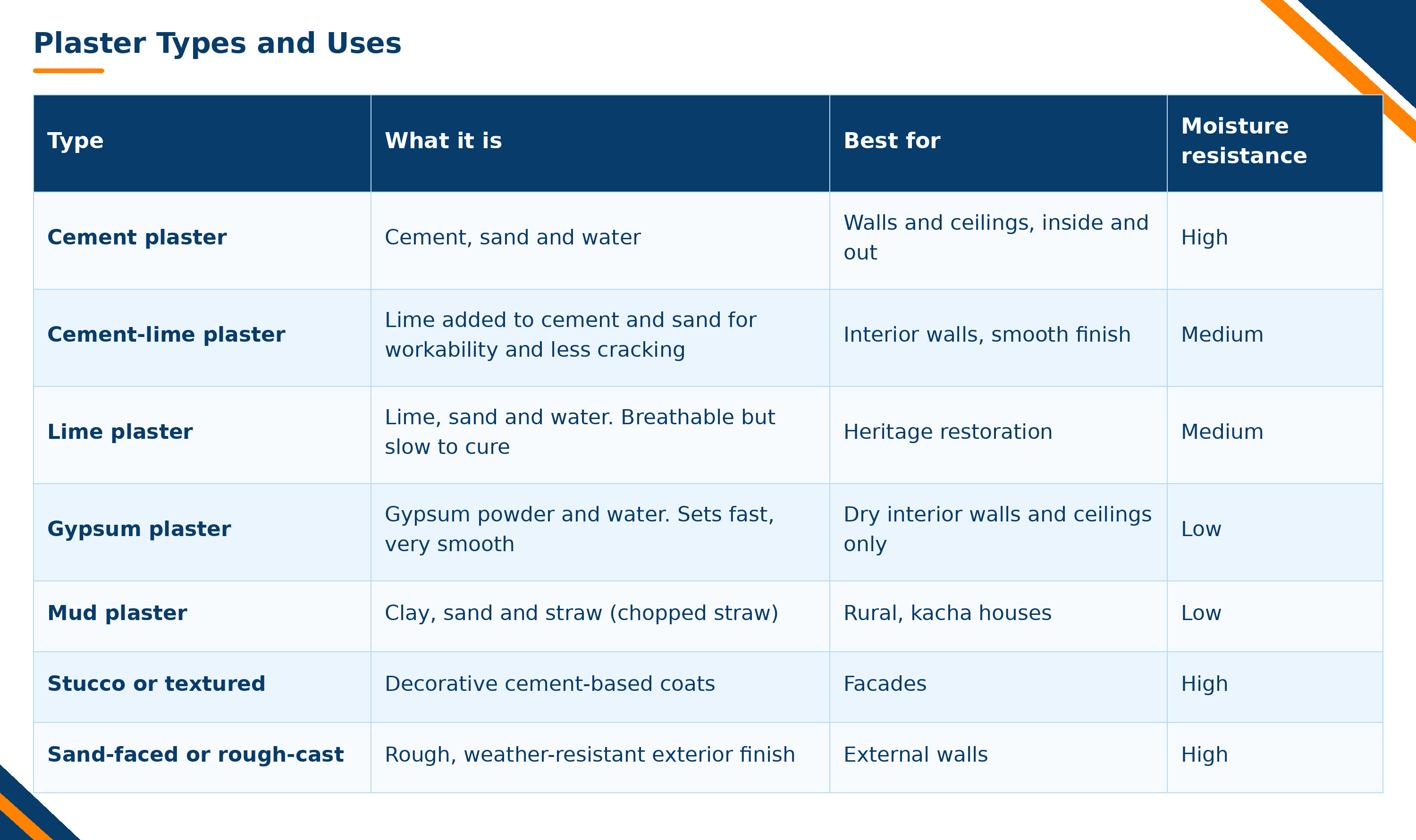
Cement plaster is strong and works indoors and outdoors. Cement-lime provides a more workable mix, and IS 1661 lists a 1:1:6 cement, lime, and sand mix to reduce cracking.
Gypsum is quick and smooth, but keep it away from bathrooms and exterior walls, because moisture ruins it. Mud plaster is still common in villages.
It costs almost nothing, but it needs redoing often and doesn’t suit permanent multi-storey construction.
Cement-Sand Ratio and Plaster Thickness
Two numbers decide how plaster behaves: the mix and the thickness. These are the values most Pakistani sites follow, in line with the South Asian reference code IS 1661.
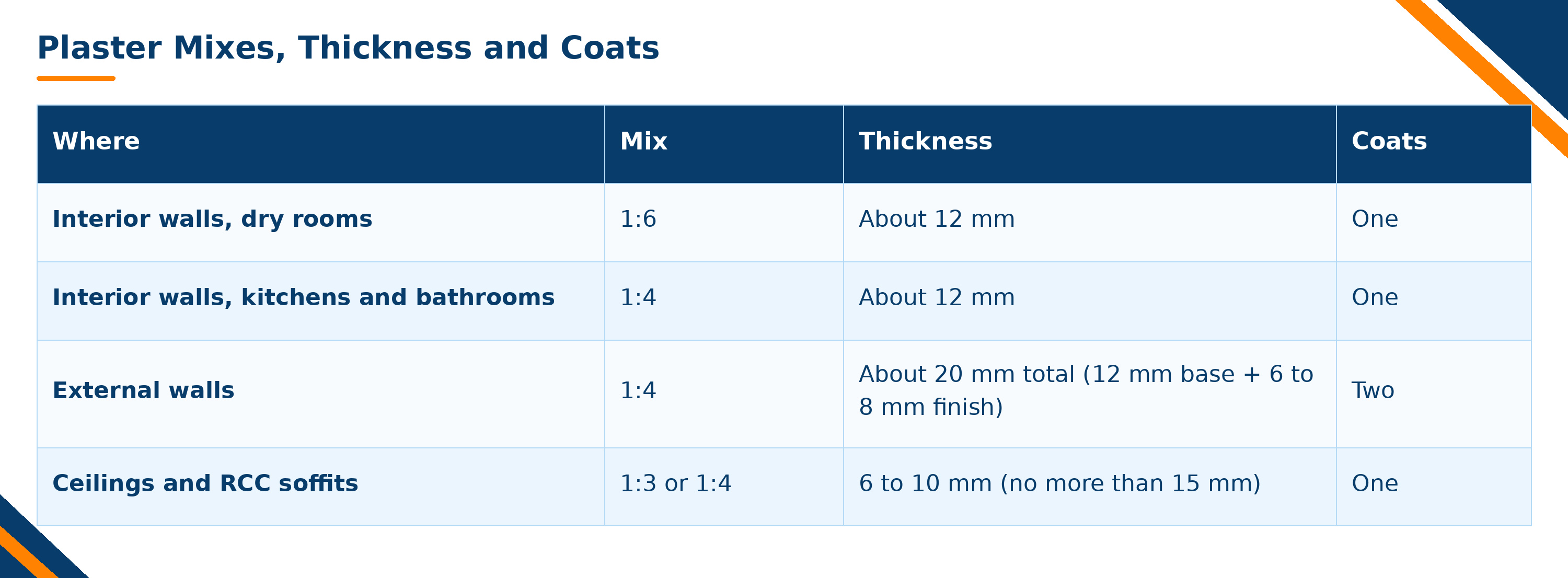
A richer mix isn’t automatically better. Too much cement shrinks more as it dries, which is why interior walls in dry rooms often use a lean 1:6 mix. Save 1:4 for damp areas and the outside.
Core Steps in Wall Plastering
1) Prepare the Wall: Brush off dust, oil, and loose material. Rake the mortar joints back about 10 mm so the plaster can grip. On smooth concrete, roughen the surface and apply a thin dash coat of cement and coarse sand so there’s a key.
2) Bridge the Junctions: Where brick meets a concrete column, beam or slab, fix wire mesh over the joint before plastering. The two materials move differently, and that’s where cracks start.
3) Wet the Wall: Soak it the evening before and damp it again before you start. A dry wall sucks the water out of the mortar, which weakens it. The surface should be damp, not dripping.
4) Set the Guides: Fix small plaster patches (dots) at the top and bottom about 1.5 to 2 m apart, and check them with a plumb bob and spirit level. Fill between them to make vertical screeds.
5) Mix the Mortar: Sieve the sand to take out stones. Mix cement and sand dry until the colour is even, then add water gradually. Mix only what you’ll use in about 30 to 45 minutes.
6) Apply the Base Coat: Throw or press the mortar firmly with a trowel, working from top to bottom. A base coat is about 12 mm.
7) Level It: Run a straight aluminium or wooden rule up and down across the screeds. Fill hollows and scrape off the excess.
8) Add the Second Coat on External Walls: Scratch the base coat with a comb so the next layer bonds. Keep it damp and let it firm up. Then apply the 6 to 8 mm second coat, typically after a few days, as your specification says. Don’t push the total past about 20 mm.
9) Finish and Cure: Use a wooden float for a flat finish or a steel trowel for a smoother one. Once the surface has hardened enough not to wash away, start light spraying and keep it damp for at least 7 days.
Do the plumbing and electrical chasing and conduit work first, and test them. Cutting into fresh plaster later leaves weak patches.
Plastering Calculation in Sq ft
Estimating before you order avoids shortages, wastage, and delays. This method gives cement and sand for any wall.
The Formula
1) Area (m²) = area in sq ft ÷ 10.764.
2) Wet volume (m³) = area (m²) × thickness (m).
3) Dry volume (m³) = wet volume × 1.27. This is the extra bulk of dry materials, because cement and sand shrink when they’re mixed with water.
4) Cement (m³) = dry volume × cement part ÷ (cement part + sand part). Multiply by 1,440 kg/m³ for kilograms.
5) Sand (m³) = dry volume × sand part ÷ (cement part + sand part). Multiply by 35.31 for cubic feet.
6) Then add 5 to 10% for wastage, corners, and uneven walls. The 1.27 factor doesn’t include this.
Worked Example: 100 sq ft, 12 mm, 1:4
1) Area: 100 sq ft = 9.29 m².
2) Wet Volume: 9.29 × 0.012 = 0.1115 m³.
3) Dry Volume: 0.1115 × 1.27 = 0.1416 m³.
4) Cement: 0.1416 × 1/5 = 0.0283 m³, and × 1,440 = about 41 kg, a little under one bag.
5) Sand: 0.1416 × 4/5 = 0.1133 m³, which is about 4 cft.
Here is the same working for the common cases, per 100 sq ft, before wastage.
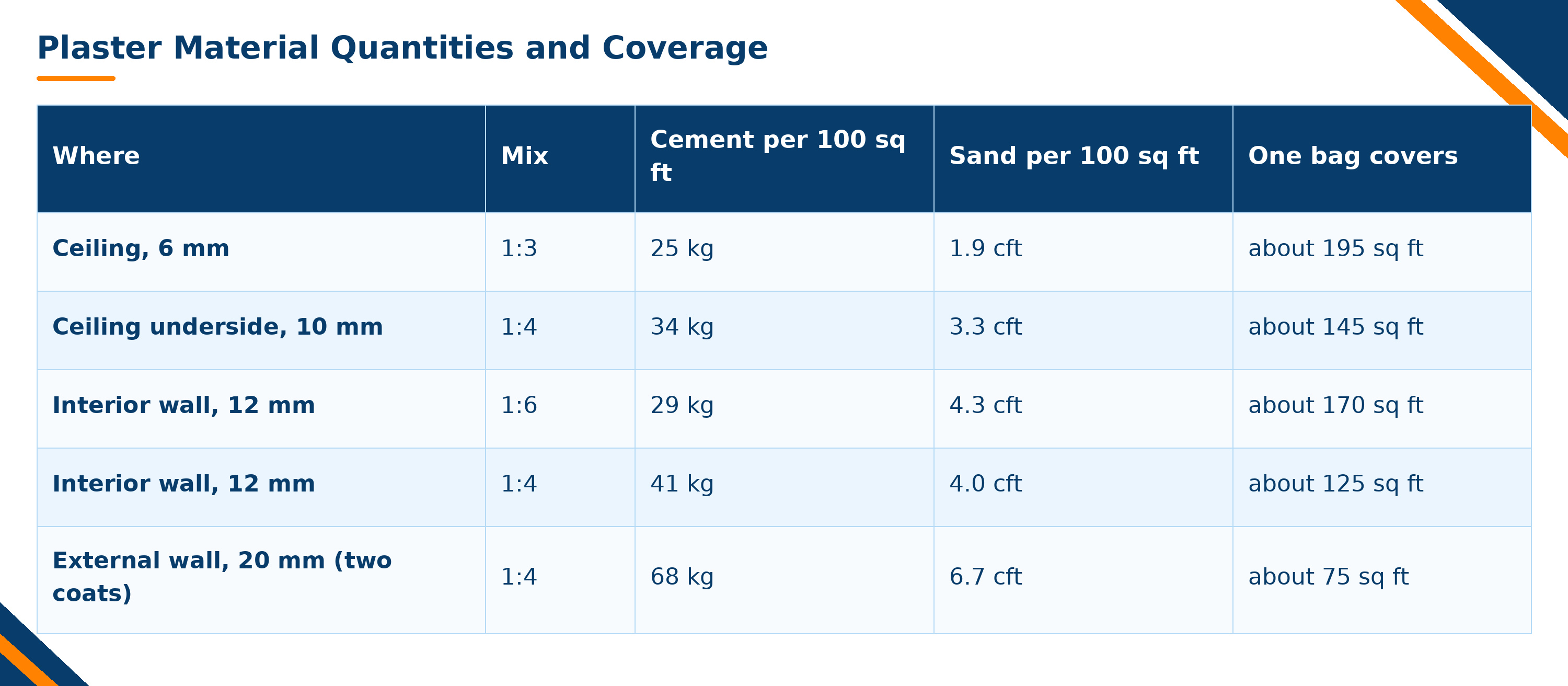
A full room. A room with 400 sq ft of wall at 12 mm and 1:4 needs about 163 kg of cement (3.3 bags) and about 16 cft of sand, before wastage.
Uneven brickwork often pushes the real thickness above 12 mm, so measure a few spots before you order.
A whole 5 marla house. Suppose a double-storey 5 marla house has 1,600 sq ft of covered area.
A rough rule is that total plaster area (inside, outside, and ceilings) runs about three times the covered area, so 4,800 sq ft.
At 12 mm, that’s about 28 bags in 1:6 or 39 bags in 1:4, and 190 to 205 cft of sand, before 10% wastage.
In practice, most houses land at roughly 30 to 45 bags and 200 to 230 cft of sand. Treat the 3x rule as a starting point, and measure your own drawings.
Plastering Cost Per Sq ft in Pakistan
Materials are the smaller part of the plastering cost. Using about Rs 1,550 for a 50 kg bag of OPC and Rs 85 per cft of river sand, here is what the materials cost per 100 sq ft is.
For a current supplier comparison, see Bestway Cement (OPC) and confirm the price for your delivery location.
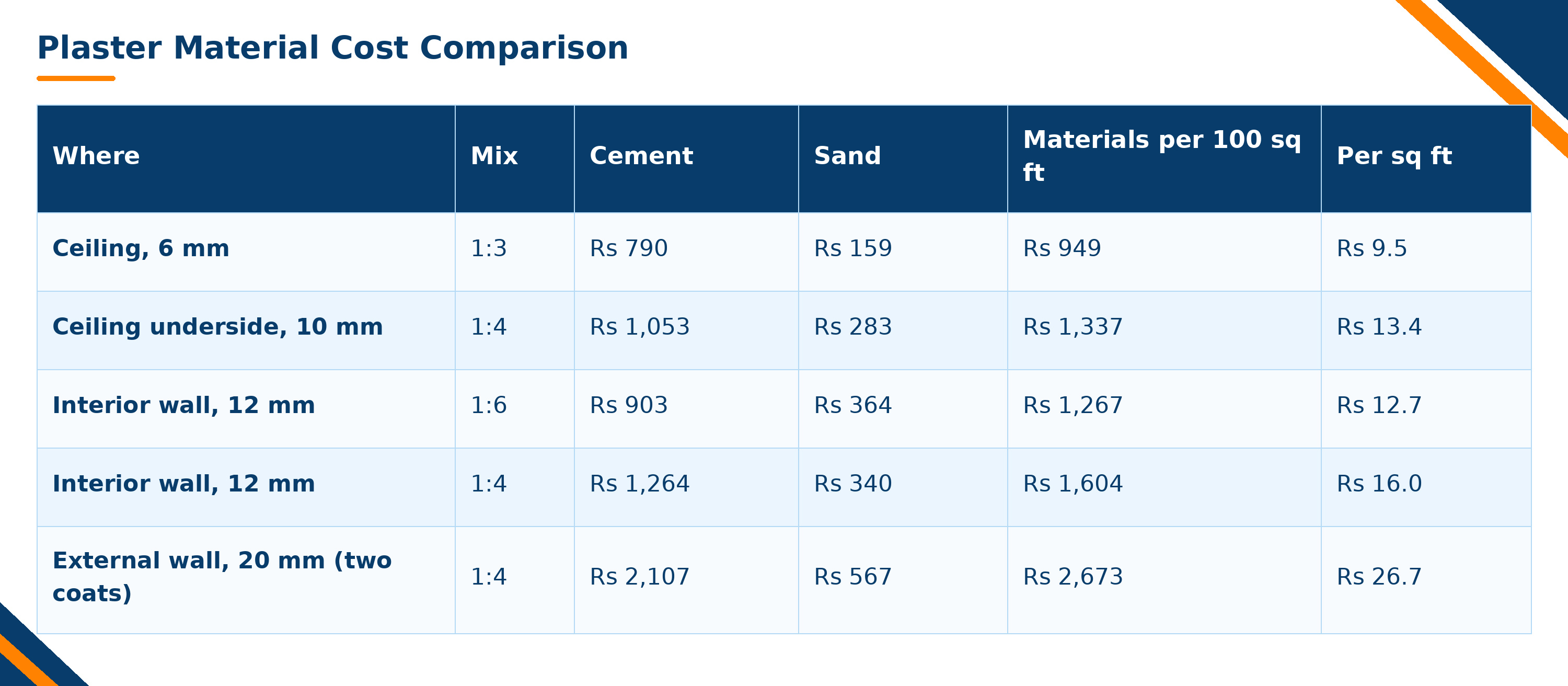
The rates in this example are planning assumptions, not live quotations. For comparison, Kohat Cement (OPC) is another listed option.
Zarea also lists Ravi sand for bulk orders. Water, scaffolding, delivery, and wastage are extra; the figures in the table are calculated from the assumptions above.
Labour is the bigger line. Published Lahore estimates for 2026 put labour-only plastering at about Rs 28 to 38 per sq ft, and a typical all-in contractor rate, with materials and margin, at roughly Rs 72 to 116 per sq ft in August 2026.
Islamabad and Rawalpindi run a little higher. So 4,800 sq ft of plaster could cost about Rs 135,000 to 180,000 in labour alone, on top of about Rs 80,000 in materials.
These are planning figures, so get written quotes.
Thickness changes the bill directly. A 20 mm external coat uses roughly 1.7 times the cement and sand of a 12 mm coat.
Thick plaster on wavy brickwork is the most common reason actual cost overshoots the estimate, which is another reason to keep the masonry plumb.
Which Cement and Sand to Use for Plastering in Pakistan
Cement. Ordinary Portland Cement (OPC) is a common choice for cement-sand plaster in Pakistan.
The right product depends on the approved mix, exposure, and project specification, not simply a higher strength grade.
Sulphate Resistant Cement (SRC) is intended for sulphate exposure, while white cement is mainly used for decorative finishes.
The cement brings together these different product types for comparison.
Portland Pozzolana Cement (PPC) is common in India, and Indian guides often recommend it for plaster.
Pakistani retail is mostly OPC, so if a supplier offers PPC, ask for its test data and follow the maker’s curing advice.
For a bulk order, compare the manufacturer’s grade, bag condition, delivery terms, and minimum quantity before choosing a supplier.
The article on why high-quality cement matters explains what to check beyond the price per bag.
Where the engineer specifies sulphate-resistant cement, Bestway Cement (SRC) is one available listing.
Confirm the required cement type rather than substituting SRC for OPC automatically.
Sand. Use clean, well-graded sand that meets the plaster specification; excessive silt, clay, and organic material can affect the finish and bond.
Fine to medium grading is often preferred for smooth plaster. Chenab sand is one river-sand option to compare, but ask the supplier about grading and cleanliness before ordering.
Coarser material may be more suitable for other construction uses.
A practical note on quantities. The linked cement listings generally have a minimum order of 200 bags, while the sand listings indicate bulk quantities.
Those terms may suit contractors working on several properties more than a single-room renovation.
Check the cement daily price for a market reference, then confirm the actual supplier quote, delivery charges, and current minimum order.
Whichever cement you buy, choose fresh bags that were stored dry and well off the ground.
Avoid bags with hard lumps, because lumps mean moisture has got in and strength has dropped.
Basic Rules for Good Plastering
1) Start With a Clean, Rough, Damp Surface: Dust and smooth faces stop plaster bonding.
2) Keep Thickness in Range: About 12 mm indoors, about 20 mm outdoors in two coats, 6 to 10 mm on ceilings.
3) Match the Mix to the Place: Lean 1:6 for dry interiors, 1:4 for outside and damp areas.
4) Use Clean Sand: Silt and clay weaken the bond.
5) Use Fresh Mortar: Use each batch within about 30 to 45 minutes, and never add water to mortar that has started to stiffen.
6) Plaster Top to Bottom: It keeps finished areas clean.
7) Use Mesh at Junctions between brick and concrete.
8) Cure for at Least 7 Days: Never skip it.
9) Avoid Extreme Weather: Strong sun, wind, and rain damage fresh plaster.
Plastering in Pakistan’s Heat, Rain and Cold
In summer, brick and blocks suck water out of mortar fast. Wet the wall well, mix in the shade, and plaster in the cooler part of the day.
Cover the finished work with wet hessian or sacking, and spray it more often than the usual two to three times a day. Plan for 10 days of curing in dry heat.
During the monsoon, protect fresh plaster from rain with plastic sheets, because washed-out mortar leaves a weak, sandy surface.
In the cold north, avoid plastering when temperatures are near freezing, since frost damages the plaster before it sets.
Common Plastering Defects and How to Fix Them
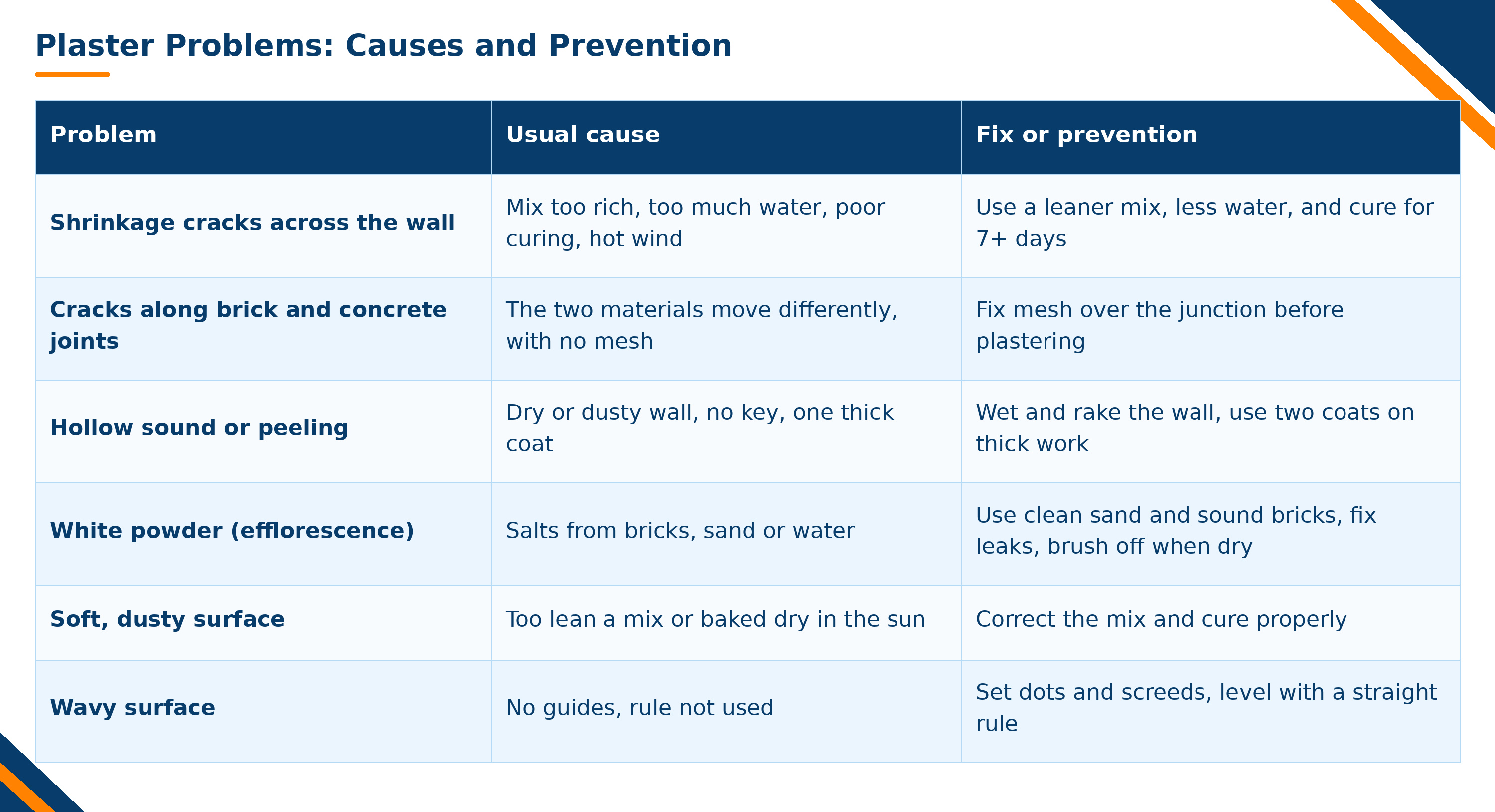
Cracks wider than a hairline, cracks that keep growing, or large hollow patches may point to a structural or damp problem behind the plaster.
Have an engineer look at them before you re-plaster.
FAQs
What is the Purpose of Plastering in Construction?
Plastering gives walls and ceilings a smooth, even surface and protects the masonry from moisture, weather and wear.
It also hides small defects and gives paint, putty or tiles a proper base, which adds to the life of the building.
What are the Basic Rules for Plastering?
Clean and wet the surface, use the right mix and clean sand, and keep thickness in range: about 12 mm indoors, about 20 mm outdoors in two coats, and 6 to 10 mm on ceilings.
Plaster top to bottom, use mesh where brick meets concrete, and cure for at least 7 days.
Which Cement is Used for Plastering?
Ordinary Portland Cement (OPC) is the standard in Pakistan, usually sold as 43 or 53 grade.
Use Sulphate Resistant Cement (SRC) where soil or water is salty, and white cement for decorative finishes.
Whichever you choose, buy fresh, dry bags and cure the plaster well.
How Long Should Plaster be Cured?
At least 7 days, and up to 10 days in hot, dry weather. Start spraying once the surface has hardened enough not to wash away; keep it damp, and shade it from direct sun and wind.
Poor curing is the most common cause of shrinkage cracks.
What is the Cement-Sand Ratio for Plaster?
Common ratios are 1:6 for interior walls in dry rooms, 1:4 for exterior walls, kitchens, and bathrooms, and 1:3 or 1:4 for ceilings.
The right choice depends on exposure and the project specification, and a leaner mix cracks less when it’s cured well.
Wrap-up
Good plastering is mostly discipline. Prepare the wall properly, match the mix to the place, keep the thickness in range, and cure it for a week.
Work out your quantities before you order, add a margin for wastage, and measure the wall rather than guessing. Do that, and you'll spend less on repairs later.