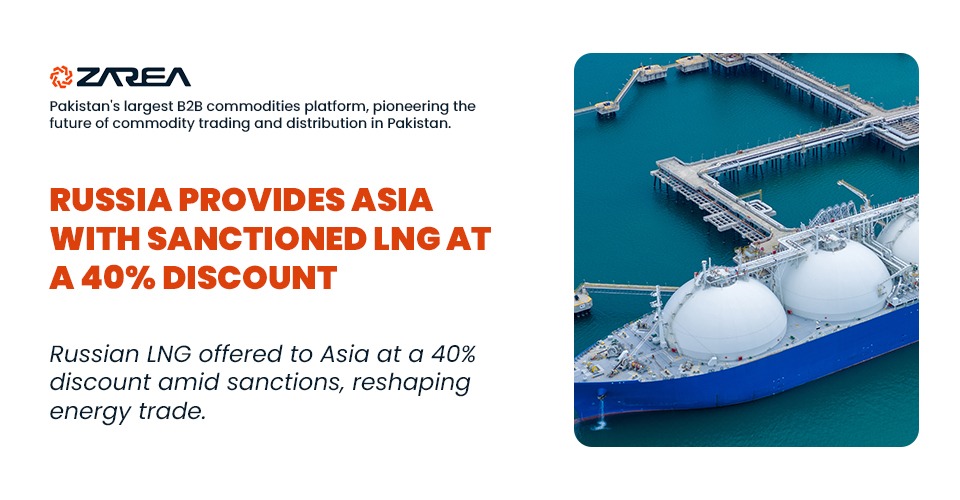
Russia Provides Asia with Sanctioned LNG at a 40% Discount
Russian LNG offered to Asia at a 40% discount amid sanctions, reshaping energy trade as South Asian markets weigh cost benefits against geopolitical risks.
A New Energy Equation in a Shifting Global Market:
Few developments in the dynamic world of international energy commerce garner as much interest as this one: Russian LNG is being sold to Asian markets at discounts of up to 40%. It seems like a simple pricing plan at first. Beneath the surface, however, is a far more nuanced story moulded by supply limitations, geopolitics, sanctions, and the unrelenting quest for energy security.
Asia's economy, especially those in South Asia, face both opportunities and challenges at this time. It is a planned attempt by Russia to keep its position in the world's energy markets in spite of growing constraints. Additionally, it represents a change in the way energy moves across national boundaries.
The Global Energy Puzzle:
In recent years, there has been pressure on the world market for natural gas. A volatile environment where prices fluctuate quickly and unpredictably has been brought about by supply interruptions, geopolitical concerns, and shifting demand.
Once viewed as a flexible and stabilising force, liquefied natural gas (LNG) is now a contentious resource. Countries are vying with one another for supplies, frequently securing long-term agreements or using other vendors.
Russian LNG has become an appealing, if contentious, alternative in this setting. Due to sanctions that restrict its access to conventional Western markets, Russia has shifted its attention to Asia and is now attracting customers with substantial price incentives.
The Power of a 40% Discount:
In the energy business, a 40% reduction is not just alluring but revolutionary. Such pricing can dramatically lower import expenses and relieve pressure on foreign exchange reserves for countries that import energy, especially those with tight budgets.
Affordable LNG can be a game-changer for South Asian nations, where population growth and industrial expansion are driving up energy demand. Reduced energy expenses can enhance energy availability, stabilise power prices, and promote economic growth.
But the bargain is more than just a marketing ploy. It is a tactical measure intended to ensure long-term purchasers in alternate markets and counteract the difficulties caused by sanctions.
Sanctions and Strategic Realignment:
Sanctions have significantly altered patterns of international commerce. Restrictions on its energy exports have forced Russia to shift its focus to non-Western markets.
Moscow is essentially rearranging its trading networks by providing Russian LNG at reduced prices. It is forming new alliances throughout Asia rather than depending on conventional European buyers.
It's interesting to note that intermediate businesses located in places like China and Russia itself frequently assist the trade. These organisations serve as intermediaries, facilitating transactions that could otherwise be hampered by legal restrictions.
The flexibility of international commerce networks, where market forces frequently discover ways to get past obstacles, is shown in this layered structure.
Asia’s Energy Dilemma:
The choice to deal with cheap LNG is geopolitical as well as economic for Asian nations.
On the one hand, the advantages are obvious. Affordable energy may boost production, spur industrial expansion, and ease consumer burdens. Access to less expensive LNG is very desirable in nations like Bangladesh, India, and Pakistan where energy shortages can impede growth.
However, there are factors like long-term viability, regulatory compliance, and geopolitical alignment. Particularly for nations with strong links to Western economies, dealing with sanctioned energy sources may entail financial and political risks.
This necessitates a careful balancing act between geopolitical reality and economic necessities.
The Role of Intermediaries in Modern Trade:
The function of intermediate firms is among this development's most fascinating features. These organisations, which are frequently less well-known, are increasingly crucial to the movement of Russian LNG to Asian markets.
They structure transactions that negotiate intricate regulatory settings, operating at the nexus of commerce and compliance. They provide a layer of separation between the source and the final consumer by serving as middlemen.
This event draws attention to a more general trend in international commodity trade: the growing significance of adaptable, flexible networks that can react to changing geopolitical environments.
Implications for Global Commodity Trade:
The emergence of cheap LNG from Russia is a part of a broader shift in the world's commodities trade.
Conventional trading routes are changing. Alliances are changing. Pricing strategies are changing. Agility and flexibility are becoming just as crucial in this new environment as size.
This offers both possibilities and problems for businesses engaged in commodity trade, especially those in emerging economies. Navigating the intricacies of contemporary trade requires an understanding of these processes.
Logistics - The Invisible Backbone:
Every shipment of LNG is supported by an intricate logistical system. The voyage of LNG is an example of engineering and coordination, from distribution networks and regasification facilities to liquefaction plants and specialised ships.
Logistics become considerably more important when working with Russian LNG. It may be necessary to modify routes, handle paperwork with care, and guarantee compliance at every turn.
A discounted deal's continued economic viability may be ascertained through effective logistics. The advantages of cheaper pricing might be swiftly undermined by delays, inefficiency, or regulatory obstacles.
This emphasises how crucial strong supply chain management is to the energy industry.
A Temporary Opportunity or a Long-Term Shift?
Whether this pattern reflects a short-term adjustment or a long-term shift in global energy commerce is a crucial topic facing the market.
On the one hand, the discounts can be short-lived due to pressing issues including supply imbalances and penalties. Pricing plans may alter in response to shifting geopolitical events.
However, the development of new infrastructure and commercial ties may have long-term consequences. Supply chains usually endure after they are reoriented and partnerships are formed.
This presents strategic questions for Asian purchasers over whether to view cheap LNG as part of a larger energy plan or as an opportunistic acquisition.
The Pakistan Perspective:
The availability of inexpensive LNG offers Pakistan a substantial opportunity. The nation has frequently experienced energy shortages, and LNG is essential to industrial activities and electricity production.
Reduced pricing for Russian LNG might boost economic recovery, lower import costs, and stabilise the energy industry. To guarantee adherence to international laws and conformity with national policy goals, however, a thorough assessment is necessary.
This instance emphasises how crucial it is to make strategic decisions when purchasing energy, striking a balance between cost, sustainability, and geopolitical factors.
Conclusion - A Market in Motion:
A striking example of how international trade adjusts to shifting conditions is the rise of cheap Russian LNG in Asian markets. It illustrates how politics, economics, and innovation interact to create a new energy environment.
It presents both difficulties and potential for Asia. It stands for resiliency and strategic realignment for Russia. Additionally, it portends a future in which success will be determined by adaptation and flexibility in the global economy.
One thing is evident as the narrative progresses: supply and demand are no longer the only factors in energy commerce. It is about navigating a world where every opportunity has its own set of difficulties and every transaction has several levels of importance.