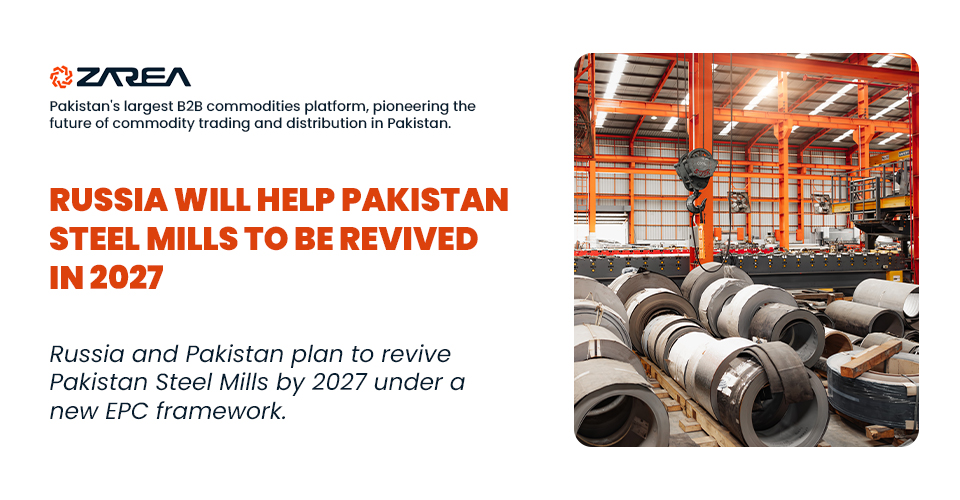
Russia Will Help Pakistan Steel Mills to Be Revived in 2027
Russia and Pakistan plan to revive Pakistan Steel Mills by 2027 under a new EPC framework. It marks a major step toward industrial recovery!
Introduction - Pakistan Steel Mills:
On July 2, 1968, Pakistan Steel Mills Corporation was established as a public sector organisation. Pakistan and the Soviet Union (USSR) struck a techno-financial deal in January 1971. This financial deal happened after Western countries showed little interest in the project.
On December 30, 1973, Prime Minister Zulfikar Ali Bhutto laid it in Bin Qasim, Karachi. Under Soviet supervision, Pakistani businesses constructed the facility during a ten-year period (1974–1985). President Zia-ul-Haq publicly opened it on January 15, 1985, after it began its commercial operations on December 25, 1984.
Technical Specifications:
Pakistan steel mills are not only designed to produce up to 3 million tonnes of steel annually. But it had an initial capacity of 1.1 million tonnes of steel production at that time. Further, it includes a residential settlement (Steel Town) and a primary plant area (10,390 acres) within it. But a dedicated water reservoir totaling around 18,660 acres is also included in it.
It uses Basic Oxygen Furnace (BOF) and Blast Furnace (BF) technologies to function as a fully integrated mill. Important units consist of:
Two blast furnaces.
Coke oven and byproduct plants.
A dedicated iron ore and coal jetty with a 7km conveyor belt system to the plant.
A thermal power plant and turbo blower station (110 MW).
Significance and Decline:
At its height, PSM was a major supplier to Pakistan's construction, automotive, and defence sectors. Meanwhile it's lowering steel imports and saving billions of dollars annually. The mill experienced financial mismanagement and corruption after an unsuccessful attempt at privatisation in 2006. Further its production was fully stopped in 2015. The main reason behind it was growing debt and a suspension of gas supply to the mill.
But today's reality has changed! Pakistan and Russia both wanted that the steel mill plant's modernisation and restoration had been agreed to as of January 2026. A shift to more effective steelmaking technology, such as Electric Arc Furnaces (EAF), is being considered.
The Revival of Pakistan Steel Mills:
The rebirth of Pakistan's steel mills has long been a topic of national significance. Meanwhile, it's a state-owned business. Further it also represented the nation's economic potential as well as the difficulties it faced. Unfortunately, the reasons that damaged PSMs were financial hardship and policy ambiguity. A clear road ahead has now surfaced with operational closures in the following years.
An important turning point in Pakistan's industrial recovery and bilateral cooperation with Russia has been reached. In 2027, it starts building an agreement on Pakistan Steel Mills' revitalization and expansion in many ways.
Strategic planning, international cooperation, and institutional supervision are the major driving forces behind this huge achievement. This agreement was verified during a briefing for a Public Accounts Committee subcommittee. Further reestablishing the pillars of Pakistan's heavy industrial foundation is the goal of the proposed revival. Moreover it goes beyond just reviving a dormant steel factory.
Background - The Decline of Pakistan Steel Mills:
Pakistan Steel Mills were the foundation of the nation's industrial infrastructure. It was founded in the early 1970s with the help of the Soviet Union. Meanwhile the plant is located in Karachi. Further it was crucial for providing steel for industrial, building, and national development initiatives. Years of poor management, political meddling and grow debt were not the only reasons behind the major closure. But antiquated technology and energy scarcity ultimately caused PSM to close in 2015.
Pakistan Steel Mills has been accruing losses as its tangible assets decline and are inactive ever since. Weak implementation frameworks and unresolved legal challenges made it more close to closure. Especially a lack of investor trust is a major contributor to the failure of several resurrection attempts. Therefore, the disclosure of a precise reactivation date signifies a change from previous ambiguity.
Pakistan–Russia Cooperation - A Strategic Industrial Partnership:
Strengthened ties between Pakistan and Russia are the foundation of the current endeavour to revitalise Pakistan Steel Mills. The Pakistan-Russia Inter-Governmental Commission inked a second pact in November 2025. This pact expresses the purpose of updating and growing steel plants. Meanwhile the preparation of a bankable Engineering Procurement and Construction (EPC) contract is under debate. Further this protocol was made possible and is currently regarded as a crucial need for initiating construction operations.
Russian participation is significant both technically and historically. Russian companies have institutional knowledge of the original steel mill's design and operating framework. But the point is that the original steel mill was built using the Soviet experience. Behind this continuity there is the possibility of a technically feasible and financially sustainable rebirth increasing.
Role of the EPC Contract and 2027 Timeline:
According to the Ministry of Industries and Production, the EMP contract is necessary to move on. So, construction on the Pakistan Steel Mills won't start until the EPC contract with Russia is signed. When compared to previous resuscitation attempts it shows a deeper methodology. So, this methodology shows a more methodical approach to project management.
The integration of design, procurement, and construction duties under a single contractual framework highlights an EPC model. Meanwhile, PSM's EPC model surely lowers implementation delays and cost overruns. The government has indicated a reasonable schedule that permits due investigation and financial structuring. In 2027, risk assessment is the starting year for construction.
Given the scope of the project and the requirement to update an antiquated infrastructure rather than merely restore historical systems, this staged approach is especially crucial.
Technical Audit and Asset Valuation:
The Russian company Industrial Engineering LLC has carried out a thorough technical assessment of Pakistan Steel Mills as part of the preparation phase. In order to identify what can be repaired and what has to be replaced, the audit evaluated the state of production lines, infrastructure, utilities, and machinery.
The business sought an asset appraisal in addition to the technical examination, which is now valued at around $139 million. For financial modelling and investment planning, which are crucial for obtaining funds and setting up the EPC contract, this appraisal offers a starting point.
In stark contrast to previous revival ideas, many of which had reliable technological and financial underpinnings, the audit process exhibits a data-driven approach.
Legal and Financial Challenges - Addressing Legacy Issues:
Pakistan Steel Mills is still dealing with unsolved legal and financial issues, despite progress on the restoration front. An improper payment of Rs. 148.5 million pertaining to an international arbitration lawsuit involving Al-Tuwairqi Steel was brought up at a parliamentary committee briefing.
The owner of the mill filed a claim in an international arbitration forum when Pakistan refused to supply petrol at a discounted rate. Pakistan prevailed in the lawsuit in the end. Pakistan is also giving away its right to recoup the contested sums. However, all committee members were concerned about the delay in submitting a recovery case to the Sindh High Court.
Officials from the government revealed that the prime minister had appointed a committee. Meanwhile this committee had cited diplomatic concerns and also examined the issue and explained the delay. Further the federal government is now getting ready to take local legal action in response to its suggestions. Moreover the federal government is also indicating a more proactive approach to safeguarding public financial interests.
Ownership Structure and Regulatory Constraints:
The ownership structure of the steel plant involved in the arbitration dispute was another important topic covered during the committee meeting. The owner has sold 95% of his stock, according to officials, and the remaining 5% cannot be sold according to rules set forth by the Securities and Exchange Commission of Pakistan.
Crucially, if unpaid debts are not settled, the government is still able to seize the remaining shares. The state has more power thanks to this regulatory leverage to settle legacy conflicts that would otherwise jeopardise the larger restoration effort.
Economic and Industrial Implications:
The national economy would be significantly impacted by Pakistan Steel Mills' successful comeback. When the mill is operating at full capacity, it may improve the trade balance, stabilise prices in the local manufacturing and construction industries, and drastically lessen Pakistan's need on imported steel.
Additionally, the project is anticipated to revitalise auxiliary businesses including transportation, engineering services, and raw material supply chains by creating thousands of direct and indirect employment. Strategically speaking, a working steel mill promotes long-term infrastructure development and increases Pakistan's industrial self-reliance.
As Pakistan's steel industry develops, buyers and construction businesses can also explore products from established steel suppliers and brands, including Aziz Steel, Al Moiz Steel, FF Steel, Mughal Steel, Kamran Steel, and Hunza Steel. Access to a wider range of steel suppliers can support construction projects by giving buyers more options for sourcing steel products according to their project requirements.
Concluding Remarks - A Wary Yet Hopeful Future:
With construction planned for 2027, Russia's commitment to assist Pakistan Steel Mills' recovery marks a cautiously optimistic turning point. This strategy is based on technical audits, asset appraisal, organised EPC planning, and legislative monitoring, in contrast to earlier announcements.
Even while there are still difficulties, especially in settling legacy issues and guaranteeing transparent implementation, the new framework points to a more responsible and mature approach. If successfully carried out, Pakistan Steel Mills' restoration might reinstate a crucial economic asset and provide as a template for the reform of other Pakistani state-owned businesses.
Whether this long-awaited rebirth moves from policy commitment to industrial reality will be determined in the upcoming years.