Steam Boiler: Types, Working Principle & Uses in Pakistan
Learn how steam boilers work, their types, industrial uses, fuel options and efficiency, plus essential buying tips for businesses in Pakistan.
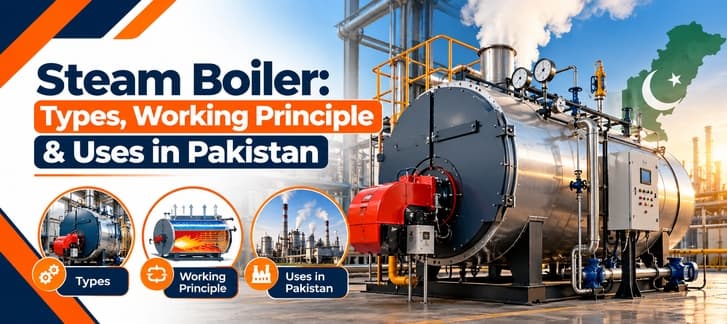
A steam boiler heats water to produce steam for industrial processes such as dyeing, food processing, sterilisation and power generation. The boiler itself is only one part of the system: water treatment, controls, piping and steam traps all affect safety, fuel use and operating cost.
If you are choosing a boiler for a factory in Pakistan, start with the steam demand and pressure your process actually needs. Fuel availability comes next. A low equipment quote can become expensive if the burner is inefficient, the fuel is unsuitable, or the installation omits essential equipment.
Quick Answers:
A steam boiler produces steam by transferring heat to water inside a pressure-rated system.
Fire-tube and water-tube are the two main construction types; neither is automatically best for every plant.
A 500 kg/hr rating means 500 kilograms of steam per hour under specified operating conditions, not a fixed electrical power rating.
Fuel cost depends on steam conditions, feedwater temperature, boiler efficiency, fuel heating value, and delivered price.
Install, inspect, and operate a boiler under applicable codes and local requirements.
How Does a Steam Boiler Work?
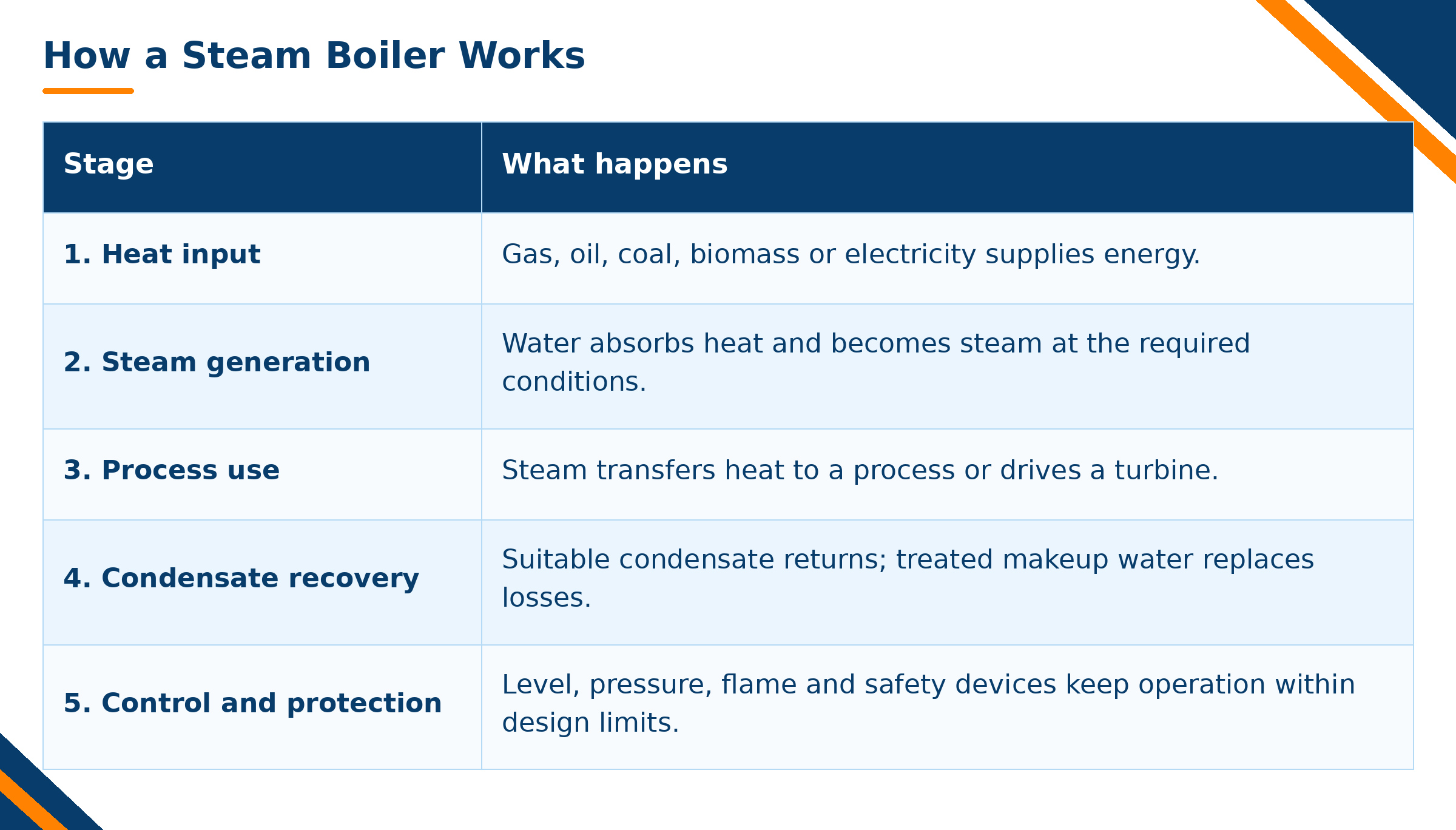
In a fuel-fired unit, a burner or furnace releases heat. Metal heating surfaces transfer that heat to water, producing steam at the required pressure. Steam flows through insulated piping to process equipment. As it gives up heat, some of it condenses; recoverable condensate can be returned to the feedwater system.
A feedwater pump, water-treatment equipment, controls, steam traps, pressure instrumentation, and protective devices support the cycle. Condensate is not always returned: losses and contamination may require treated makeup water.
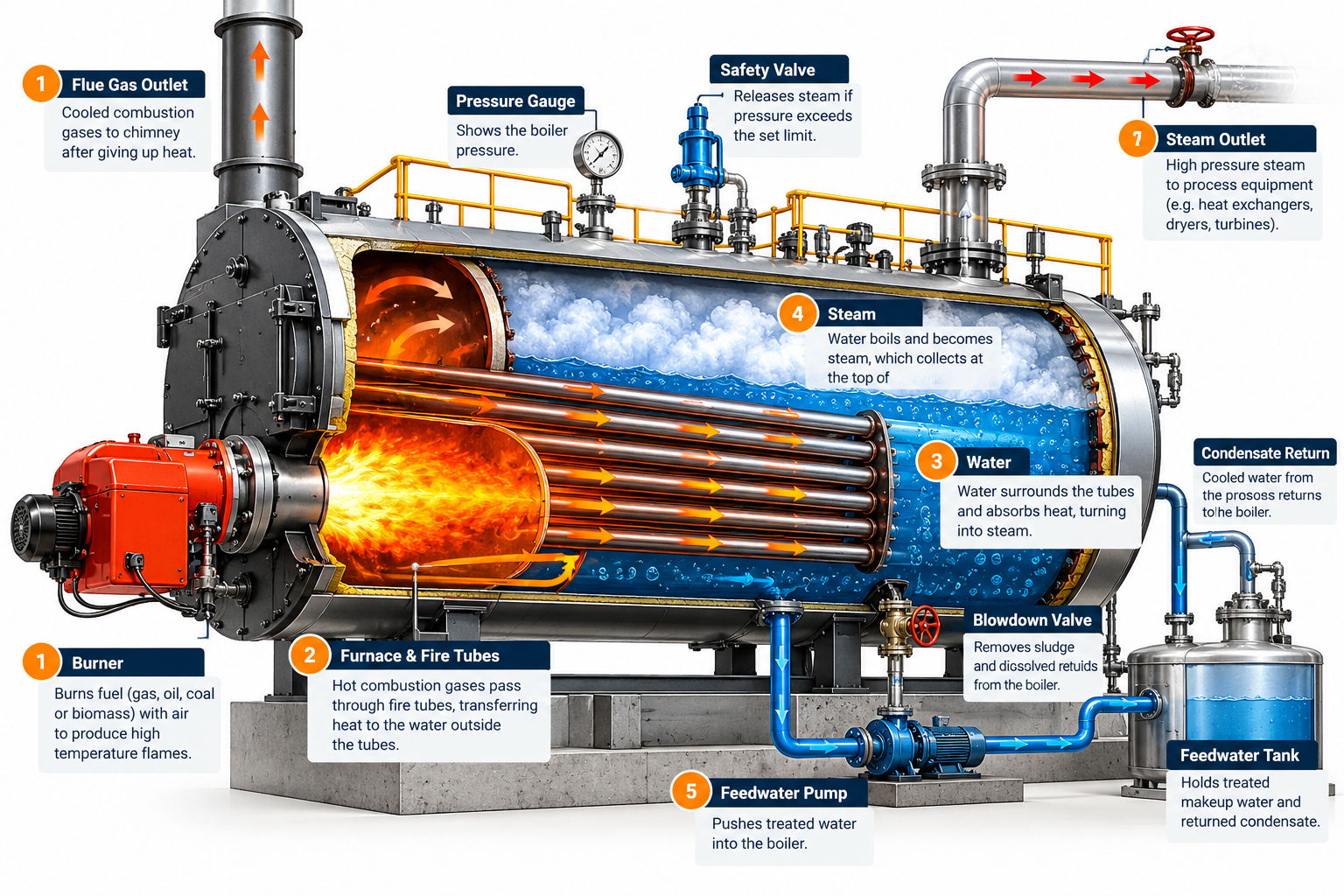
Main Parts of a Steam Boiler
Burner or furnace: releases heat using the specified fuel.
Heating surfaces and steam space: transfer energy and separate steam from water, depending on design.
Safety valve: protects against overpressure; it is not a substitute for proper controls and inspection.
Water-level indication and low-water protection: help prevent dangerous operation with insufficient water.
Feedwater pump and treatment: maintain water supply and control scale and corrosion.
Blowdown arrangement: manages dissolved and suspended solids according to the water-treatment programme.
Steam piping, traps and insulation: deliver usable steam and limit avoidable losses.
Fire-Tube vs Water-Tube Steam Boilers
Fire-tube boilers pass hot combustion gases through tubes surrounded by water. Water-tube boilers circulate water and steam inside tubes heated from outside.
The right choice depends on capacity, pressure, load changes, space, maintenance support, and water quality.
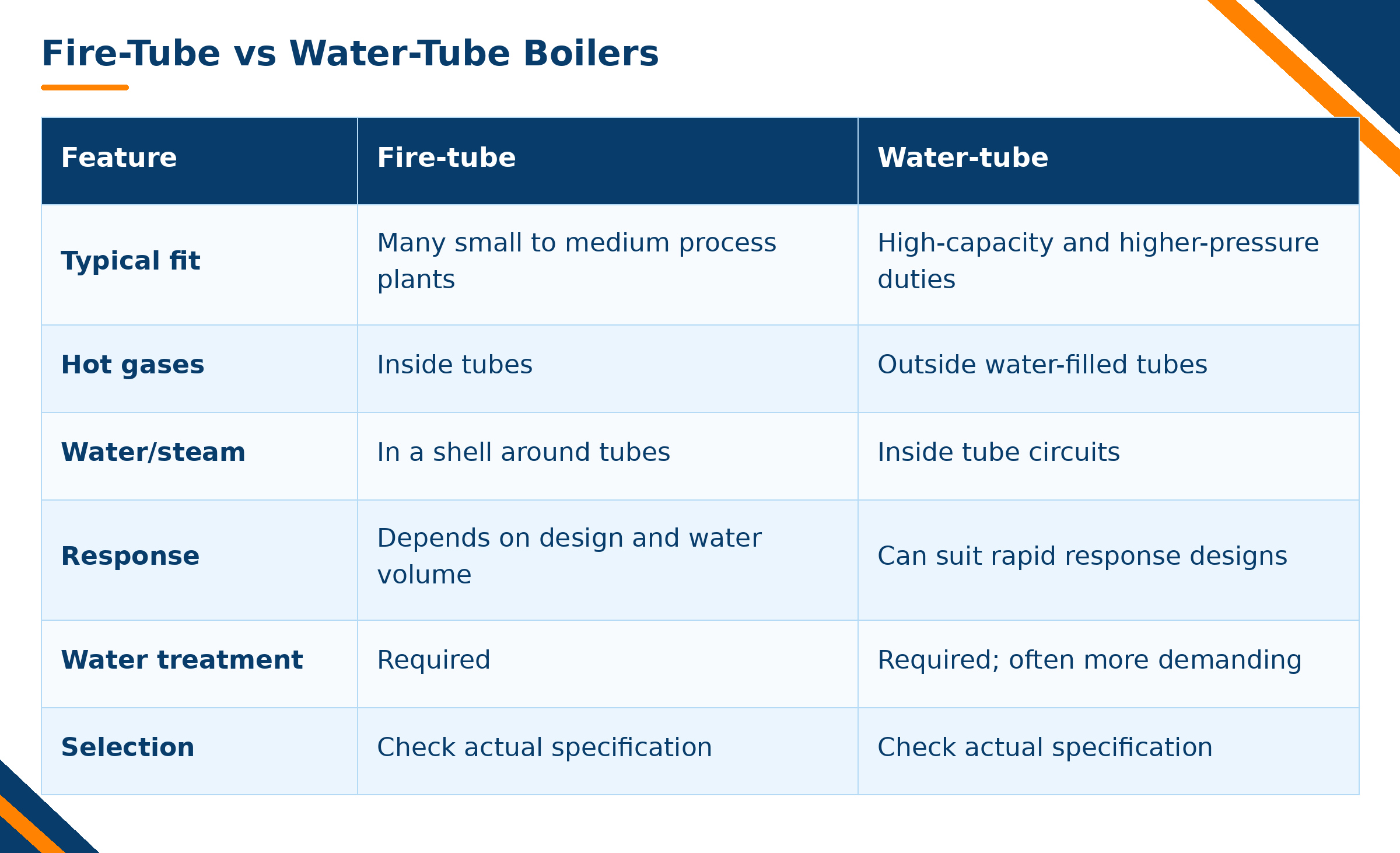
Packaged, vertical, and once-through or coil steam generators describe other design or packaging choices; they should not be treated as identical to the two tube arrangements. Ask the manufacturer which pressure-vessel code applies to the specific model.
Industrial Uses in Pakistan
Textile mills: dyeing, finishing, sizing and pressing.
Food and beverage plants: cooking, blanching, sterilisation and cleaning.
Rice mills: paddy parboiling and process heating; some sites use rice husk in purpose-built furnaces. For a closer look at this feedstock, read rice husk applications.
Sugar mills: process steam and cogeneration using bagasse in suitable boilers. Learn more about the residue in the sugarcane bagasse.
Pharmaceutical and healthcare facilities: controlled steam for approved sterilisation processes.
Paper, chemical and rubber industries: drying and process heating.
Power plants: high-pressure steam for turbines.
Fuel selection depends on the boiler design, local supply, and verified fuel characteristics.
Which Fuels Can a Steam Boiler Use?
Natural gas, liquid fuels, coal, and biomass are common options; electric steam generators are also available. Fuel is not interchangeable simply because it burns. The furnace, fuel handling, ash removal, emission controls, and combustion system must be designed or professionally approved for the chosen fuel.
Buyers comparing solid fossil fuels can browse coal.
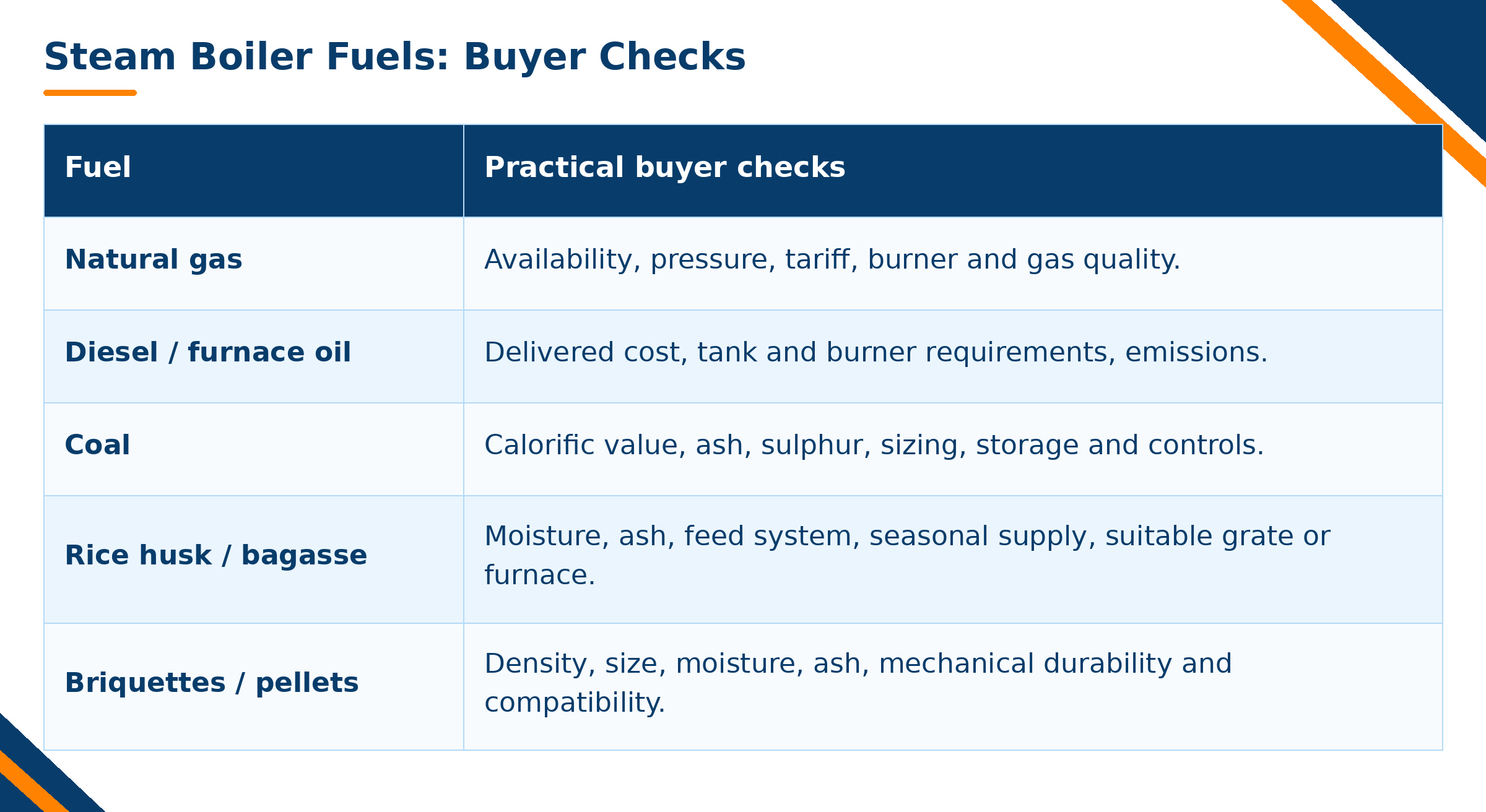
A fuel comparison should start with delivered cost and a laboratory-tested heating value, not a commodity label alone. Liquid-fuel options can be explored under energy and petroleum.
Product specifications and samples should be reviewed against the manufacturer’s permitted fuel range. For agricultural residues, see agriculture biomass.
Biomass combustion requires equipment designed for its fuel properties, ash, and emissions profile. For related equipment considerations, read the biomass boiler.
How Much Fuel Does a 500 kg/hr Steam Boiler Consume?
A 500 kg/hr steam rating alone cannot tell you the fuel requirement. Steam pressure, steam dryness, feedwater temperature, operating load, boiler efficiency, and the fuel’s lower heating value all matter.
Illustrative calculation only: assume 500 kg/hr of saturated steam at about 10 bar absolute, feedwater near 100°C, steam enthalpy about 2,778 kJ/kg, feedwater enthalpy about 419 kJ/kg, and 85% fuel-to-steam efficiency.
The useful heat rate is approximately 500 × (2,778 − 419) ÷ 3,600 = 328 kW. The required fuel input is about 386 kW, or 1,388 MJ per hour.
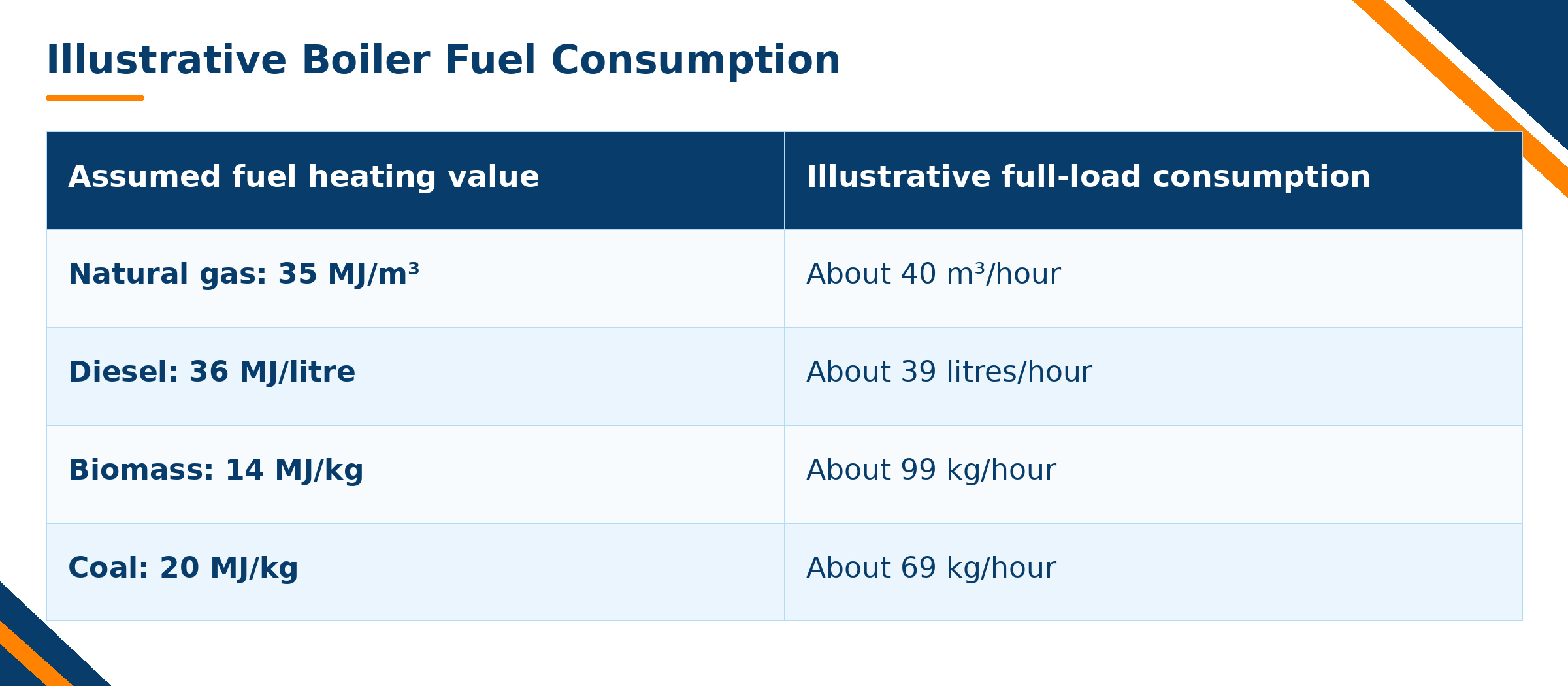
These are worked examples, not measured figures or purchase specifications. Actual consumption can differ substantially, particularly at partial load or with wet solid fuels. Confirm using the manufacturer’s steam and fuel data, and use consistent gross/net heating-value and efficiency bases.
How to Compare Boiler Fuel Costs Fairly
A low price per tonne is not the same as a low price per tonne of steam. Compare delivered fuel cost, tested heating value, boiler efficiency, ash disposal, handling, maintenance, and emissions-control costs.
For example, rice husk with high moisture can deliver less usable energy per kilogram than a dry sample of the same material. One example of a solid fuel listing is Punjabi Coal; suitability still requires technical confirmation.
For an initial comparison, calculate fuel cost per useful gigajoule as: delivered fuel price per kilogram ÷ (heating value in GJ/kg × applicable boiler efficiency). Then add handling, treatment, disposal, and other relevant costs.
Have the final economic case checked against real operating data. For biomass comparison, review the listed specifications for rice husk before requesting a quote.
How Much Does a 500 kg/hr Steam Boiler Cost in Pakistan?
There is no dependable single market price for a 500 kg/hr steam boiler. A quote may cover only the vessel, while another includes the burner, feedwater tank, softener, controls, chimney, installation, and commissioning.
Fuel type, pressure rating, construction code, automation, and after-sales support also change the price.
Ask at least two qualified suppliers for dated, itemised quotations on the same basis. Until comparable current quotes are available, publishing an unsupported PKR range would be misleading
Steam Boiler Efficiency And Maintenance
Fuel bills rise when heat is lost through uninsulated lines, failed steam traps, excess combustion air, fouled heating surfaces or avoidable blowdown. Depending on the installation, condensate return and properly designed heat recovery can improve system performance.
The DOE steam-system sourcebook explains these opportunities in detail.
Water treatment must be tailored to the boiler and feedwater analysis. Do not add chemicals or adjust operating settings based on a generic blog recommendation; use a qualified water-treatment provider and the boiler manufacturer’s instructions.
Steam Boiler vs Hot-Water Boiler
A steam boiler produces vapour for process heating or power applications. A hot-water boiler keeps water in liquid form and circulates it for heating or industrial processes.
Steam can deliver substantial latent heat as it condenses, but the right system depends on process temperature, pressure, heat demand, and distribution design. Neither is universally more efficient or economical.
Safety, Codes and Inspection in Pakistan
Steam boilers are pressure equipment. Before installation or commissioning, the owner should confirm the applicable provincial law, registration, inspection, and operator requirements with the relevant boiler inspection authority. Requirements can vary by location and equipment class.
Ask for the manufacturer’s design code, fabrication records, test certificates, safety-device documentation, and commissioning report. International reference frameworks include the ASME Boiler and Pressure Vessel Code, including different sections for different boiler applications; the applicable code must be established for the actual equipment.
Only trained, authorised personnel should perform operational checks, maintenance and safety testing in accordance with approved procedures. This article is not an operating or emergency-response procedure.
What to Ask a Steam Boiler Supplier
What is the guaranteed steam capacity at my required pressure and feedwater temperature?
Is the output saturated or superheated steam, and what dryness or quality is guaranteed?
What fuel properties and burner or furnace configuration does the quotation assume?
What is the guaranteed efficiency and fuel consumption at rated and part load?
Which design code, certificates, inspections and local approvals are included?
Does the quote include water treatment, feed tank, controls, stack, installation and commissioning?
What are the maintenance plan, spare-parts lead times, warranty and local service arrangements?
Can the supplier provide a reference installation with similar steam demand and fuel?
Frequently Asked Questions
What are the two main types of steam boilers?
Fire-tube and water-tube. Fire-tube units carry hot gases inside tubes surrounded by water; water-tube units carry water inside heated tubes. Actual suitability
depends on the manufacturer’s design and the plant’s requirements.
How much fuel does a 500 kg/hr steam boiler use?
There is no fixed answer. A properly stated calculation needs steam conditions, feedwater temperature, efficiency, and fuel heating value. The example above illustrates the method; request a manufacturer-backed consumption guarantee.
Can a coal-fired boiler run on rice husk or biomass briquettes?
Not automatically. Fuel feeding, combustion, ash handling, and emissions systems may need redesign or approval. Consult the original equipment manufacturer and qualified boiler engineer before any fuel conversion. Zarea also lists bagasse, but a listing does not establish boiler compatibility.
Wrap Up
Choose the steam boiler around the process, not the brochure. Confirm steam demand, pressure and fuel quality first; then compare efficiency, delivered fuel costs, water treatment, service support and code compliance.
For Pakistan-based buyers, locally sourced coal and agricultural residues may be worth comparing, but only where the equipment is designed for them. A clear specification and an itemised quote are better starting points than a headline purchase price.