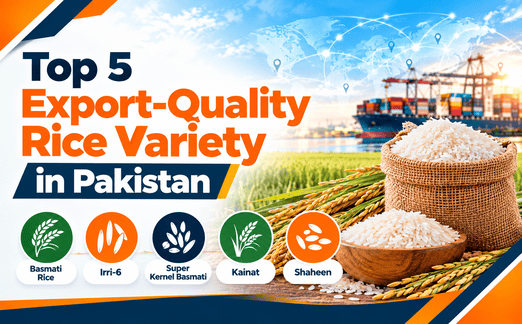
Top 5 Export-Quality Rice Variety in Pakistan | How We Get Them?
Discover the top 5 export-quality rice variety in Pakistan, including 1121 Basmati, Super Kernel, IRRI-6, PK-386, and D-98.
Introduction – Rice Variety in Pakistan:
Pakistan is one of the world's top exporters of high-quality rice, prized for its long grain, aroma, and reliable cooking performance. Rich alluvial soils, a favourable climate, and decades of cultivation expertise across Punjab and Sindh combine to produce rice that competes with the best in the world.
Every variety carries its own grain length, aroma, and texture, which is exactly what makes each one suited to different dishes and different buyers — ranging from fragrant Basmati to high-yielding non-Basmati types.
This guide covers five export-quality rice varieties grown in Pakistan: what makes each one distinct, and where to source it for domestic or commercial use.
1121 Basmati Rice – The King of Long Grains:
1121 Basmati is best known for its exceptional cooking quality and ultra-long grain, averaging around 8.2 mm raw — among the longest of any commercially traded rice. After cooking, the grains stay separate, fluffy, and elongate further without breaking apart, which is exactly the trait that makes it the go-to choice for chefs plating pulao and biryani.
1121 Basmati Types:
White: naturally fragrant, suited to everyday cooking.
Steam: holds up well under heat and keeps its shape during cooking.
Sella (parboiled): firmer texture, nutrient-retentive, longer shelf life.
Sourcing Tip: Sialkot, Gujranwala, and Hafizabad host Punjab's leading exporters. For bulk purchases, 1121 steam rice listing is a useful starting point, alongside REAP's (Rice Exporters Association of Pakistan) member directory for verified exporters.
Super Kernel Basmati – The Best Option for Fragrance:
Super Kernel Basmati grows almost exclusively in the fertile belt between the Ravi and Chenab rivers in Punjab. Its grain runs about 7.2 mm — shorter than 1121, but with a more pronounced natural aroma and a slender profile that elongates cleanly when cooked.
Producers typically age it for six to twelve months before sale, which deepens its flavour and scent. That aroma is what's earned it a reputation as one of the most fragrant basmati varieties on the market, popular with restaurants and export buyers across the Middle East, Europe, and North America.
Sourcing Tip: Sheikhupura and Narowal are the main production districts. TDAP's (Trade Development Authority of Pakistan) export directory is a good resource, and Super Kernel listings are worth checking for current bulk pricing.
IRRI-6 – Economical & High in Demand:
IRRI-6 is a mainstay of non-Basmati rice variety in Pakistan for those seeking price without sacrificing quality. Farmers commonly grow it in the Sindh region, and it has an average grain length of 6.0 mm. Chefs prize it for its robust cooking ability, good yield, and soft texture. Because exporters may offer it in different broken percentages (5%, 10%, 25%, and 100%), bulk importers and the food processing industry have a variety of options.
Sourcing Tip: IRRI-6 processing and export are concentrated in Karachi, Larkana, and Thatta. For large orders, exporters situated in Sindh provide reasonable pricing.
PK-386 – A Versatile Performer:
Developed at the Rice Research Institute in Kala Shah Kaku, PK-386 is a long-grain non-aromatic rice variety that is early-maturing and high-yielding. The average grain length measures 6.8 mm, and consumers value it for its price, clean look, and superb cooking outcomes.
Although it lacks the scent of Basmati, producers regard it as a dependable export-quality rice that companies utilize in value rice packaging, catering, and institutions.
Procurement Advice: Widely available in the districts of Sheikhupura and Gujranwala in Punjab. Central Punjab’s rice processing facilities or reputable vendors can handle large requests.
D-98 (Sindhi Basmati) – The Hidden Gem:
Cultivated mostly in Sindh, D-98 rice, often known as Sindhi Basmati, is a lesser-known yet excellent fragrant rice type in Pakistan. It is less expensive than Super Kernel Basmati and has pearl-white grains and a pleasant scent.
D-98, which has an average grain length of 6.8 mm, is becoming more and more well-liked in the Gulf and African markets since it offers the cooking capabilities of premium rice without the expensive cost.
Sourcing Tip: Two important production locations are Hyderabad and Nawabshah. For clients from abroad, local exporters in Sindh frequently provide D-98 in bulk packing.
You can also visit our premium rice products here:
1) Kainat 1121 Steam Rice 25 KG
3) Premium Steam Basmati Daachi 25kg
4) Mezbaan Sella Kainat 1121 25kg
5) Mezbaan Steam Kainat 1121 25kg
7) Zarafa Super Kernal 25-26 rice 25kg
8) Mezbaan White Kainat 1121 25kg
Why Pakistan’s Rice is Flourishing in The World?
Pakistan's rice is flourishing due to its record-breaking production volumes. While it also has favorable international market dynamics and a strong price competitiveness. These qualities of Pakistani rice make them no 1 rice in the worlds.
1) Record harvests: Thanks to an increase in cultivation land in Punjab and Sindh. Because in these regions production has hit all-time highs of about 10 million metric tons of rice.
2) India's Export Restrictions: Pakistan was able to seize important price-sensitive markets. Because of government restrictions and prohibitions on non-Basmati from India. Also their broken rice shipments make trouble for them.
3) Global Price Competitiveness: Pakistani rice varieties are quite appealing in places like Africa, Southeast Asia, China, and the Middle East. Pakistan's reasonable prices and advantageous currency rates make this happen. Because these steps make Pakistan a global competitive rice country.
Pakistan is one of the world’s leading suppliers of rice because of:
Several agroclimatic zones that are suitable for both non-Basmati and Basmati rice.
Sophisticated grading and milling methods.
International certifications (HACCP, ISO, Halal) and strict quality control.
Affordable prices and large quantities are available.
Where to Source Export-Quality Rice in Pakistan?
For buyers seeking verified suppliers and consistent quality, consider these platforms:
Zarea – A rising B2B marketplace for sourcing grains and commodities.
REAP – Rice Exporters Association of Pakistan’s member directory.
Alibaba and Tradekey – Find it on these registered Pakistani exporters with verified credential.
Local Rice Mills – In areas like Karachi, Lahore, Kamoke, and Gujranwala which have hundreds of registered rice mills for sourcing.
Note: Always confirm certificates, export records, and packing specifications in order to place foreign orders for flawless experience.
Final Thoughts
From the practical adaptability of IRRI-6 and PK-386 to the regal aroma of Basmati, every rice variety in Pakistan has something special to offer. Knowing where and what to source may make all the difference in terms of quality and price, whether you are a rice importer, owner of a culinary business, or just a rice aficionado.
Discover Pakistan’s rich history and get started in one of the most potential rice sectors in the world right now!
FAQ’s
How many types of rice does Pakistan grow?
Pakistan grows a wide range of rice varieties across two broad categories: aromatic Basmati types (including 1121, Super Kernel, and D-98) and high-yielding non-Basmati types (including IRRI-6 and PK-386). This guide covers five of the most commercially significant export varieties, though dozens of local cultivars exist beyond these.
Which rice variety is best in Pakistan?
It depends on what you're optimizing for. 1121 Basmati holds the record for grain length and is the top choice for presentation-focused dishes like biryani. Super Kernel Basmati is generally considered the most fragrant and is often called the "king" of Pakistani basmati for that reason. For value and volume, IRRI-6 and PK-386 are the more practical choices.
What's the difference between Basmati and non-Basmati rice in Pakistan?
Basmati varieties — 1121, Super Kernel, D-98 — are aromatic and prized for their scent and grain elongation after cooking. Non-Basmati varieties — IRRI-6, PK-386 — lack that aroma but offer higher yields and lower costs, making them the backbone of Pakistan's bulk and institutional rice trade.
Where is most export-quality rice grown in Pakistan?
Punjab is the centre of Basmati production, particularly the districts of Sialkot, Gujranwala, Hafizabad, Sheikhupura, and Narowal. Sindh is the main source of non-Basmati rice and D-98 Sindhi Basmati, concentrated around Karachi, Larkana, Thatta, Hyderabad, and Nawabshah.
How can I verify a rice supplier before placing a bulk order?
Check the supplier's export history, certification (HACCP, ISO, Halal where relevant), and packing specifications before committing. Marketplaces and industry directories that list verified exporters reduce the risk of dealing with an unverified trader.