What are Fruit Crops? Essential Types and Growing Tips
What are fruit crops? Explore their main classifications, botanical facts, and actionable growing tips to maximize your orchard or garden yield.
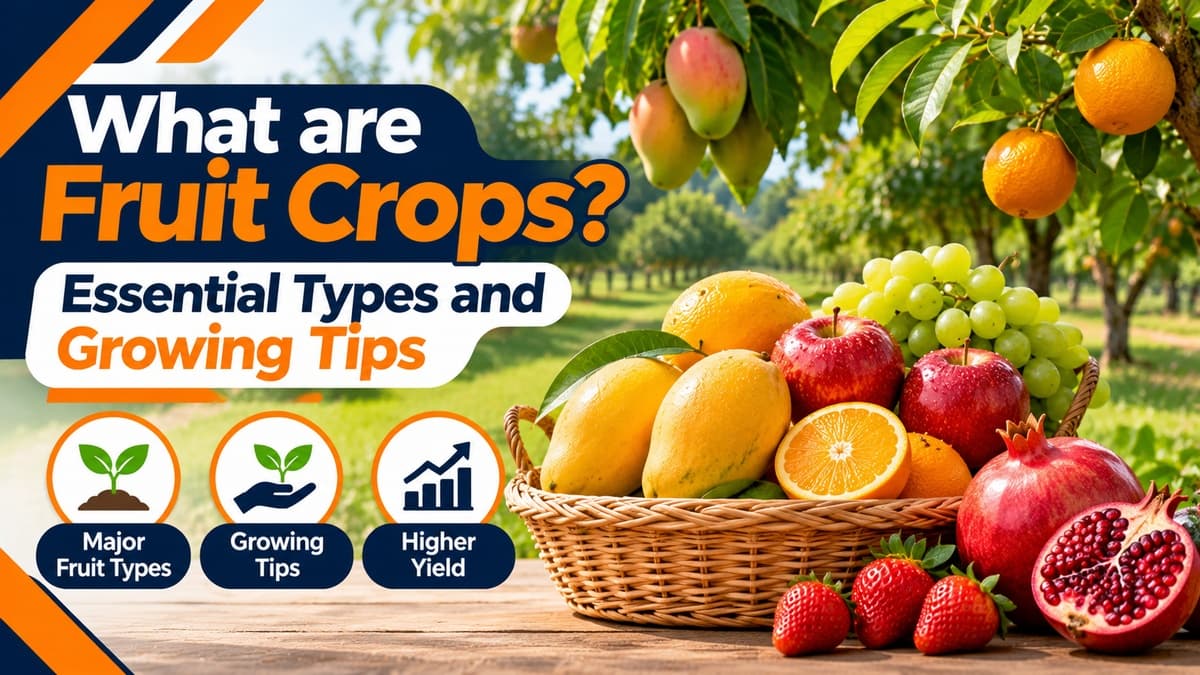
Introduction:
Has you ever bitten into a crisp and juicy apple on a chilly autumn morning? Or have you ever enjoyed the rich and tropical sweetness of a perfectly ripe mango at summer's peak? These fruits are the ultimate prize in a highly specialized branch of agriculture. Before they were fruits.
You are in the right place. If you are looking to understand the mechanics behind the orchard management of fruits. Or you want to build a thriving backyard fruit orchard? Let’s find out about the world of fruit crops. Also explore fruit types and discover strategic growing tips that turn tiny saplings into high-yield powerhouses.
What Are Fruit Crops?
Fruit crops are perennial or annual plant species in botanical terms. Because they develop from flowers in matured ovaries. While they are cultivated specifically for their edible and seed-bearing structure. These types of crops typically consist of edible roots, stems or leaves unlike vegetables. Additionally, fruit crops hold a unique reproductive status in the plant kingdom. Because they are mostly woody perennials. Futhermore planting a fruit crop is a long-term investment that yields dividends for years, or even decades to come.
The Core Types of Fruit Crops:
You must first understand how they are classified to successfully cultivate fruit crops. This crop is divided into four primary categories like climate, temperature tolerance, and physical structure:
1) Temperate Fruits: These types of crops thrive in regions that have distinct four-season climates. Basically they require a specific duration of winter cold which is known as "chilling hours". While these plants want to break their dormancy and trigger spring flowering during cold season.
2) Tropical and Subtropical Fruits: These plants love the heat season and are highly sensitive to frost-like temperatures as well. Because these plants require proper warm and humid conditions to thrive and mature to fruit.
3) Small Fruits and Berries: These fruits are low-growing perennial shrubs or vines. Or they are trailing brambles in some cases. Additionally these types of plants produce delicate and fleshy fruits like berries.
4) Tree Nuts: Nuts are botanically classified as dry fruit crops. While they are often culinary outliers. Therefore, they feature a hard outer shell that protects an edible kernel inside them.
The Vital Purpose of Fruit Crops:
Why do we dedicate millions of hectares of global agricultural land to fruit crops? Because their purpose extends far beyond satisfying a sweet tooth.
1) Nutritional Fortification: Fruit crops are nature's vitamin pills. Because they deliver essential micronutrients and dietary fiber to us. They also have vitamin C and antioxidants that prevent chronic diseases.
2) Economic Engines: Fruits generate significantly higher revenue per acre for farmers compared to traditional cereal crops like wheat or maize. Because they are high-value crops.
3) Environmental Stability: Orchard fruits act like carbon sinks. Because their deep root systems anchor the soil and prevent erosion. While they also improve our local biodiversity.
10 Examples of Fruit Crops:
To give you a clear picture of this agricultural diversity, here are 10 examples of fruit crops spanning different botanical categories:
1) Apple (Malus domestica): The quintessential temperate pome fruit, loved for its crisp texture and long storage life.
2) Mango (Mangifera indica): The undisputed king of tropical fruits, celebrated for its rich, aromatic pulp.
3) Sweet Orange (Citrus sinensis): A subtropical heavy hitter packed with vitamin C and widely used for juicing.
4) Banana (Musa acuminata): A fast-growing tropical herbaceous plant that provides a global dietary staple.
5) Grape (Vitis vinifera): A versatile vine fruit crop used for fresh consumption, raisins, and winemaking.
6) Strawberry (Fragaria × ananassa): A popular small fruit crop that yields quickly, making it a favorite for vertical farming.
7)Peach (Prunus persica): A classic temperate "stone fruit" known for its velvety skin and juicy flesh.
8) Avocado (Persea americana): A unique subtropical fruit crop prized for its high healthy fat content and creamy texture.
9) Blueberry (Vaccinium corymbosum): A perennial shrub crop that thrives in acidic soils and produces antioxidant-rich berries.
10) Almond (Prunus dulcis): A tree nut crop that demands precise Mediterranean climates and provides a highly nutrient-dense nut.
Strategic Growing Strategy of Fruit Crops:
You cannot treat a fruit orchard like a patch of corn or wheat. Success relies on a meticulous, long-term growing strategy:
1) Propagation Precision: While vegetables are grown from seeds, high-quality fruit crops are almost always propagated through grafting or budding. This joins a high-yield scion (the top part) with a disease-resistant rootstock (the bottom part), ensuring the fruit grows true-to-type.
2) Microclimate Alignment: Match your crop to your climate. Planting a tropical mango in a frost-prone valley or an apple tree in a scorching desert will result in failure.
3) Spatial Layout: Design your orchard layout (square, rectangular, or hexagonal systems) to ensure every single tree receives optimal sunlight penetration and adequate airflow.
How to Maximize the Yield of Fruit Crops:
Transitioning from a basic harvest to a bumper crop requires mastering these advanced cultivation techniques:
1) Precision Pruning: Prune your fruit trees during their dormant season. Removing dead wood and opening up the canopy allows sunlight to reach the lower branches, directly boosting fruit size and color.
2) Regulated Irrigation: Fruit crops need consistent moisture, especially during flowering and fruit-set. Implementing drip irrigation delivers water straight to the root zone, reducing evaporation and preventing water stress.
3) Strategic Thinning: When a tree produces too many young fruits, remove the excess. This prevents branches from snapping and ensures the remaining fruits grow larger and more flavorful.
4) Integrated Pest Management (IPM): Combine biological controls (like beneficial insects) with minimal, targeted organic sprays to protect your yields without damaging the local ecosystem.
Key Supporting Facts:
1) Yield Efficiency: Fruit crops yield significantly higher tonnage per hectare compared to grain fields, making them incredibly resource-efficient food sources.
2) Water Management: While fruit trees require deep watering, their established root systems often make them more resilient to short-term dry spells than shallow-rooted seasonal vegetables.
3) Pollination Dependence: Over 70% of fruit crops rely on insect pollinators—primarily bees—to set fruit. Without healthy pollinator populations, orchard yields drop drastically.
The Future of Fruit Crops in Pakistan:
Pakistan's diverse topography, stretching from the snowy peaks of the north to the sun-baked plains of the south, makes it an ideal cradle for fruit cultivation. Currently, fruit crops cover roughly 853.4 thousand hectares across the country.
The crown jewel of Pakistan's fruit industry is the mango. Accounting for roughly 8.5% of global mango production, Pakistan stands proudly as the world's third-largest mango producer. Golden varieties like Chaunsa, Sindhri, and Anwar Ratol are highly sought after in international markets, bringing in vital foreign exchange.
As agriculture shifts toward modern practices, the future of Pakistani fruit crops lies in expanding high-density apple orchards in Gilgit-Baltistan and Balochistan, upgrading citrus processing in Punjab, and adopting modern cold-chain logistics. By minimizing post-harvest losses, Pakistan is positioned to become a dominant global fruit exporter.
Leveraging Digital Marketplaces for Optimized Fruit Nutrition:
To achieve top-tier yields, modern orchard owners are moving away from traditional, imbalanced urea applications and turning toward precise nutrient management. Digital B2B marketplaces like Zarea are transforming how farmers source these critical agricultural inputs in Pakistan. Through platforms like the Zarea Fertilizer Catalog, growers can easily compare and secure essential fruit-enhancing macronutrients—such as Sulfate of Potash (SOP) to improve fruit size, color, and sugar content, or balanced inputs like Sona DAP to promote sturdy root system establishment during early orchard development. By bridging the gap between local growers and high-quality chemical or eco-friendly organic fertilizers, these tech-driven channels empower orchards to hit export-quality standards right from the soil level.
1) Ferti K 30 Percent 3 litre for your fruit plant health.
2) Calinbo Calcium 10w/V 10 litre for high yield.
3) Growphos 10Kg for soil health.
4) HI K Gold 1kg for high quaity fruit.
5) SOP 25 Kg to improve your fruit nutrition.
6) Orbit K 25kg for plants nutritional health.
7) Katalyst Potassium ( K2o ) 30W/V for plant's potassium requirements.
The Bottom Line:
Cultivating fruit crops is a beautiful blend of patience, art, and rigorous science. Whether you are aiming to scale a commercial mango orchard or simply want to pick fresh peaches from your own backyard, the principles remain the same: choose the right variety for your climate, protect your pollinators, and manage your soil with care. With the right strategy, your fruit crops will reward you with sweet abundance for generations to come.
Frequently Asked Questions (FAQ):
What are fruit crops?
Fruit crops are perennial or annual plants cultivated specifically for their edible, seed-bearing structures that develop from the matured ovaries of flowers. Unlike vegetables, which are the vegetative parts of plants (roots, stems, or leaves), fruit crops are primarily woody perennials grown for their sweet or tart reproductive flesh.
How do you classify fruit crops?
Fruit crops are classified into four main categories based on climate and growth habits:
1) Temperate fruits (e.g., apples, peaches) require cold winter chilling hours.
2) Tropical and subtropical fruits (e.g., mangoes, citrus) require warm climates and fear frost.
3) Small fruits and berries (e.g., strawberries, blueberries) grow on low bushes or vines.
4) Tree nuts (e.g., almonds, walnuts) are botanically dry fruits with edible inner kernels.
Why are fruit crops propagated through grafting instead of seeds?
Fruit crops are propagated through grafting to ensure the new trees grow true-to-type, producing identical fruit quality and yield to the parent plant. Planting fruit crops from seeds causes genetic variation, resulting in unpredictable fruit quality, wild traits, and significantly delayed harvesting timelines.
How can farmers maximize the yield of fruit crops?
Orchard owners maximize fruit crop yields by implementing regular dormant-season pruning to improve sunlight penetration, utilizing drip irrigation for consistent moisture during fruit-set, executing fruit thinning to encourage larger fruit sizes, and deploying Integrated Pest Management (IPM) to curb insect damage.