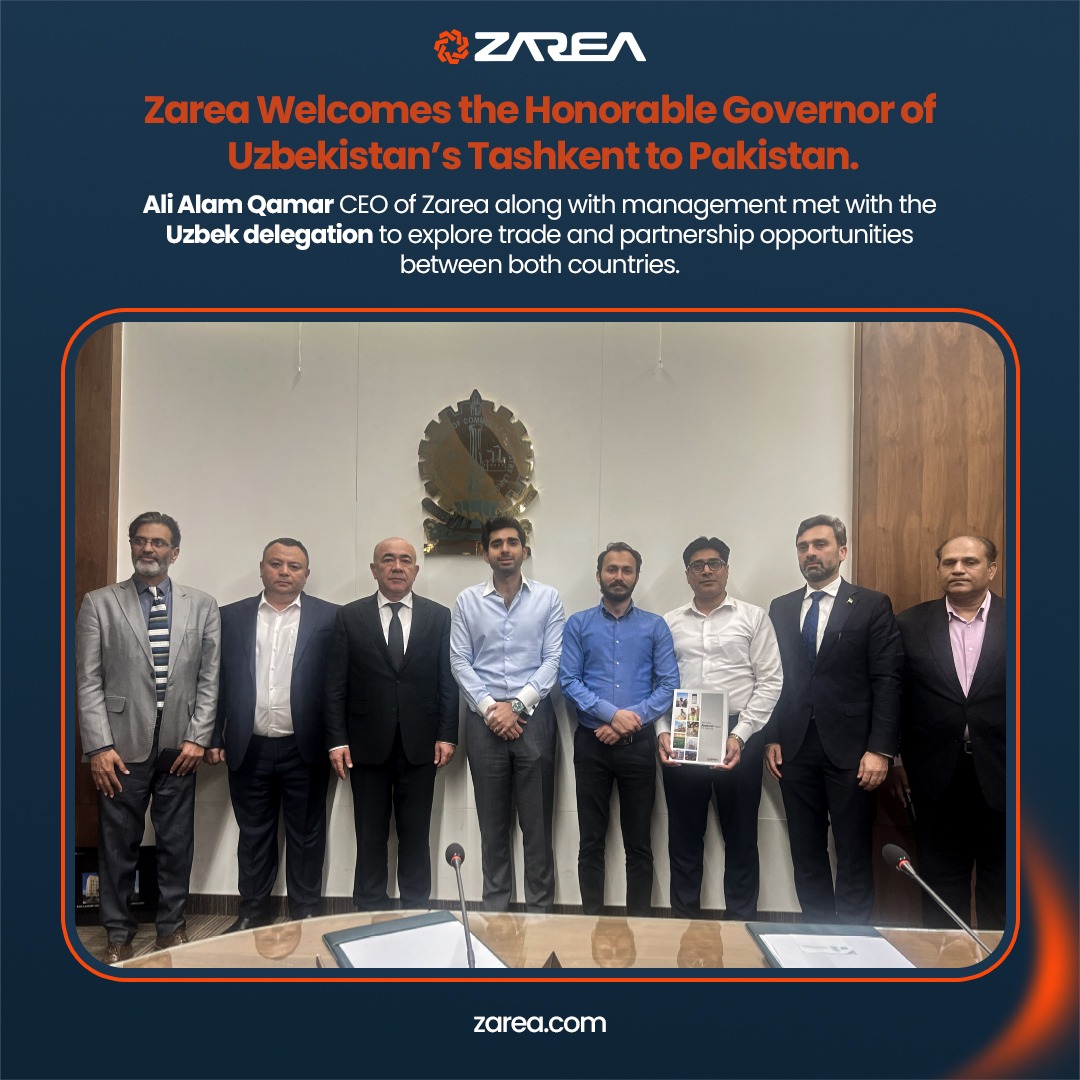
Zarea Welcomes the Honourable Governor of Tashkent, Uzbekistan to Pakistan
Zarea hosts Uzbekistan’s Tashkent Governor to strengthen Pakistan-Uzbekistan trade ties, focusing on agricultural grains, logistics, and global commodity partnerships.
_2026-04-06_09-56-06.png)
Building Bridges in Global Commodity Trade
Business moments are frequently quantified in terms of quantities exchanged, concluded transactions, and enlarged markets. Occasionally, however, a moment occurs that beyond measurements and turns into a representation of something far more. One such occasion was when Zarea welcomed the governor of Tashkent, Uzbekistan; it was a potent symbol of vision, trust, and the common goal of transforming regional trade.
It was more than just a diplomatic visit. It was a confluence of minds dedicated to realising the enormous promise of global commodities trading, logistical innovation, and agricultural grains.
At the center of this event was Zarea CEO Ali Alam Qamar, who was having a serious conversation with the Uzbek delegation alongside the company's senior team. Beyond formality, the conversations were based on a common understanding that cooperation, efficiency, and strategic alliances are the key to the future of commerce.
Explore our Linkedin Post:
A proud moment for Zarea 🇵🇰🤝🇺🇿
We were honored to welcome the Governor of Uzbekistan’s Tashkent during his visit to Pakistan. Ali Alam Qamar - CEO of Zarea, along with the management team, met with the Uzbek delegation to discuss new opportunities for trade collaboration and stronger economic ties between Pakistan and Uzbekistan.
At Zarea, we remain committed to building bridges that enable global commodity trade and strategic partnerships.
Where Agriculture Meets Opportunity:
The foundation of developing nations like Pakistan and Uzbekistan has always been agriculture. Both countries have a long history of producing high-quality crops, hardy farmers, and rich soil. However, despite this strength, the two areas' agricultural commerce has not yet reached its full potential.
Platforms like Zarea can help in this situation by acting as both facilitators and accelerators of change.
The gathering brought to light the enormous potential in the trading of agricultural grains, including rice, wheat, pulses, and oilseeds. Both nations can open up new export routes, stabilise price systems, and provide steady revenue streams for both farmers and traders by matching supply capacities with demand channels.
Short-term profits were not the topic of discussion. It was about creating an ecosystem that makes agricultural value chains more intelligent, transparent, and competitive on a global scale.
Logistics - The Backbone of Modern Trade:
Trade is based on infrastructure rather than just purpose. One of the main topics of discussion was logistics, which is sometimes overlooked but extremely important.
Whether a product arrives at its destination on schedule, in top shape, and at a reasonable price depends on effective logistics. This becomes increasingly more important for agricultural goods, where quality and timeliness are critical.
The concept that logistics is about connecting rather than merely conveyance is consistent with Zarea's vision. Reducing friction at every level of the process is the aim, from digital monitoring and supply chain visibility to warehouse solutions and freight optimisation.
The interaction with the Uzbek delegation looked at ways to improve regional connectivity, especially through commercial routes that connect South and Central Asia. For both importers and exporters, better logistics networks may drastically cut expenses, shorten transit times, and open up new markets.
In this way, logistics becomes a strategic asset rather than just a service.
A New Chapter in Global Commodity Trade:
The world's commodities trade is changing quickly. Transparent marketplaces, real-time data, and digital platforms are replacing traditional processes. International cooperation is now necessary in this new environment.
This change was mirrored in the conversations at Zarea. Both parties understood how critical it was to use technology to improve trade procedures, cut down on inefficiencies, and foster stakeholder confidence.
This new wave of innovation is embodied in Zarea's platform. It gives buyers and sellers access to verified marketplaces, real-time pricing, and smooth transaction procedures by digitising commodities trade. This increases productivity and fosters confidence, both of which are crucial components of international trade.
The gathering emphasised a common goal: to build a more robust, transparent, and connected trade environment that benefits all stakeholders, including farmers, exporters, and legislators.
Strategic Partnerships - The Way Forward:
This moment was really about collaboration.
Building strategic alliances takes time. They demand mutual growth commitment, objective alignment, and trust. All three were evident in Zarea's interactions with the Uzbek delegation.
Geographically situated to link important markets throughout Asia, Pakistan and Uzbekistan are both at a key crossroads. Together, they may expand their export portfolios, open up new trade avenues, and improve their standing in international commodities markets.
This is exactly in line with Zarea's objective, which is to create links between markets, empower stakeholders, and stimulate economic progress.
These collaborations are not exclusive to big organisations or governments. They include the companies, merchants, and farmers who make up the core of the commodities ecosystem. Zarea makes ensuring that progress is sustainable and shared by fostering inclusive possibilities.
Beyond Business - A Shared Vision:
The sense of common purpose was what really set this occasion apart.
Trade volumes and economic statistics were not the only topics of discussion. It was about making a difference—about giving farmers access to better markets, assisting companies in expanding internationally, and supporting the economic growth of both countries.
It was acknowledged that cooperation is essential for resilience in the linked world of today. Collective solutions are needed to address issues including market instability, climate change, and supply chain disruptions.
Together, Pakistan and Uzbekistan are moving closer to creating a more secure and prosperous regional economy.
Zarea’s Commitment to the Future:
One thing became evident as the conference drew to a close: this was a beginning rather than a finish.
Zarea is still dedicated to acting as a catalyst for change in the world's commodity trade. The business keeps redefining commerce via partnerships, technological investments, and efficiency.
The Uzbek delegation's visit is a potent reminder of what may happen when cooperation and vision come together. It supports Zarea's view that connectivity—not only between markets but also between people, ideas, and opportunities—is essential to the future of commerce.
A Moment of Pride, A Vision for Tomorrow:
For Zarea, this joyous moment is a declaration of intent more than just a milestone.
It shows a dedication to strengthening agricultural trade, fostering closer economic relations, and establishing a smooth logistical ecosystem that facilitates international trade. It represents the start of a new era in ties between Pakistan and Uzbekistan, one that is motivated by creativity, confidence, and common goals.
Moments like this serve as a source of inspiration and accountability for Zarea as it moves forward, encouraging it to keep pushing the envelope, creating connections, and influencing the direction of international commodities trading.
Because in the end, genuine success is determined by the relationships we make and the chances we open up for future generations, not simply by development.