Assessing the Ecological Impact of Expanding Mustard Cultivation in Pakistan
Assess the ecological impact of mustard cultivation in Pakistan, examining land use, water needs, biodiversity and sustainable farming practices.
A Case Study on Environmental Sustainability and Agricultural Trade-offs
Introduction - The Growing Importance of Mustard Cultivation
In Pakistan, mustard cultivation has attracted increasing interest. This is due to the nation's efforts to increase edible oil production domestically. Mustard lessens its reliance on imported products. However, it also encourages crops that are tolerant of climate change. On the other hand, mustard contributes to both food security and rural livelihoods. In essence, mustard is a traditional oilseed and is produced in portions of Khyber Pakhtunkhwa, Sindh, and Punjab also.
The environmental impacts of growing mustard production have grown in importance as a policy. Furthermore, the mustard study goes far beyond compare to its financial worth. Especially when you talk about it in light of soil erosion, water shortages, and climate change.
This case study evaluates the expanding mustard cultivation in Pakistan and its environmental implications. We are not only focusing on land use, soil health, and sustainability opportunities. But we're also discussing mustard biodiversity, water consumption and greenhouse gas emissions. It aims to assess whether mustard can be scaled responsibly without compromising ecological balance.
Production Overview and Cropping Systems in Pakistan
Mustard is mostly planted during the Rabi season as a cool-season crop in Pakistan. It is essentially a growing cycle that can last anywhere from 100 to 140 days. Basically, this cycle depends on the variety and climate. Additionally, it is frequently used in cropping systems that rely on cereals. Rice-mustard and wheat-mustard rotations are part of this system. Therefore, these rotations improve land productivity nationwide. However, it also gives farmers an extra source of revenue during winter.
The majority of mustard farming is rain-fed, especially in central and northern Punjab. Unfortunately, supplemental irrigation for mustard growth in dry zones is scarce. It is also appropriate for smallholder farmers because of its very low input needs. These farmers have limited access to mechanized equipment, fertilizers, and water.
Land Use and Biodiversity Implications
Mustard cultivation exerts moderate pressure on land resources from an ecological standpoint. Mustard can be grown on marginal or previously cultivated land unlike crops such as oil palm and sugarcane. Meanwhile, mustard reduces deforestation needs or land conversion. Its inclusion in crop rotations improves land-use efficiency and helps disrupt the pest. Further disease cycles are associated with monocropping.
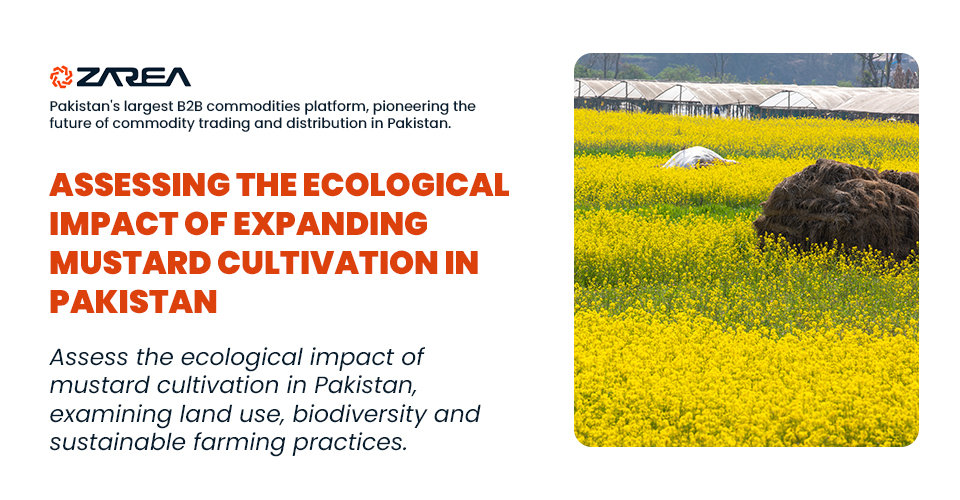
Mustard fields also contribute positively to on-farm biodiversity. While the crop’s bright yellow flowers serve as an important nectar source for pollinators. So particularly honeybees during the winter season when alternative floral resources are limited. However, concerns arise when mustard is cultivated on a large scale using uniform hybrid varieties. If traditional landraces are displaced, such practices can reduce genetic diversity. Further it also weakens ecosystem resilience.
Water Use and Risk of Water Pollution
Water scarcity is a defining challenge for Pakistan’s agriculture sector overall. Further it makes water-efficient crops increasingly valuable. Mustard cultivation is well aligned with this priority. This is because mustard has a relatively low water requirement when you compare it to other oilseeds. Moreover, the crop relies on rainfall in most of its regions. So basically minimal irrigation is needed for mustard during the critical growth stages.
Inefficient irrigation and improper fertilizer application can increase the environmental risks. But on the other hand, the excessive use of nitrogen fertilizers can also lead to nutrient runoff. Moreover this factor also increases the risk of nitrate contamination in nearby water bodies. Although efficient irrigation techniques are applied with balanced nutrient management. Yet mustard demonstrates a favorable water footprint and poses limited water quality risks.
Greenhouse Gas Emissions and Climate Considerations
Greenhouse gas emissions are associated with mustard cultivation. These emissions are mainly linked to nitrogen fertilizer use. Basically farm machinery that uses these fertilizers release nitrous oxide and increases fuel consumption. The overall carbon footprint of mustard remains comparatively low despite these factors.
Modest fertilizer needs to crop's shorter growing season. So these limited irrigation requirements reduce energy use and emissions. Moreover, mustard’s adaptability to cool temperatures and low exposure to extreme heat events. Further these conditions enhance its resilience to changing overall climate conditions. In the end, these characteristics position mustard cultivation as a viable component. That's why this component makes climate-smart agriculture in Pakistan.
Fertilizer, Pesticide Use, and Soil Health
In order to achieve optimal yield, mustard requires moderate nitrogen and sulfur levels. Overapplication of fertilizers can degrade soil health very badly. Moreover it also increases greenhouse gas emissions and contributes to nutrient leaching. Similarly, pest control pressures can encourage excessive pesticide use overall. This may include aphids and diseases like white rust.
This only happens if integrated pest management (IPM) and integrated nutrient management adopt innovative practices. Additionally, chemical inputs can also be significantly reduced, reinvigorating soil health. Mustard’s root system helps improve soil structure efficiently. It's considered that crop residue incorporation greatly enhances soil organic matter. Although, these practices not only contribute to improving soil fertility. Yet they also help with long-term agricultural sustainability.
Energy Use and Post-Harvest Processing Impacts
Energy consumption during mustard cultivation is relatively low. The main reasons behind relatively limited irrigations and moderate mechanization. Therefore, environmental impacts increase during these post-harvest processes. So particularly during oil extraction through mechanical pressing or solvent-based methods.
Additional concerns include fuel use for transportation and wastewater generation at processing facilities. These impacts can be mitigated with energy-efficient technologies. These impacts can also be improved through waste management systems. But renewable energy sources have also been integrated into oilseed processing units.
Environmental Value of Mustard Biomass
With significant ecological and economic value, mustard straw represents an important by-product all over the world. It is not only used as livestock feed after an appropriate treatment. But also as organic mulch or compost in Pakistan. Mustard biomass use improves soil moisture retention and enhances nutrient cycling. It may also reduce the practice of residue burning which causes pollution.
Emerging applications include the use of mustard straw for bioenergy production. This may include biogas generation and biomass briquettes. These practices support circular agriculture and the conversion of waste into valuable resources. Meanwhile, they are lowering air pollution and promoting carbon sequestration in the environment.
Social and Economic Trade-offs
From a socio-economic perspective, mustard cultivation supports smallholder incomes, provides seasonal employment, and contributes to domestic edible oil availability. However, farmers face challenges including price volatility, weather dependence, and limited access to quality seeds and modern inputs.
Balancing economic incentives with environmental safeguards remains essential. Without appropriate extension services and market support, expansion driven solely by short-term profitability may undermine long-term sustainability.
Sustainability Pathways and Best Practices
The ecological performance of mustard cultivation can be strengthened through targeted interventions. Integrated nutrient and pest management reduces chemical dependence, while precision irrigation enhances water-use efficiency. Conservation tillage, residue retention, and the adoption of climate-resilient varieties further improve soil health and productivity.
Policy support, farmer training programs, and investment in research and development are critical to scaling these practices across Pakistan’s mustard-growing regions.
Conclusion
This case study finds that mustard cultivation, when managed responsibly, represents a relatively sustainable oilseed option for Pakistan. Its low water requirement, moderate greenhouse gas emissions, and positive contribution to soil health make it well suited to environmentally conscious farming systems. The productive use of mustard biomass further strengthens its sustainability profile.
With appropriate policy alignment, extension support, and adoption of best agricultural practices, expanding mustard cultivation can support Pakistan’s goals of food security, climate resilience, and rural development while maintaining ecological balance.