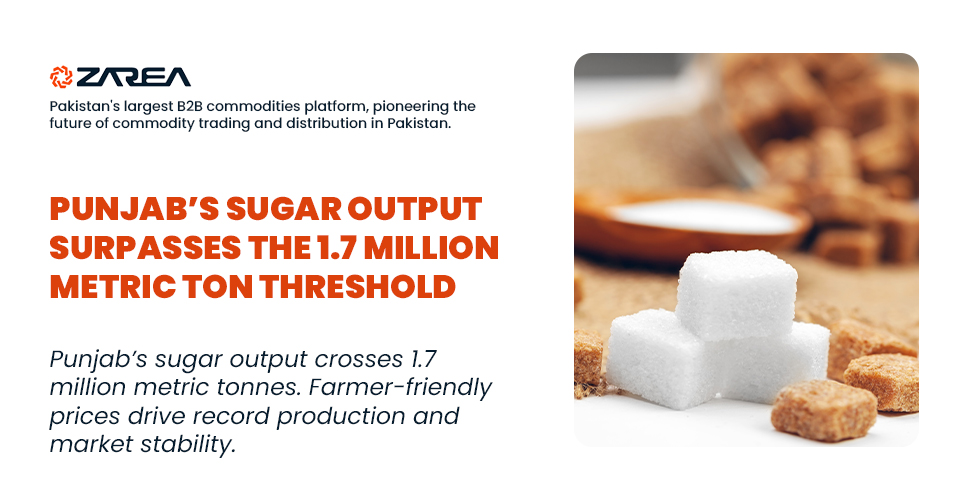
Punjab’s Sugar Output Surpasses the 1.7 Million Metric Ton Threshold
Punjab’s sugar output crosses 1.7 million metric tonnes. Farmer-friendly prices drive record production and market stability.
Executive Summary of A Case Study
During the ongoing crushing season Punjab’s sugar sector recorded a significant milestone. This is happening because the sugar output exceeded 1.7 million metric tonnes (MMT). This achievement reflects a combination of timely policy interventions. Strict regulatory enforcement and improved coordination between the provincial government and sugar mills made this happen. Moreover, farmers also played a vital role on this occasion in order to achieve this milestone.
Although the sugar outcome strengthens the domestic sugar availability in Punjab province. Yet it also underscores the effectiveness of governance-led agricultural market stabilization.
Background: Importance of Sugar Output in Punjab
Punjab is Pakistan’s largest sugarcane-producing province and plays a pivotal role in Pakistan. It is also responsible for ensuring national sugar supply stability. Sugar output is a critical indicator of agricultural productivity, industrial efficiency and farmer welfare. Meanwhile, any fluctuation in production directly affects the retail prices of sugar. Further Farmer incomes and government import or export decisions also affect sugar.
Historically, delays in crushing seasons and payment disputes have constrained sugar output these days. Moreover addressing these structural inefficiencies has remained a policy priority for provincial authorities.
Policy Intervention and Early Crushing Strategy
According to the Secretary of Food Safety and Consumer Protection in Punjab Dr. Kiran Khurshid. She stated that Punjab had adopted strict and timely policy measures. These policies ensured that sugar mills began crushing operations earlier than in previous seasons on November 15. This early start proved decisive in achieving record production.
The Punjab government has imposed penalties of Rs 5 million per day on mills who fail to commence crushing on schedule. This is because of enforcing compliance at all sugar mills. Further this enforcement mechanism discouraged sugar production delays. As it also compelled mills to operate at optimal capacity from the outset of the season.
More than 18.647 million metric tonnes of sugarcane were processed during the season as a result. In this way, the processing directly translates into higher sugar output.
Production Performance and Availability
The province produced over 1.712 million metric tons of sugar. So sugar production surpassed the widely watched 1.7MMT threshold. This figure does not include carry-forward stocks of 112,116 metric tonnes of sugar. Further these statistics were available at the beginning of the season.
Total sugar availability in Punjab has therefore reached approximately 1.824 million metric tonnes. Of this volume:
790,638 metric tonnes have already been released into the market
1.033 million metric tonnes remain in strategic reserves
This balance between market supply and reserves has helped prevent sudden price volatility and ensured uninterrupted availability for consumers.
Impact on Farmer Payments and Rural Economy
The increase in sugar output is a key dimension which has been having a positive impact on sugarcane growers. Moreover, Dr Kiran Khurshid confirmed that sugar industry had made record payments exceeding Rs. 165 billion. Further these payments cover 99.84% of the total farmer dues in the 2026 season. This mark is a sharp improvement compared to previous years' seasons. In previous seasons, payment coverage stood at approximately 85%.
The government has also raised the official sugarcane purchase price to Rs. 436 per 40 kilograms. This purchase price was up from Rs. 387 per 40 kilograms last year. Meanwhile this increase in sugar production reflects a farmer-centric policy approach. Moreover this approach is aimed at ensuring fair returns amid rising input costs.
Timely payments and high procurement prices have strengthened farmer confidence and improved liquidity in rural areas. These timely payments have also encouraged sustained sugarcane cultivation.
Market Stability and Price Implications
Higher sugar output has contributed to and stabilized domestic sugar prices from a market perspective. Meanwhile the availability of adequate stock has reduced speculative pressure. Moreover, sugar availability has also limited the need for emergency imports. The provincial government has retained flexibility in responding to demand fluctuations or unforeseen supply disruptions. The provincial government also maintains sufficient reserves of sugar.
This outcome is particularly important given Pakistan’s broader inflationary environment. This is the environment where food prices have remained a sensitive political and economic issue.
Comparative Performance and Governance Lessons
Punjab’s performance stands out for three key reasons as compared to previous seasons:
Early operational timelines, ensuring maximum cane processing
Strict enforcement mechanisms, reducing non-compliance by mills
Improved farmer-mill coordination, resulting in near-total dues clearance
This case study highlights how governance-driven reforms about sugar. As these reforms can deliver tangible improvements in agricultural output without direct fiscal subsidies.
Risks and Forward Outlook
Although the strong sugar output figures show, several risks remain. Yet, climate variability, water availability and rising production costs could affect future sugar yields. Moreover, sustained oversight of sugar is required in order to ensure that sugar mills continue to make timely payments to farmers. So that sugar reserves are managed transparently throughout Punjab.
Looking ahead, policymakers may need to balance surplus management with export considerations. Meanwhile safeguarding sugar's domestic price stability.
Conclusion of the Case Study
Punjab’s sugar output surpasses the 1.7 MMT threshold. This threshold also represents a notable success in agricultural governance and market management. It also indicates that through early crushing, strict enforcement and farmer-friendly pricing policies can make a good market. If the province has enhanced sugar production, stabilized its markets, and strengthened rural incomes, so Punjab grow faster.
This case demonstrates that disciplined policy execution and accountability mechanisms can significantly improve sugar outcomes. Pakistan’s agri-industrial sectors also offer a replicable model for other provinces and crops.