Agricultural Machinery in Pakistan: Types and How to Choose
Meta description Explore agricultural machinery in Pakistan, including tractors, farm equipment, 2026 price examples, and tips to choose the right machines for your farm.
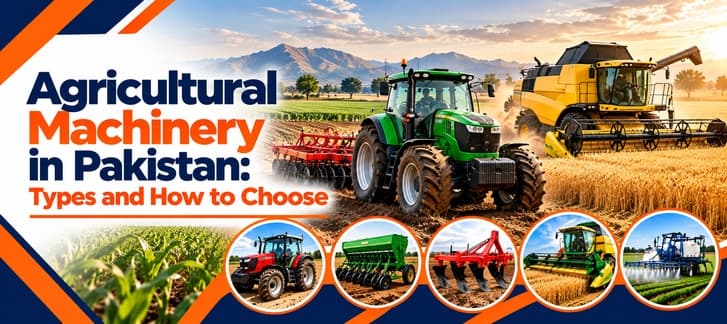
Agricultural machinery is anything that does the heavy, repetitive work on a farm: preparing soil, sowing, moving water, spraying, harvesting, threshing. People also call it farm machinery, agri farm machinery or farm equipment.
At one end you’ve got a 30 HP tractor pulling a cultivator. At the other, a combine harvester or a solar tubewell. What a farm actually needs depends on its size, its crops, and how much work it can hire in instead of owning.
Here we go through the main categories used in Pakistan, dated price examples for tractors and implements, the small machines that suit most farms, and where precision tools and bigger commercial equipment come in. Every price comes from a published list with a date on it. Treat it as a reference point and ask a dealer for today’s quote.
Agricultural machinery in Pakistan includes tractors, cultivators, ploughs, seed drills, sprayers, irrigation pumps, threshers and combine harvesters. These machines help farmers prepare land, plant crops, manage irrigation and harvest produce.
The right equipment depends on farm size, crop type, available budget and whether hiring machinery is more economical than owning it.
Mechanization in Pakistan: Where Things Stand
Pakistan has plenty of tractors but not much power per acre. A 2016 review in the CIGR Journal counted about 0.94 million tractors, which works out to roughly 0.84 hp per acre. FAO recommends 1.0.
The same review found that holdings under 2 hectares make up about 85% of the total. The numbers are a few years old, but the picture hasn’t changed much: small farms, mid-sized tractors, and a lot of shared or hired equipment.
Main Categories of Agricultural Machinery
Machinery is usually grouped by the job it does. On a Pakistani farm that comes down to seven groups.
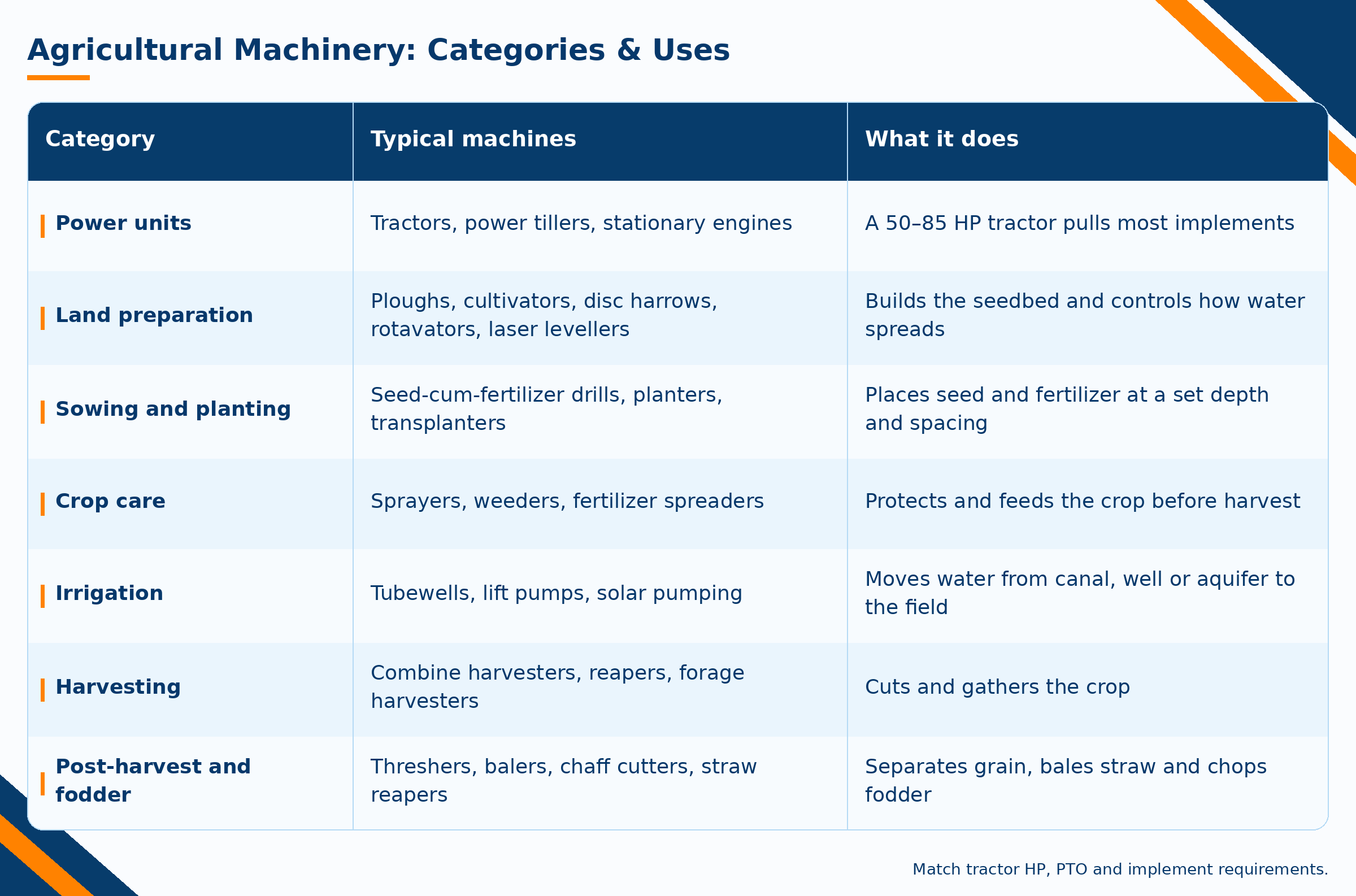
A drill or planter is only as good as what you put in it. If you buy seed in bulk, compare options in the seed category before sowing season starts.
Sprayers and spreaders handle crop care.
Granular fertilizers like urea and DAP go through a spreader or drill best when the grade and packing are uniform, so check the product spec before you set the machine.
Irrigation is where things have changed fastest. The 7th Agricultural Census 2024 counted 959,865 solar pumps, 52% of all tubewells and lift pumps in the country. Diesel units dropped 36% since 2004, to 530,500, as ProPakistani reported.
Punjab leads, with 862,238 solar tubewells against 331,059 on diesel. If you’re planning the switch, start with the solar category. Punjab’s government also offers a PKR 500,000 subsidy on a 10 kW system through its tubewell solarization programme, but eligibility rules apply, and they change, so check the current terms.
Harvest and post-harvest are where mechanization runs deepest. The same 2016 review put thresher sales at 20,000 to 30,000 units a year and described cereal threshing as close to 100% mechanized. Balers and straw reapers carry that on to fodder and residue, so wheat straw leaves the field as something you can sell.
Local Pricing Examples (Pakistan)
These are published list or invoice prices for specific dates. They aren’t what a dealer will quote you on the day. Premiums, delivery, and waiting time all change the final number.
Tractors
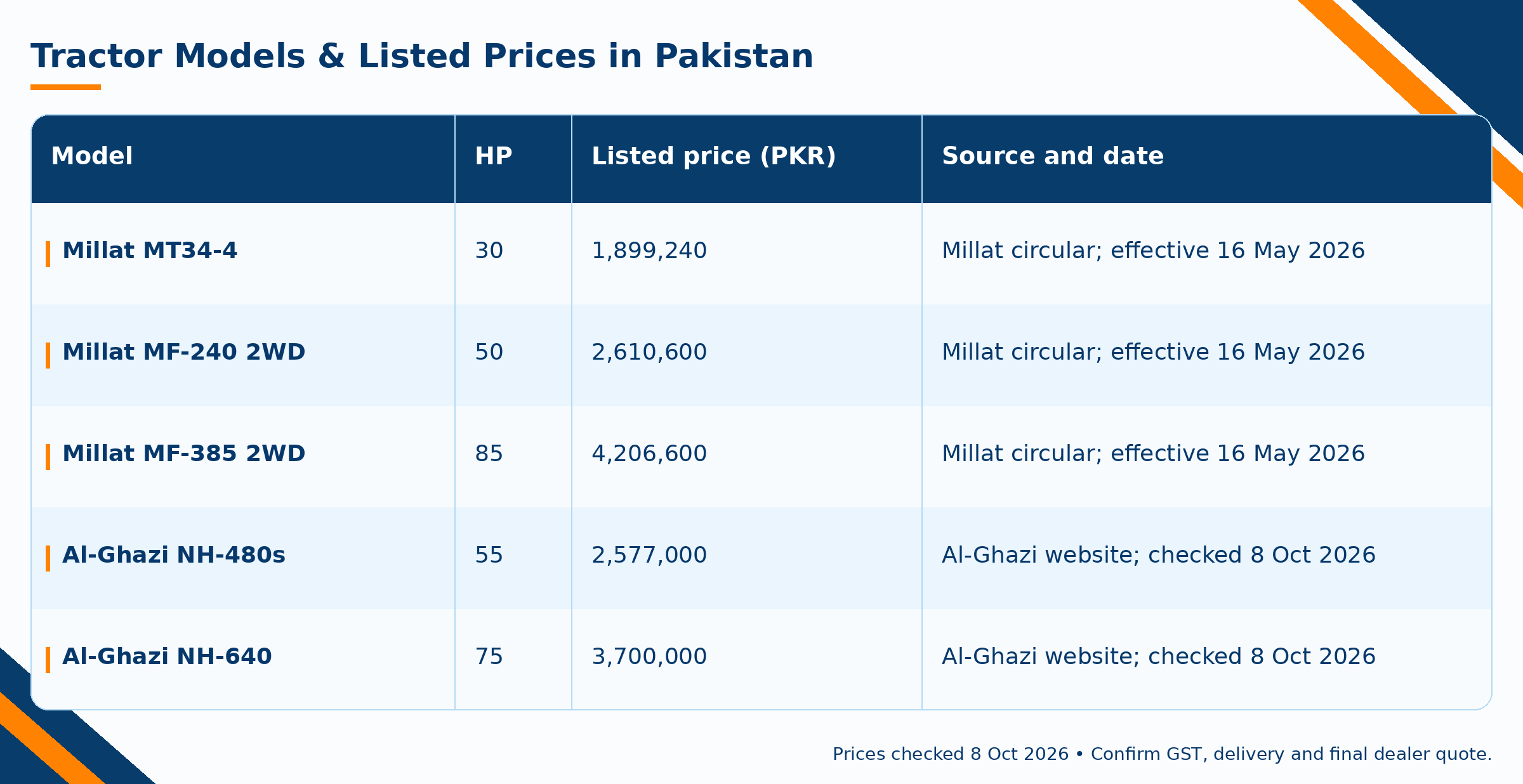
The tractor figures come from Tractors.com.pk, updated on 4 October 2026, which compiles company invoice and booking rates. It notes that market rates can differ. Imported brands like YTO move with the dollar, so their prices swing more than locally assembled tractors.
Implements
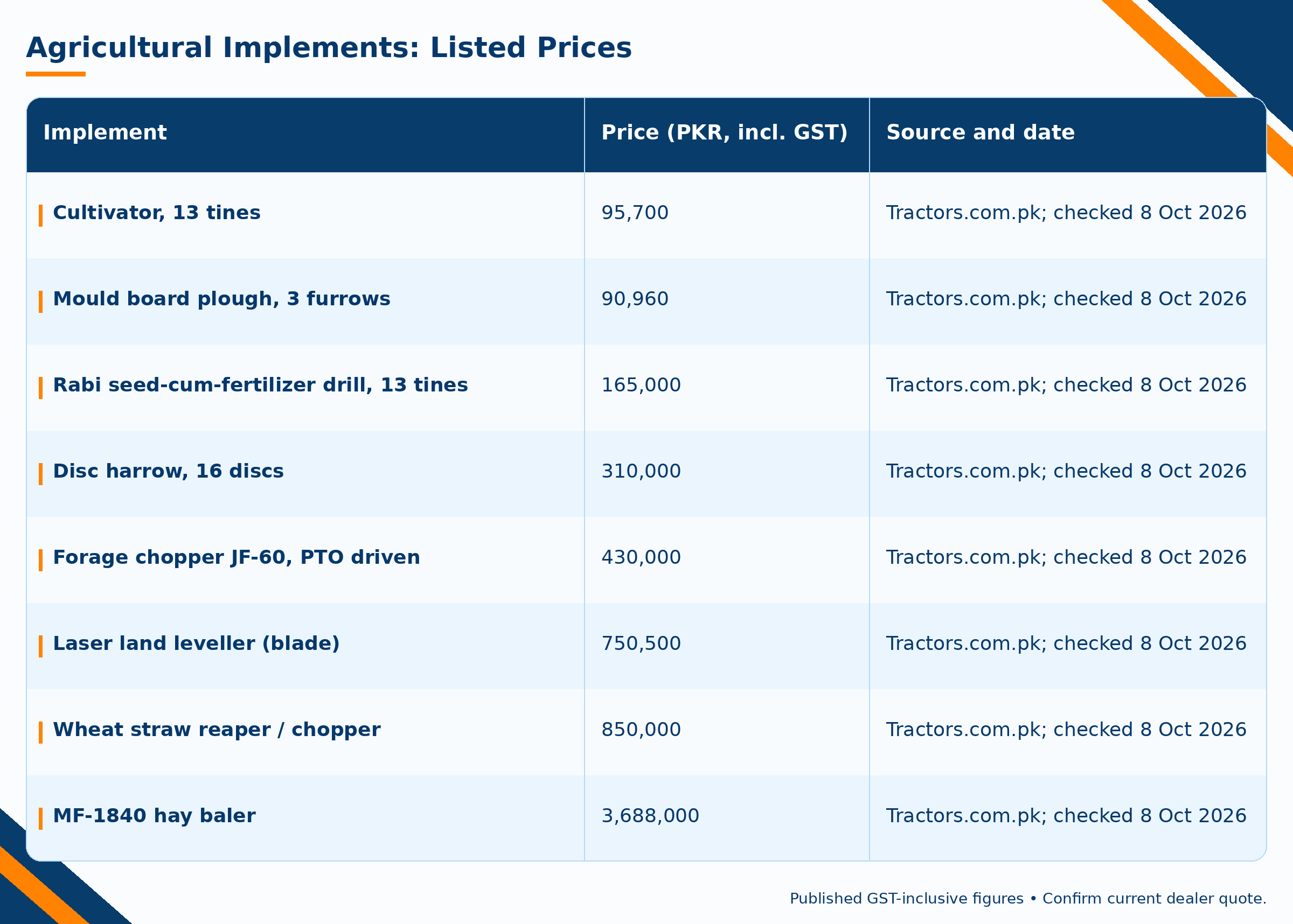
Implement prices come from Millat’s list, updated 18 April 2026. We couldn’t find a current, dated Pakistani price list for threshers, sprayers or rotavators, so we’ve left them out rather than guess. Ask two or three local makers for written quotes.
For context, tractor sales were 1,052 units in August 2026, up 6% on last year, with Millat at 809 and Al-Ghazi at 243 (Intermarket Securities data, reported by TechJuice). Across July to January of FY26, sales were 15,434 units against 20,158 a year earlier, about 23% lower, according to PAMA data covered by Profit.
Top 10 Small Agricultural Machinery in Pakistan
Nobody publishes sales rankings for small machines in Pakistan, so this isn’t one. It’s ten machines that work on small and medium farms, which is most farms here. Prices appear only where we found a dated listing.
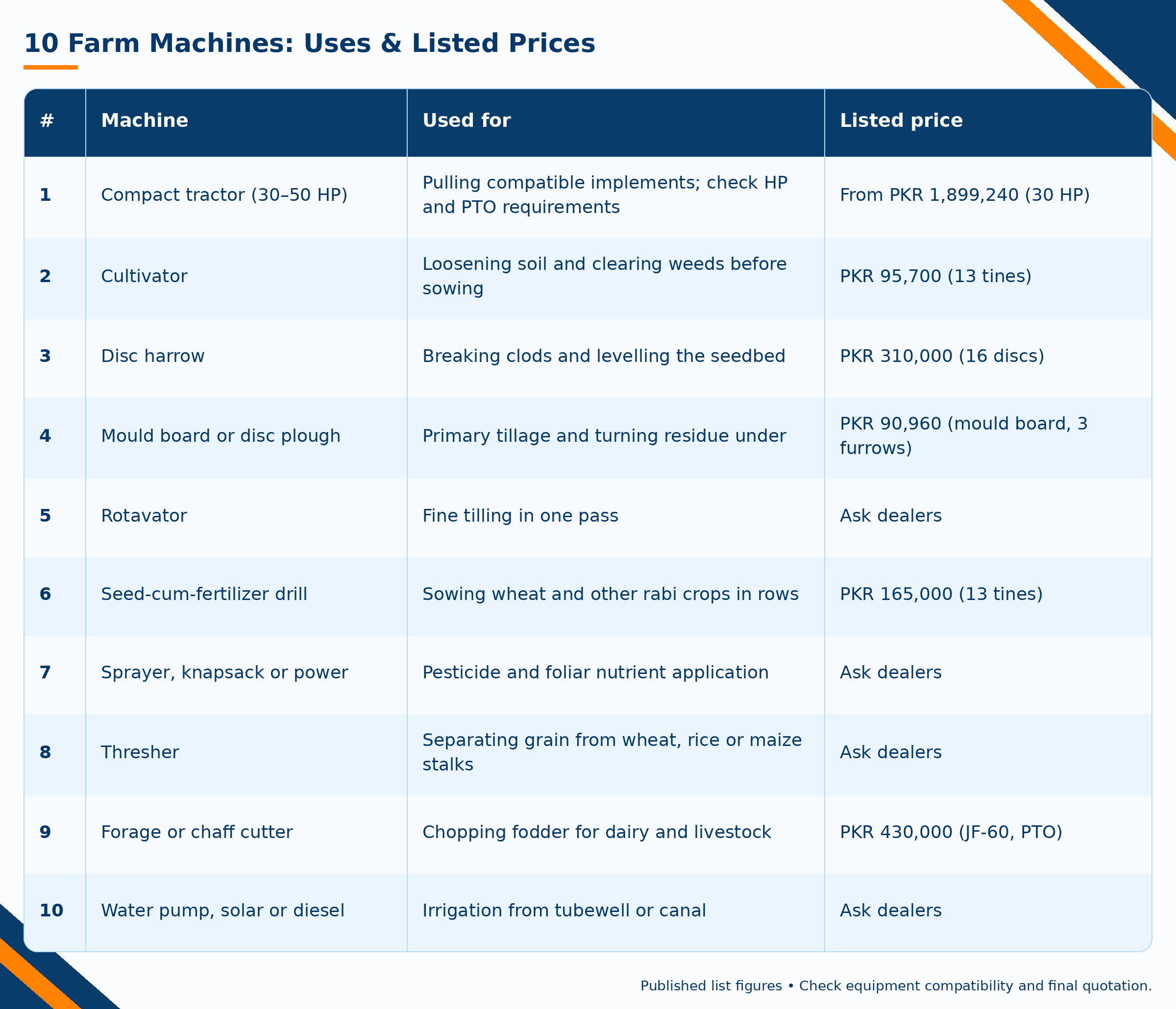
Small farms rarely own all ten. A Food Policy study of 350 rice-wheat farmers in Punjab (Ali et al., 2018) found that 57% had access to laser land levelling, and that service providers played a big part in that. For machines you use a few days a year, hiring per acre is often the practical answer.
Precision Agriculture and Agriculture Innovations
Precision agriculture means using GPS, sensors, and automation to treat each part of a field according to what it needs. The US Government Accountability Office gives auto-steering for planting and activity monitors for dairy cows as examples, and warns the technology can be complex and expensive to start with (GAO, January 2024).
In Pakistan, the best-proven precision machine is much older: the laser land leveller. A survey of ten Punjab districts in 2011–12 found irrigation water savings of 31% per hectare from laser levelling, 49% from zero tillage and 40% from bed-furrow planting.
A more recent comparative trial reported 15–25% less irrigation water in Pakistan, with wheat yields rising from 3,800 to 4,550 kg per hectare. Those are survey and trial results, not guarantees. Soil type and operator skill both matter.
The blade alone lists at PKR 750,500 in Millat’s April 2026 list. At that price, hiring levelling as a service makes more sense for most small farms than buying. Inputs follow the same logic: applying fertilizer based on a soil test means you don’t pay for nutrients the field doesn’t need.
Commercial Agriculture: Machinery for Larger Operations
Commercial growers buy differently. They run bigger tractors, balers, forage harvesters, and combines, and they care more about hours of use than the purchase price. An 85 HP Millat MF-385 lists at PKR 4,206,600, a hay baler at PKR 3,688,000, and a maize-head forage harvester at PKR 898,000 (Millat and Tractors.com.pk lists, 2026).
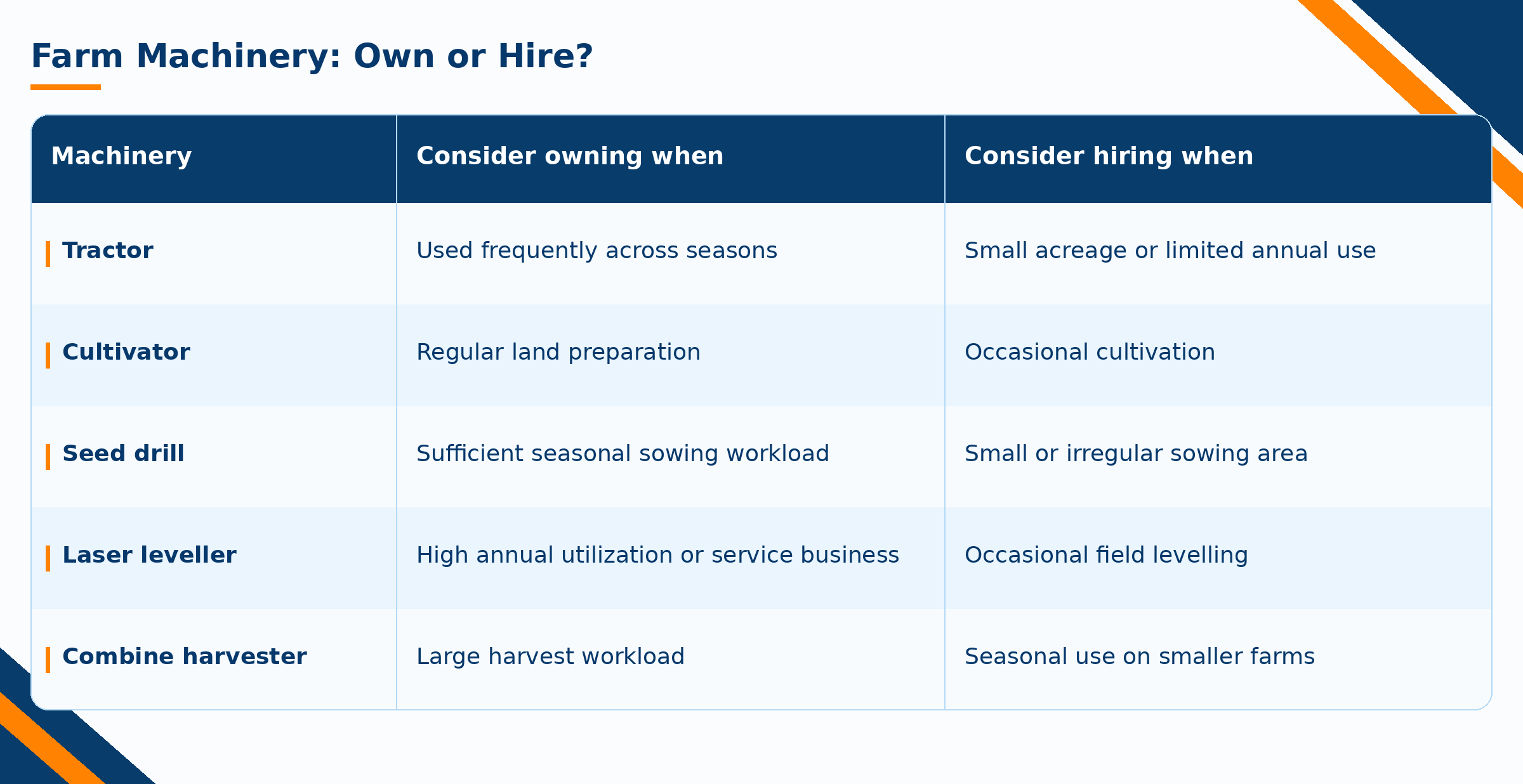
Local makers are moving up the range too. Millat’s 2026 annual report lists the sale of combine harvesters as a milestone for the year. For any big piece of agricultural farm machinery, our view is simple: own the core tractor and drill, and hire the specialist machines.
Break-even hours are annual ownership cost (depreciation, interest, fuel, repairs, and operator) divided by the hourly hire rate. If you won’t use the machine for more hours than that, hire.
A combine turns a standing crop into a commodity, and the crop price decides how fast it pays back. Wheat, for instance, is listed in bulk on Zarea.
Agricultural Commodities and Machinery Demand
Machinery demand follows farm income, and farm income follows weather and crop prices. Between July and September 2025, after floods hit rice and cotton areas, farmers bought 2,981 tractors.
That’s 43% fewer than the 5,206 a year earlier, according to PAMA data reported by Arab News. If you’re timing a purchase, keep an eye on the crops you sell. Zarea’s daily price page follows commodity prices, and it’s worth checking next to any machinery quote.
What Owning Farm Machinery Really Costs
The sticker price is only part of the bill. Add up financing or interest, diesel and lubricants, repairs and spare parts, operator wages, and the days a machine sits idle before you compare models. Diesel and oil are the running costs you can’t dodge, and they’re one reason irrigation has swung to solar so quickly.
How to Choose the Right Farm Equipment
Match the tractor to the work. Most implements on a small farm need 50–60 HP. More power than your implements use just burns extra fuel.
Start with the job, not the brand. List what you do each season and how many acres it covers before you look at models.
Check parts and service. A machine with a dealer nearby beats a cheaper one that waits a month for parts.
Hire before you buy. Rent a thresher, leveller or harvester for a season and count the hours you really use it.
Get quotes in writing, with the price date, delivery cost, and warranty.
The Future of Agriculture in Pakistan
Three trends already show up in the data. Irrigation is moving from diesel to solar. Precision tools reach small farms mostly through service providers, the way laser levelling did.
And crop residue is turning into a product: straw and husk that used to be burned or left in the field now feed boilers and kilns, a shift we cover in agri waste-to-energy. How fast each one spreads depends on credit, subsidies, and the price of the crops that pay for the machines.
Frequently Asked Questions
What types of machines are used in agriculture?
Agricultural machines are grouped by the job they do: power units like tractors, land preparation tools like ploughs and cultivators, sowing machines like seed drills, crop care equipment like sprayers, irrigation pumps, harvesting machines like combines and reapers, and post-harvest machines like threshers and balers.
What are the top 10 small agricultural machinery in Pakistan?
For small and medium farms, the usual ten are the compact tractor, cultivator, disc harrow, plough, rotavator, seed-cum-fertilizer drill, sprayer, thresher, fodder cutter, and water pump. It’s a practical list, not a sales ranking, because no public data ranks machines by sales in Pakistan.
What are some farm machinery?
Tractors, ploughs, cultivators, rotavators, seed drills, sprayers, laser land levellers, combine harvesters, threshers, balers and irrigation pumps are the common ones. Each handles one stage of the crop cycle, from preparing the soil to storing the harvest.
What is the best equipment for farming?
There isn’t one, because it depends on farm size, crop, and budget. For most small Pakistani farms, a 50–60 HP tractor with a cultivator, seed drill, sprayer and thresher covers the basics, and laser levelling is worth hiring in. Bigger commercial farms add balers, forage harvesters or combines once the acreage justifies them.
Wrap-Up
For most Pakistani farms, the right agricultural machinery starts small: a 50–60 HP tractor, a cultivator, a seed drill, a sprayer and a thresher, with laser levelling hired in. Go bigger only when your acreage and crop income can carry it.
Use dated prices, get quotes in writing, and count running costs, not just the purchase price. That’s what separates a machine that pays for itself from one that sits in the shed.