Energy Crisis in Pakistan | Rs1,225 Billion Debt Crisis Addressed
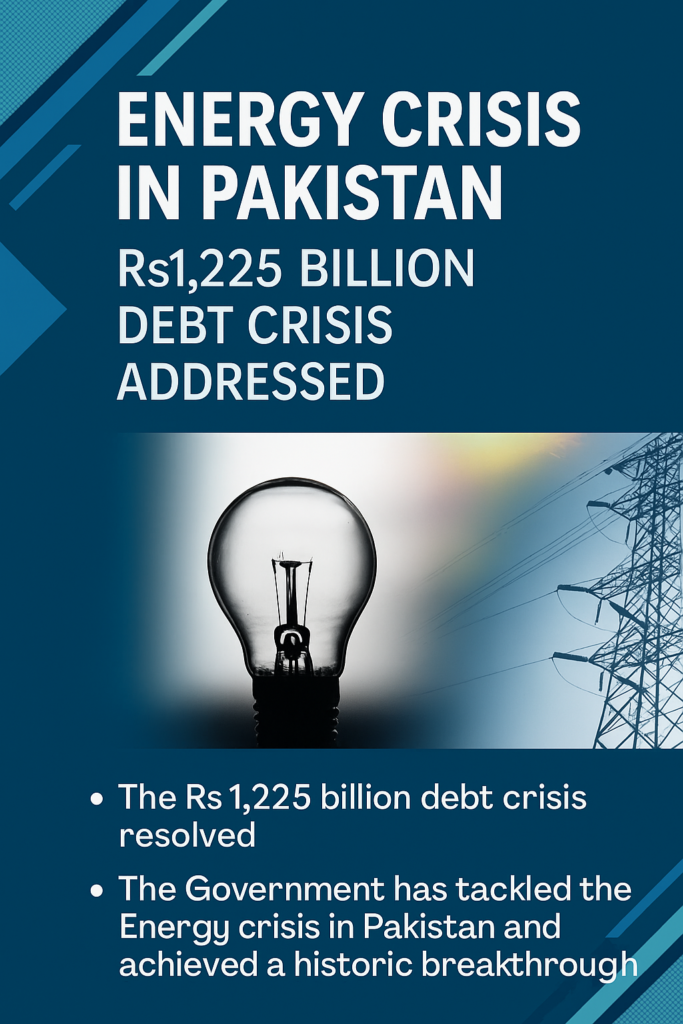
The Rs 1,225 billion debt crisis resolve. The Government has tackled the Energy crisis in Pakistan and achieved a historic breakthrough.
Introduction – Energy Crisis in Pakistan:
Pakistan’s energy dilemma is not a recent development. Decades of inadequate infrastructure investment, dependence on imported fuels, line failures, theft, and late payments across the supply chain are its main causes. Fundamentally, power distribution companies (DISCOs) incur cyclical debt when they are unable to collect full payments from customers as a result of theft and inefficiency. These deficiencies lead to unpaid invoicing from power generators, which delays fuel supplier payments. This ultimately results in a vicious circle of mounting liabilities that choke the sector.
In recent years, circular debt has surpassed trillions of rupees according to records. This dangerous debt undermines the energy supply’s sustainability and deters more investment. Meanwhile the Pakistani government tries harder to fill budgetary shortfalls with subsidies. Moreover, the consumers frequently experience power interruptions further taxing the public coffers.
The Rs1,225 Billion Debt Restructuring:
In September 2025, the Government of Pakistan declared electricity industry debt had been addressed. Additionaly, they had been successfully restructured to the tune of Rs1,225 billion. The Prime Minister’s Task Force on Power, the Ministry of Energy, the State Bank of Pakistan (SBP), the Pakistan Banks Association (PBA), and 18 partner banks worked together to achieve this historic breakthrough.
Two essential elements are involved in the restructuring:
Restructuring Rs660 billion in current loans: This action improves budgetary flexibility and relieves repayment demands on the government.
New funding of Rs565 billion: By enabling the clearance of past-due payments to independent power producers (IPPs), this cash infusion would boost energy providers’ confidence and guarantee stability in the production of electricity.
The fact that this endeavour does not place an additional burden on customers is what makes it so noteworthy. Repayments would instead be covered by the Rs3.23 per unit fee that is already a part of power rates. This strategy strikes a compromise between public affordability concerns and the government’s economic responsibilities.
Institutional Collaboration and Leadership:
The accomplishment is institutional as well as monetary. It emphasises how well regulators, financial institutions, and government agencies work together. The policy leadership was supplied by the Prime Minister’s Task Force, which was led by Sardar Awais Ahmad Khan Leghari, the Minister of Power. The smooth implementation was maintained by top officials, including Finance Minister Senator Muhammad Aurangzeb and Prime Minister on Privatisation Advisor Muhammad Ali.
The Pakistan Banks Association and the State Bank of Pakistan, led by Governor Jameel Ahmad, were instrumental in providing anchor funding, demonstrating faith in the future of the energy industry. The financial sector’s faith in a restructuring model that guarantees repayment discipline while releasing liquidity for other sectors of the economy, such as housing, education, healthcare, small and medium-sized businesses (SMEs), and agriculture, is demonstrated by the participation of 18 partner institutions.
to view product listings, place your bulk buy order, and obtain the most latest pricing. Go to Zarea today! the largest business-to-business (B2B) commodities marketplace in Pakistan, setting the standard for future commodity distribution and trade in the nation.
Broader Implications for the Energy Sector:
In addition to being a vital first step in stabilising the power industry, the effective settlement of this debt has wider ramifications for Pakistan’s energy problem.
Opening Up Fiscal Space:
In order to shift funds to other productive sectors, the government restructured sovereign guarantees totalling Rs 660 billion. Reviving economic development and relieving the strain on public finances require this.
Bringing Back Investor Trust:
Resolving past-due payments to IPPs will increase energy producers’ confidence in the government’s ability to perform its obligations. It is anticipated that Pakistan’s pressing need to diversify its energy mix would draw both domestic and foreign investment in energy projects, particularly those using renewable energy.
Making Certain Energy Security:
Energy security is directly impacted by addressing circular debt. IPPs can preserve fuel supplies and generating capacity with better cash flows, lowering the possibility of blackouts and energy shortages that interfere with day-to-day operations and business operations.
A Move in the Direction of Sustainability:
Financial restructuring opens the door to long-term changes. Additionally, it also provides short-term respite as well. On the other hand, with regained trust in the electricity industry gives an extra hand. It is now easier to achieve efficiency improvements, investment in renewable energy and improved governance.
Remaining Challenges in the Energy Crisis in Pakistan:
Even with this development, Pakistan’s energy situation is far from resolved. Stability is nevertheless threatened by structural problems. According to records, many distribution firms continue to experience a significant rate of line losses and electricity theft. These firms compromise their collective income ability. Meanwhile the reliance on imported fuels is the main reason that the industry is vulnerable to global energy costs fluctuations. Additionally, the slow adoption of renewable energy sources hinders energy diversification.
Furthermore, the use of surcharges to cover budgetary shortfalls runs in the danger of maintaining power rates. On the other hand, a huge number of customers are fully excluded from any kind of benefit. Especially industrial and agricultural sectors customers are paying the price for these surcharges. Moreover higher energy prices will unfortunately reduce competitiveness and raise inflationary pressures if they are not controlled.
Additionally, political unrest and difficulties with governance frequently cause changes to fail. Maintaining success will depend on making sure that policy actions are consistent throughout administrations.
Energy Crisis in Pakistan – The Way Forward:
Pakistan must undertake extensive changes that address both financial and operational inefficiencies if it hopes to build on the success of the Rs1,225 billion reorganisation.
Improving the Effectiveness of Distribution:
Smart metering methods must be used in order to lower line losses and increase revenue collections. Further, the infrastructure must be upgraded and theft must be stopped for smart effectiveness in energy distribution.
Encouraging the use of renewable energy:
Greater reliance on solar, wind, and hydropower can improve sustainability over time. It decreases total tariffs and the dependence on expensive imported fuels also lessens.
Promoting Involvement of the Private Sector:
Pakistan should foster an atmosphere that encourages private sector investments in electricity generation and distribution now that investor confidence has returned. This process may be sped up with transparent incentives and rules.
Increasing Governance Strength:
To stop circular debt from resurfacing, institutional reforms, better corporate governance of DISCOs, and independent regulatory supervision are essential.
Affordability and Cost Recovery in Balance:
Tariffs must accurately represent the cost of power, but subsidies should only be given to those that are most in need, not to all households, to maintain financial restraint without sacrificing equality.
Final Thoughts:
An important step in resolving Pakistan’s energy problem has been taken with the resolution of the Rs1,225 billion circular debt crisis. This resolution demonstrates institutional cooperation’s strength. It’s also reorganized with careful financial oversight and a budgetary restraint dedication. Additionally, this accomplishment sets the stage for a more resilient and sustainable energy industry. Even if there are still obstacles to overcome, it will help.
Pakistan’s forward path necessitates striking a careful balance between renewable energy and boosting. Meanwhile it’s preserving supply security, continuing reforms in the political face and economic unpredictability. Further it’s also guaranteeing affordability for customers while attaining cost recovery. Additionally if these actions are consistently taken in the right way. Then the nation may transform its protracted energy crisis into a chance of stability and progress.