Conservation Agriculture: 3 Principles, Types and Examples
Learn conservation agriculture, its three principles, soil conservation methods, benefits, challenges and practical farming techniques in Pakistan.
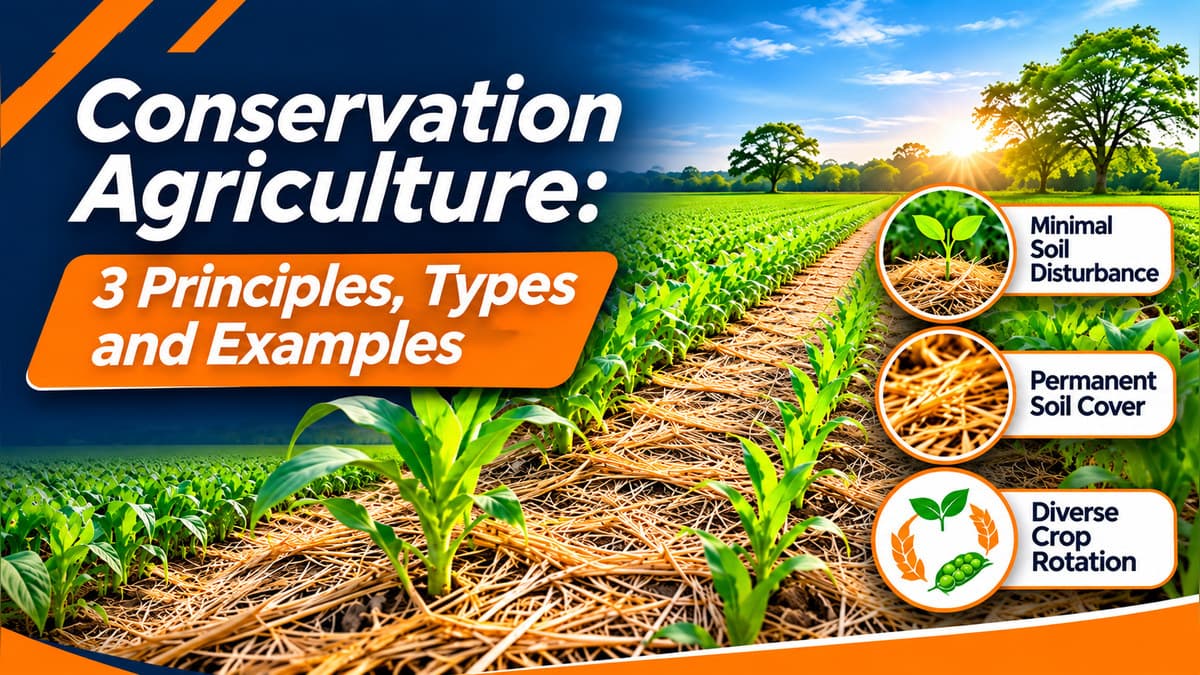
Conservation agriculture is a farming approach built on three linked ideas: disturb the soil as little as possible, keep it covered with crop residue or living plants, and grow a mix of crops instead of the same one every season.
The FAO counted about 205 million hectares farmed this way in 2018/19, roughly 15% of the world’s cropland.
In Pakistan, the best-known example is wheat sown straight into rice stubble with a Happy Seeder, with no ploughing and no burning.
This guide explains the three principles, how farmers apply them in Pakistan, what the evidence says about water and costs, and where the approach can go wrong.
It also gives a practical way to test the system on one field before making a larger investment.
Quick Answers
1) What it is: a farming system with minimum soil disturbance, permanent soil cover, and crop diversification.
2) Scale: about 205 million hectares in 102 countries in 2018/19, up 93% since 2008.
3) Pakistan example: wheat sown with a Happy Seeder into rice residue in the rice-wheat belt of Punjab.
4) Water: some studies report irrigation savings from zero tillage and field levelling, but results depend on crop, soil, rainfall, and how water is measured.
5) Catch: weeds, a tight sowing window, and seeder costs are real problems. An early Punjab survey recorded 14% disadoption of zero tillage.
What is Conservation Agriculture?
It is more than skipping the plough. A farmer needs three things working together: limited soil disturbance, a protective layer of crop residue or living cover, and a varied crop sequence.
Zero-till wheat without cover or rotation is a useful practice, but not the complete system.
It grew from a simple observation: ploughing speeds up the loss of soil organic matter, dries the topsoil, and leaves bare ground exposed to sun and rain.
Brazil began no-till farming in the early 1970s, and the practice has since spread across the Americas, Australia, Central Asia and South Asia.
Kassam and colleagues, in the most-cited global count, put the area at 180.4 million hectares in 2015/16 and 205.4 million in 2018/19.
The Three Principles of Conservation Agriculture
Every definition rests on the same three principles. The numbers below are the thresholds researchers use when they count an area.
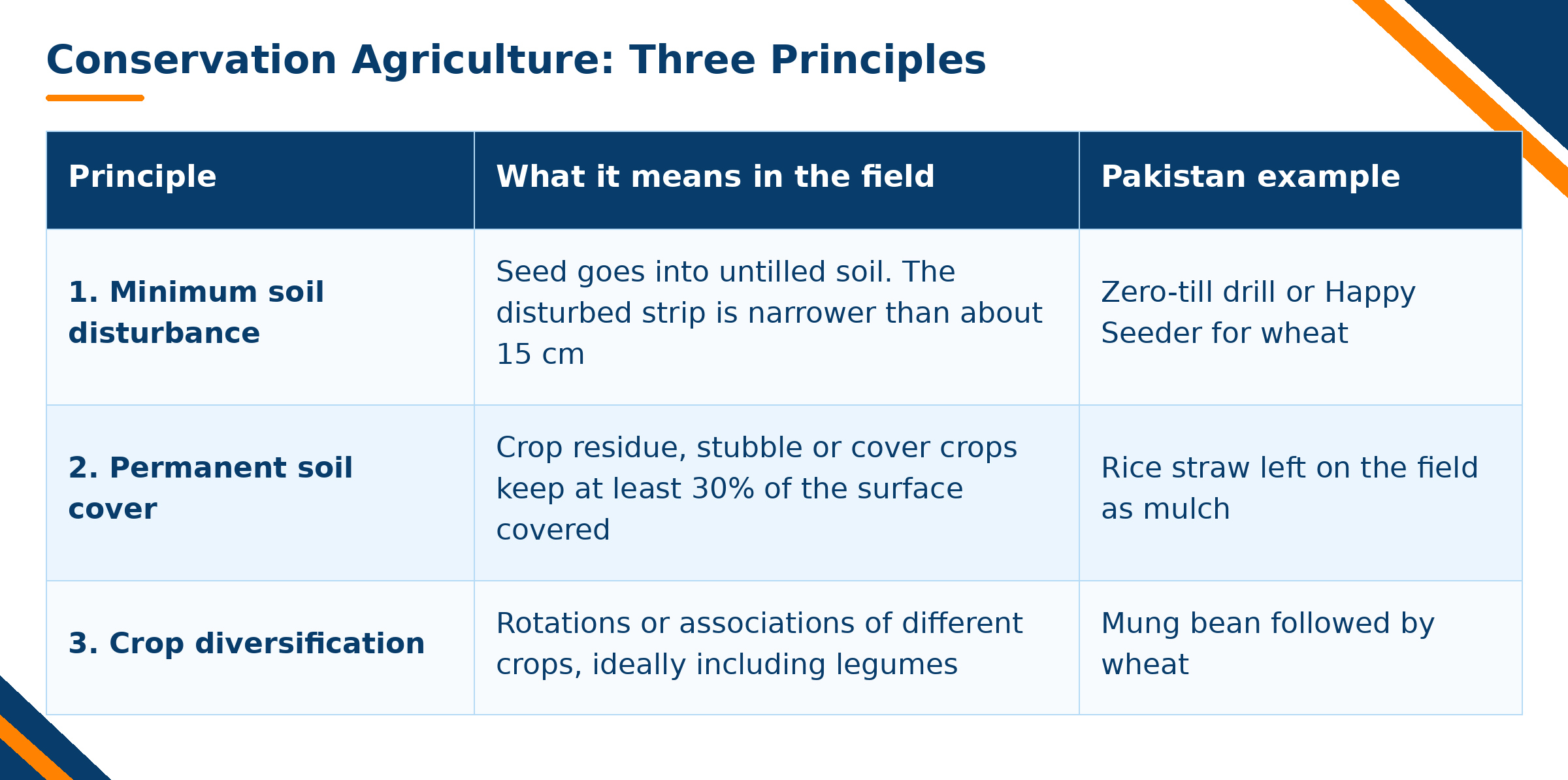
Soil cover gets measured in bands: 30 to 60%, above 60 to 90%, and above 90%. Below 30% cover, the field doesn’t count.
That matters, because a field with no-till seeding but burned straw has the first principle and misses the second.
The third principle is easy to overlook. A cereal-legume rotation can diversify the farm and, when managed well, contribute nitrogen through biological fixation.
It does not remove the need for soil testing or a crop-specific nutrient plan.
Types of Conservation Agriculture
Farmers use several techniques to move towards conservation agriculture.
The table compares these approaches, but not every technique on its own meets all three principles.
For example, strip-till still needs soil cover and crop diversification to form a complete system.
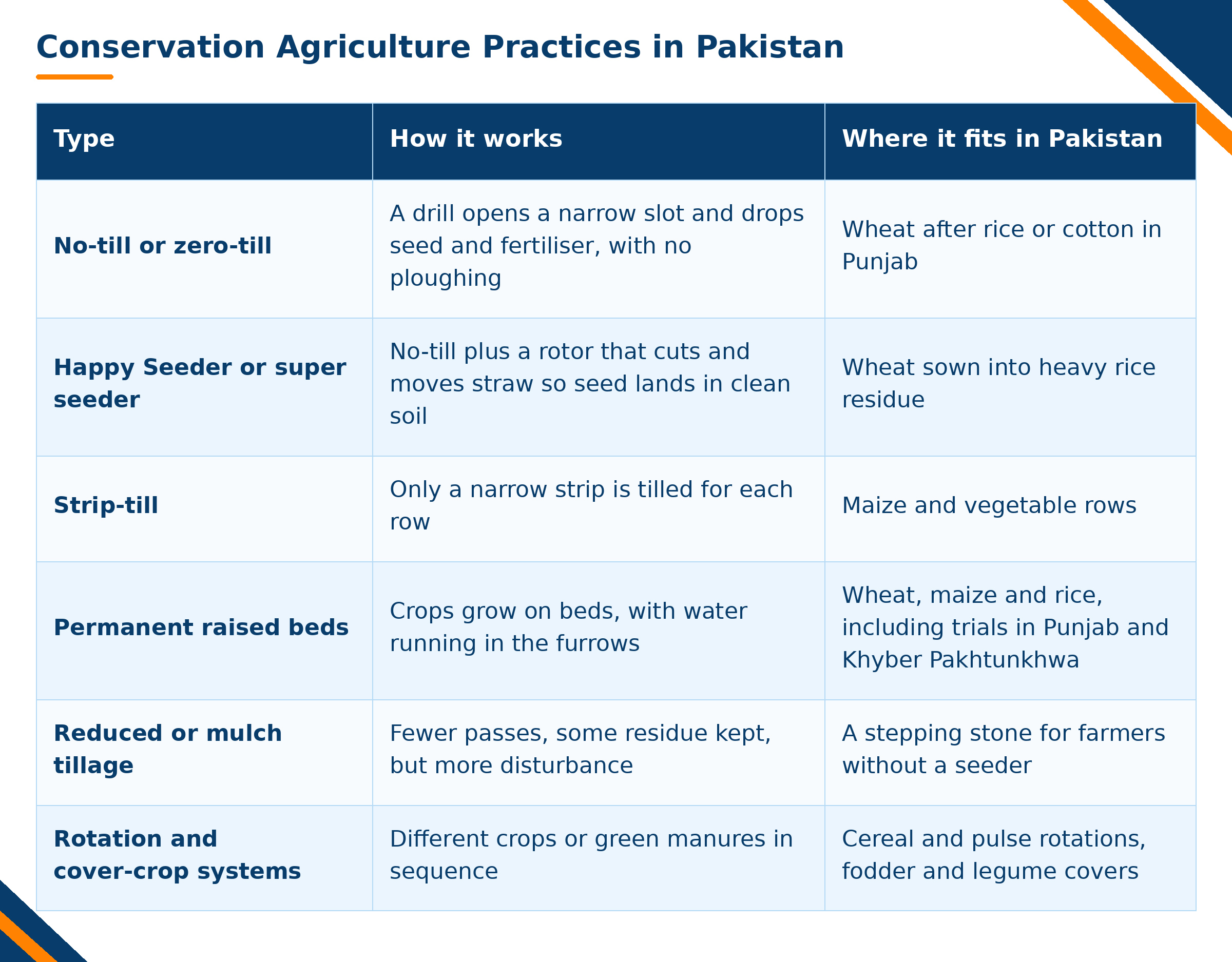
One caution. FAO regional work in Asia notes that much of what gets counted as conservation agriculture is partial, meaning no-till winter crops without full residue cover or rotation.
That’s a good start, but it won’t give you every benefit below.
Conservation Agriculture Examples from Pakistan and Abroad
The best examples are close to home.
Pakistan’s rice-wheat system covers more than 2.2 million hectares, about three-quarters in Punjab, and most of the research has happened there.
1) Happy Seeder wheat in Punjab. CIMMYT tested locally built seeders with farmers. One farmer, Nabi, sowed just over three hectares of wheat without burning rice residue and saved more than 260 litres of diesel.
2) Sargodha field trials. A study of rice residue practices over two seasons found Happy Seeder wheat yielded at least as well as the common practice of burning, with yields between 3,195 and 4,366 kg per hectare.
3) Mung bean and wheat on zero tillage. A Punjab trial reported 13% more wheat and 9% more mung bean, a cost saving of Rs 6,236 per hectare, and Rs 25,601 more net return per hectare.
4) Direct-seeded rice. Sowing rice into unploughed, unpuddled fields can save about a quarter of the irrigation water used for flooded rice.
5) Bed planting in Khyber Pakhtunkhwa. Maize on beds used 20 to 30% less water per unit of yield than the farmer practice in one trial.
Further afield, no-till rotations are standard in Brazil, Argentina, the US Midwest, Canada and Australia, and in Central Asia, where Kazakhstan is a leader.
FAO regional notes also record strip-till in Bangladesh, mini-till for lentil and maize in Nepal, and rice-wheat systems across India.
The Key Benefits
The benefits are practical, but they do not arrive automatically.
Fewer tractor passes can reduce fuel costs, residue can protect exposed soil, and a more varied rotation may help manage pests.
The evidence below also shows why results differ from farm to farm.
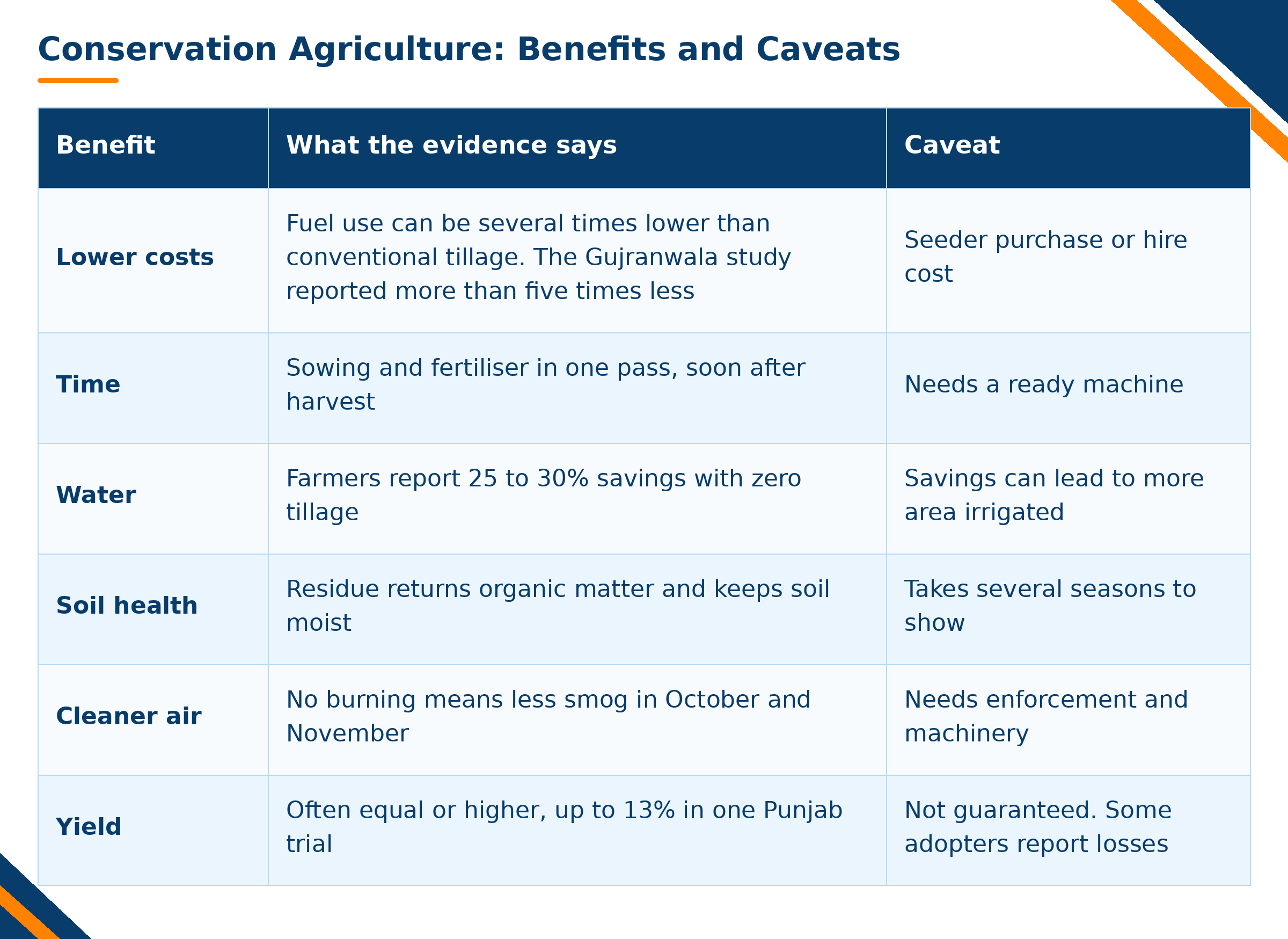
The smog link is worth stressing. Widespread residue burning in Pakistan and India each October and November is one of the factors aggravating Punjab’s smog.
Punjab’s agriculture minister said in September that the province had grown its super seeder fleet from about 300 to 10,000 in three years through subsidies, and reported a 70% drop in recorded burning incidents last year.
Water Conservation in Agriculture: Where It Helps
Water conservation in agriculture is a pressing concern for Pakistan.
Yet it is important to separate water applied to a field from water actually saved across an irrigation system.
The estimates below come from different crops and study designs; they should not be added together or treated as guaranteed savings.
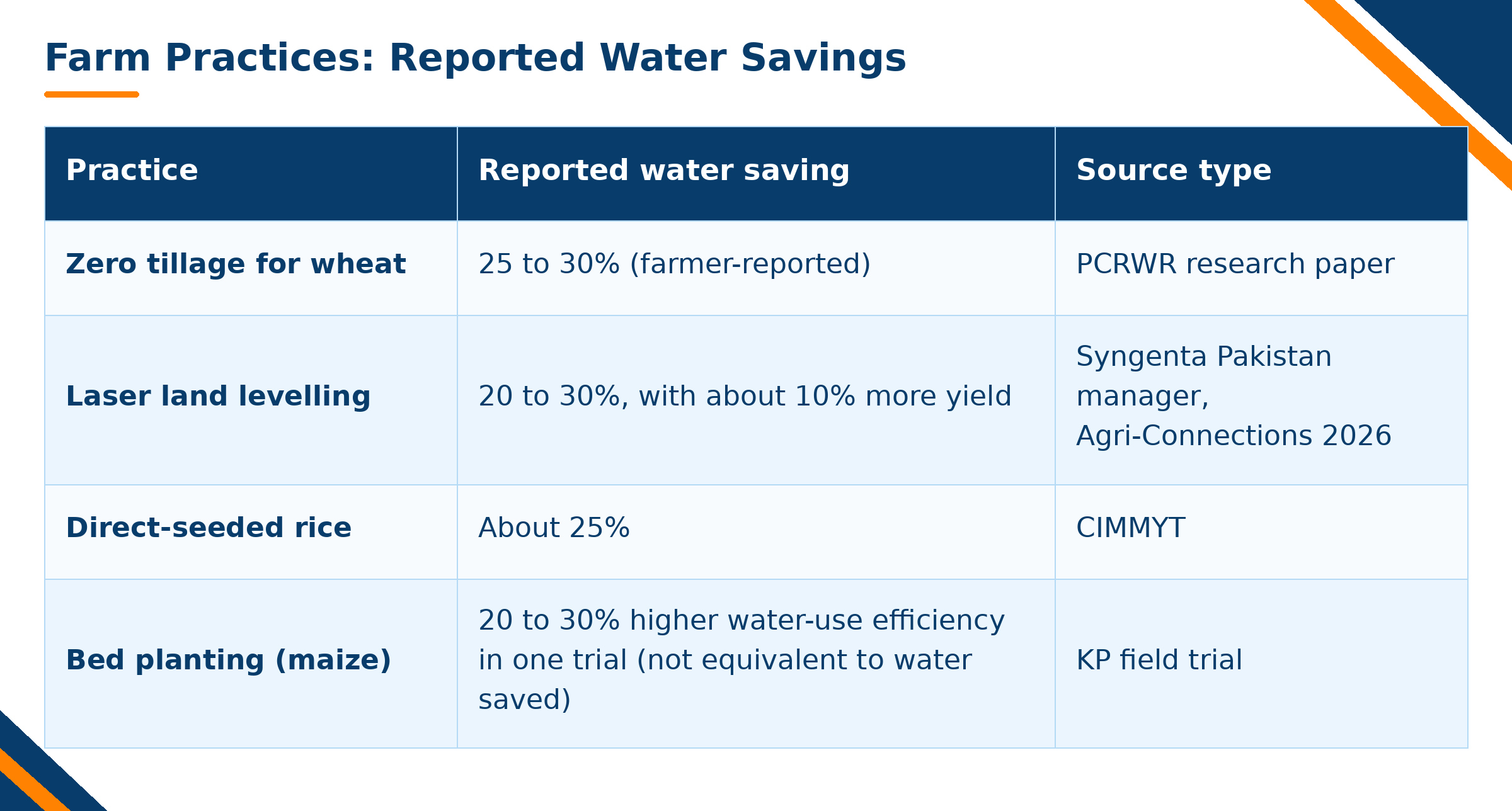
There’s a catch that policy papers often skip.
A study of rice-wheat farmers in Punjab by IWMI researchers found medium and large farmers tended to use their saved irrigation water to expand cropped area.
That means field-level savings don’t always add up to less water use for the basin. Without rules on how saved water is used, the total can even rise.
Common Techniques and Technologies
The right equipment depends on the crop, the amount of residue left after harvest, and whether a suitable service provider can reach the field on time.
A seeder that performs well in light stubble may struggle in heavy rice residue.
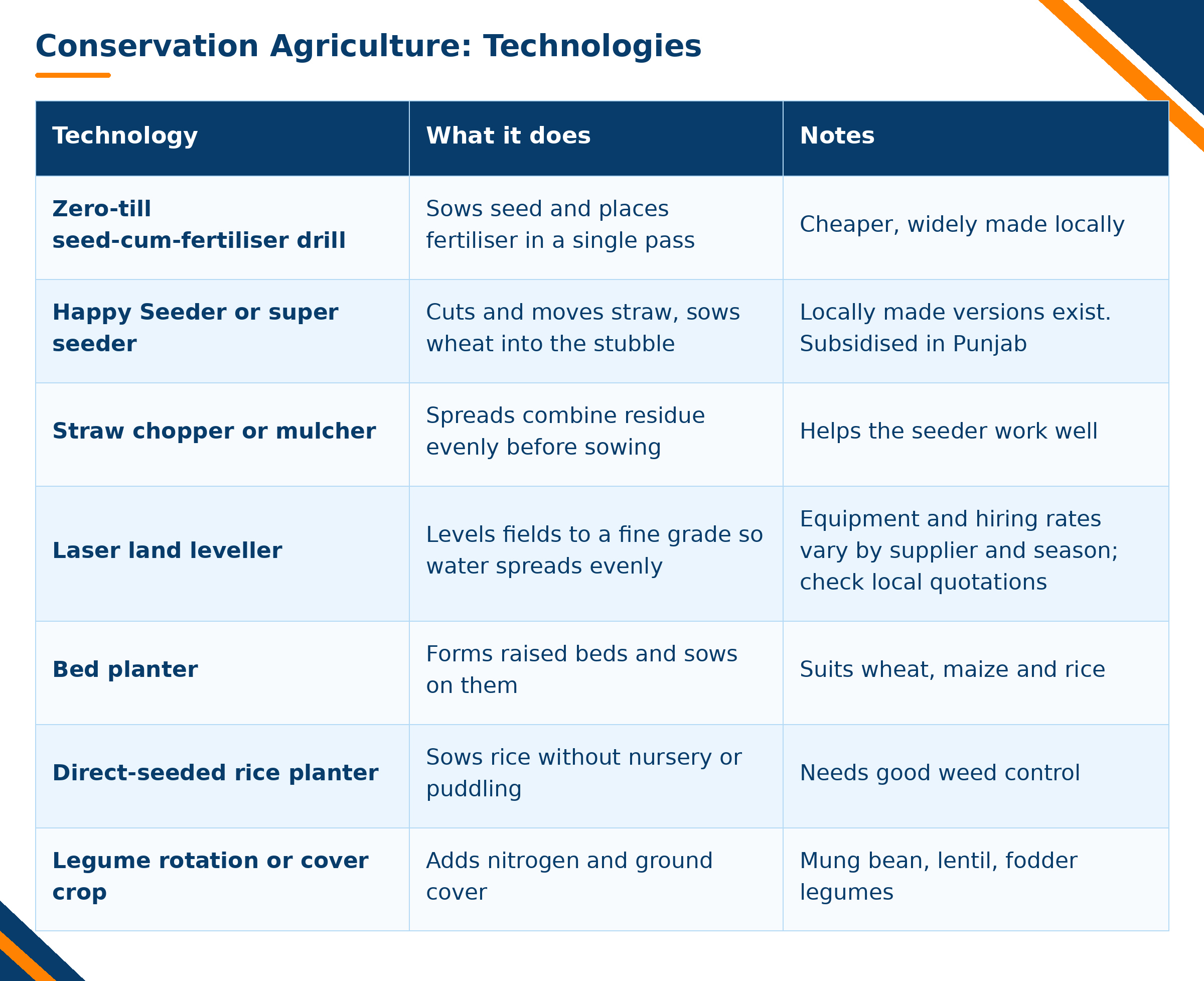
Cost note: equipment prices and subsidy terms change. For a small farm, comparing a local hire quote per acre with the cost of extra tractor passes is usually more useful than relying on an old machine price.
Fertilizer placement changes too. A drill puts it in the same pass as the seed, which is part of why zero-till wheat saves time.
Zarea’s fertilizer category lists what’s available for traders and farmers.
For example, Engro Urea 50 kg is a nitrogen fertiliser sold in bags.
Conservation farming does not mean applying less fertiliser automatically: use a soil test, the crop’s nutrient needs, and local agronomic advice to set rates.
Challenges: Where CA Falls Short
There are real obstacles. Earlier surveys in Punjab recorded both adoption and abandonment of zero-till wheat, while some farmers experienced lower yields.
Those results reflect particular locations and years, not a prediction for every farm.
Weed control, machine availability, and seed placement deserve attention before changing the whole operation.
1) Weeds. Without ploughing, weeds need other control. A Khyber Pakhtunkhwa trial found zero-till maize yielded 30% less because of weed pressure.
2) The sowing windows. Farmers have only two to three weeks between rice harvest and wheat sowing, so machines must be available on time.
3) Cost and scale. Smallholders can’t easily buy a super seeder, so rental services and subsidies decide who adopts.
4) Learning. Seed depth, residue handling, and herbicide timing differ from conventional farming, and the first season often has a learning dip.
The sensible first step is a side-by-side field trial. Keep records for both plots and judge the outcome after harvest, not just after sowing.
How to Start: A Practical Checklist for a Pakistani Farm
1) Start with one field. Pick a field with good drainage and a recent combine harvest, and keep a conventional plot next to it for comparison.
2) Fix the surface. If levelling is poor, laser levelling first makes every later step easier.
3) Use a seeder, not a plough. Book a zero-till drill, Happy Seeder, or super seeder before harvest, not after.
4) Keep the residue. Spread straw evenly with a chopper and don’t burn it.
5) Plan weed control. Talk to your agriculture officer about herbicide timing for your crop.
6) Add a legume. Put a pulse into the rotation where it fits the rotation; legumes can contribute nitrogen but do not replace soil testing.
7) Record everything. Note costs, diesel, water, and yield, and compare them with your conventional plot.
Before the next sowing season, ask your district agriculture office whether zero-till or super-seeder rental support is currently open, who qualifies, and which application dates apply.
Do not budget for a subsidy until the department confirms it for your district and season.
Turning Crop Residue into Income
Keeping enough crop residue on the soil comes first. Only genuinely surplus material should be removed for sale; taking too much straw can undermine the soil-cover principle.
Rice husk is different from standing rice stubble: it is produced during milling, not during harvest.
For surplus material that can be collected without stripping field cover, buyers may compare wheat straw and other agricultural residues.
Check moisture, contamination, and the quantity available before offering a bulk load.
Rice mills may also have rice husk to market. Because husk is a milling by-product, selling it does not replace the need to retain suitable residue in the field.
Sugar mills produce bagasse, another by-product with industrial uses. It belongs in a separate supply chain from the crop residue a farmer leaves as mulch.
For a closer look at these different material streams, see the guides to rice husk uses, biomass briquettes and sugarcane bagasse.
They cover processing and markets rather than replacing the agronomic need for field cover.
Markets for Conservation-Farmed Crops
For grain sales, check whether the harvest meets the buyer’s quality and volume requirements.
Farmers comparing bulk outlets can review the wheat listing and confirm its specifications, minimum order, and delivery terms before making a commitment.
Crop choice should come before the sales decision. For a sense of the available commodities, browse grains and pulses.
Ask for a dated quote rather than treating an online listing as a guaranteed harvest price.
If you plan to rotate cereals with legumes, choose varieties suited to your sowing season and soil.
Zarea’s seed category can help you compare listings, but confirm each lot is intended for sowing and check its germination and suitability before ordering.
Surplus straw and other industrial by-products belong to a different market from food grains.
Agricultural biomass provides examples, but never remove the residue your field needs to maintain protective soil cover.
FAQs
What Do You Mean by Conservation Agriculture?
This is a farming system that combines minimal soil disturbance, continuous soil cover, and crop diversification.
No-till alone is only one part of it.
What are the Five Methods of Soil Conservation?
Five common methods are contour farming, terracing, cover cropping, mulching, and reduced or no-till farming.
These are soil-conservation practices; conservation agriculture specifically combines minimal disturbance, soil cover, and crop diversification.
How Can Farmers Start Conservation Agriculture in Pakistan?
Begin with one field, retain enough crop residue, arrange a suitable seeder, and plan a crop rotation.
Compare water use, fuel costs, weeds, and yield against a conventional field before expanding.
Wrap-up
Conservation agriculture is worth testing, not romanticising. Leave enough residue to protect the soil, disturb it as little as the crop allows, and plan a useful rotation.
Start on one field, keep a comparison plot, and record the results. The best decision for next season will come from your own costs, soil condition, and harvest.
Treat the dates, subsidies, and water figures as a snapshot, and confirm them with your local agriculture office.