Energy Crisis in Pakistan: Causes, Effects & Solutions
Explore the energy crisis in Pakistan in 2026, its causes, rising fuel prices, electricity shortages, economic impact, and possible solutions.
The world is in the middle of an energy crisis. It began when war between Iran and a US-Israel coalition broke out on 28 February 2026, and the Strait of Hormuz, which normally carries about a fifth of the world’s oil, effectively closed.
The IEA calls it the largest supply disruption in oil market history. Pakistan, which imports most of its fuel and much of its gas, has been among the hardest hit: petrol peaked at Rs 458.41 a litre in April, and load shedding returned this year.
This guide explains what caused the crisis, its global impact, which countries are worst affected, how it hit Pakistan’s fuel and electricity, and what to watch next.
The data comes from the IEA, Pakistani regulators and newspapers, and international reporting up to 6 November 2026. The situation is changing every week, so
use dated figures with care.
Quick Answers
1) Cause: war involving Iran, the closure of the Strait of Hormuz, and attacks on Gulf energy facilities, including Qatar’s Ras Laffan LNG complex.
2) Scale: the IEA puts the peak oil supply loss above 12 million barrels a day, about 11.5% of world demand, against 4.5 million in 1973.
3) Hardest hit: import-dependent economies, especially in Asia: Pakistan, Bangladesh, Sri Lanka, Vietnam and the Philippines.
4) Pakistan today: petrol Rs 352.59 and diesel Rs 382.25 a litre from 6 November, down from the April peak but still very high.
5) Outlook: supply is recovering but fragile. The IEA expects a rebound of 7.7 million barrels a day in 2027 if shipping normalises.
What is an Energy Crisis?
An energy crisis is a shortage or price spike in energy supply big enough to disrupt daily life and the economy. It can show up as fuel queues, rationing, blackouts, or prices that households and factories can no longer afford.
Some crises start with a supply cut, like an embargo or a blocked shipping lane. Others start with a financial problem, like a country that can’t pay for the fuel it needs.
The 2026 crisis is mostly the first kind. Oil, LNG, and even gas-based fertiliser all pass through the same narrow waterway, so one closure hit fuel, power, and food costs at once.
What is the Energy Crisis in Pakistan?
The energy crisis in Pakistan refers to the country's ongoing struggle to provide reliable and affordable electricity, natural gas, and fuel to households, businesses, and industries.
It is driven by several interconnected problems, including dependence on imported fuels, rising energy costs, circular debt, inefficient power distribution, and weaknesses in energy infrastructure.
In 2026, disruptions to global oil and gas supplies have added further pressure, increasing fuel costs and contributing to electricity shortages.
As a result, households face higher utility bills, while industries and businesses struggle with rising operating expenses.
Addressing Pakistan's energy crisis requires better energy management, improvements in the power sector, greater use of domestic and renewable energy sources, and reduced dependence on imported fuels.
What is Causing the Current Energy Crisis in Pakistan?
Four things stack on top of each other. First is the war and the Hormuz closure itself, which cut oil exports from Gulf producers. Second is damage to infrastructure.
On 18 March, Iran struck Qatar’s Ras Laffan LNG complex, which cut Qatar’s LNG production capacity by about 17%, and repairs are reported to take three to five years. Asian spot LNG prices rose by more than 140%.
Third is thin buffers. Europe entered the crisis with gas storage at about 30% after a harsh winter, and the US Strategic Petroleum Reserve fell in September to its lowest level since 1982.
Fourth is shipping risk that won’t go away. A ceasefire was announced on 8 April, but traffic stayed far below normal, and renewed attacks in July, September and October kept insurers and shippers cautious.
The IEA’s August report noted loadings peaked at 20 million barrels a day in early July, then dropped to around 12 million.
Global Impact of the Energy Crisis
The global energy crisis hit oil prices first. Brent crude surged to about $118 in late March, fell to around $70 by 1 July, climbed back above $100 in late July and touched $109 in early September.
Prices eased this week on hopes that the conflict could wind down after the US midterm elections. For consumers, diesel was the real pain: the IEA says diesel and gasoil availability was 1.5 million barrels a day lower in the second quarter and 1.7 million lower in the third than a year earlier.
The IMF says the damage is uneven and falls most on energy importers and vulnerable economies, and in July it put world growth at 3% for 2026. In the US, average diesel hit $6.53 a gallon on 22 September, up 77% from a year earlier.
The shock reaches food through fertiliser. Over 30% of the world’s urea is exported from the Gulf through the Strait, and urea is made from natural gas, so higher gas and shipping costs feed straight into crop costs.
If you buy farm inputs, you can track what’s on offer in Zarea’s fertilizer category. Browse the fertilizers for product availability; a listing is not agronomic advice.
Energy investment is shifting too. The IEA’s World Energy Investment 2026 report expects oil investment to fall below $500 billion for a third year, gas investment to hit $330 billion, its highest in a decade, and coal investment to reach $180 billion, the highest since 2012.
That last number explains why many Asian grids leaned on coal this year, and why coal kept its place in the mix.
Which Countries are in the Energy Crisis?
Almost every economy has felt the energy crisis through higher prices, but the sharpest pain is in countries that import most of their fuel from the Gulf and have small reserves.
Here is what was reported, as of the dates in each report.
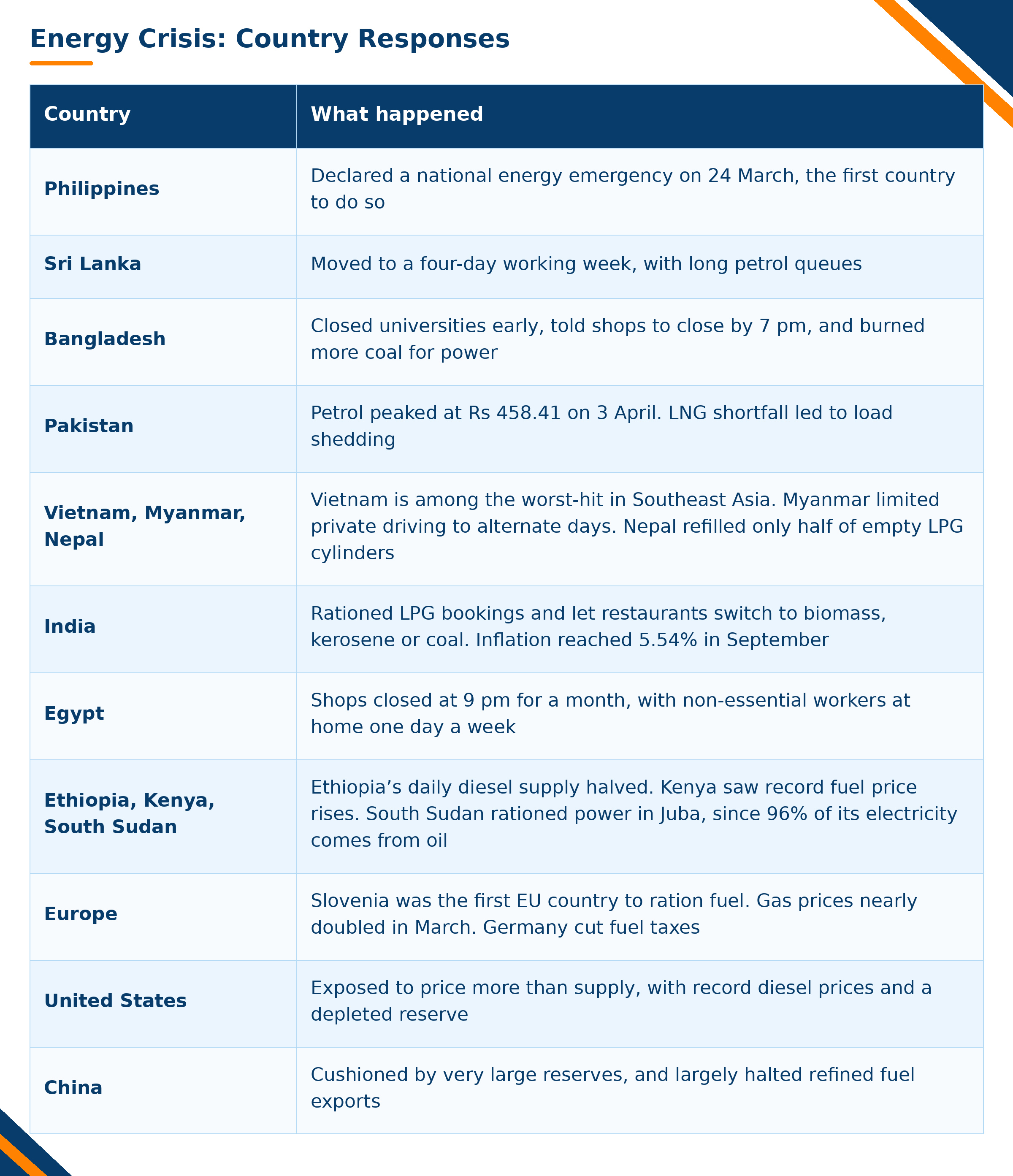
India’s response is worth noting for Pakistani businesses. When LPG ran short, it let commercial kitchens burn local fuels, and the BBC reported a rise in firewood sales.
The same logic is why agricultural biomass such as husk and shells keeps moving up the shopping list of boiler and kiln owners.
Businesses assessing agricultural residues can explore agricultural biomass as a sourcing category.
Energy Crisis in Pakistan: How the Gulf War Hit Home
The energy crisis in Pakistan arrived through three doors at once: petrol and diesel, LNG, and the exchange rate that pays for both.
In early March, the finance minister told the Senate Standing Committee on Finance that the country had about 28 days of petrol and diesel and 10 days of crude on hand, ruled out rationing, and said the LNG cargoes from Qatar had been delayed.
The government set up a cabinet committee, moved from fortnightly to weekly fuel pricing, and asked Saudi Arabia for an alternative supply route.
Prices tell the story. Petrol peaked at Rs 458.41 and diesel at Rs 520.35 a litre on 3 April.
A relief scheme takes up to Rs 100 off each litre for owners of motorcycles, rickshaws and vehicles up to 800 cc, and more than 1.75 million people had registered by 19 September.
Pricing has now gone from weekly to daily.
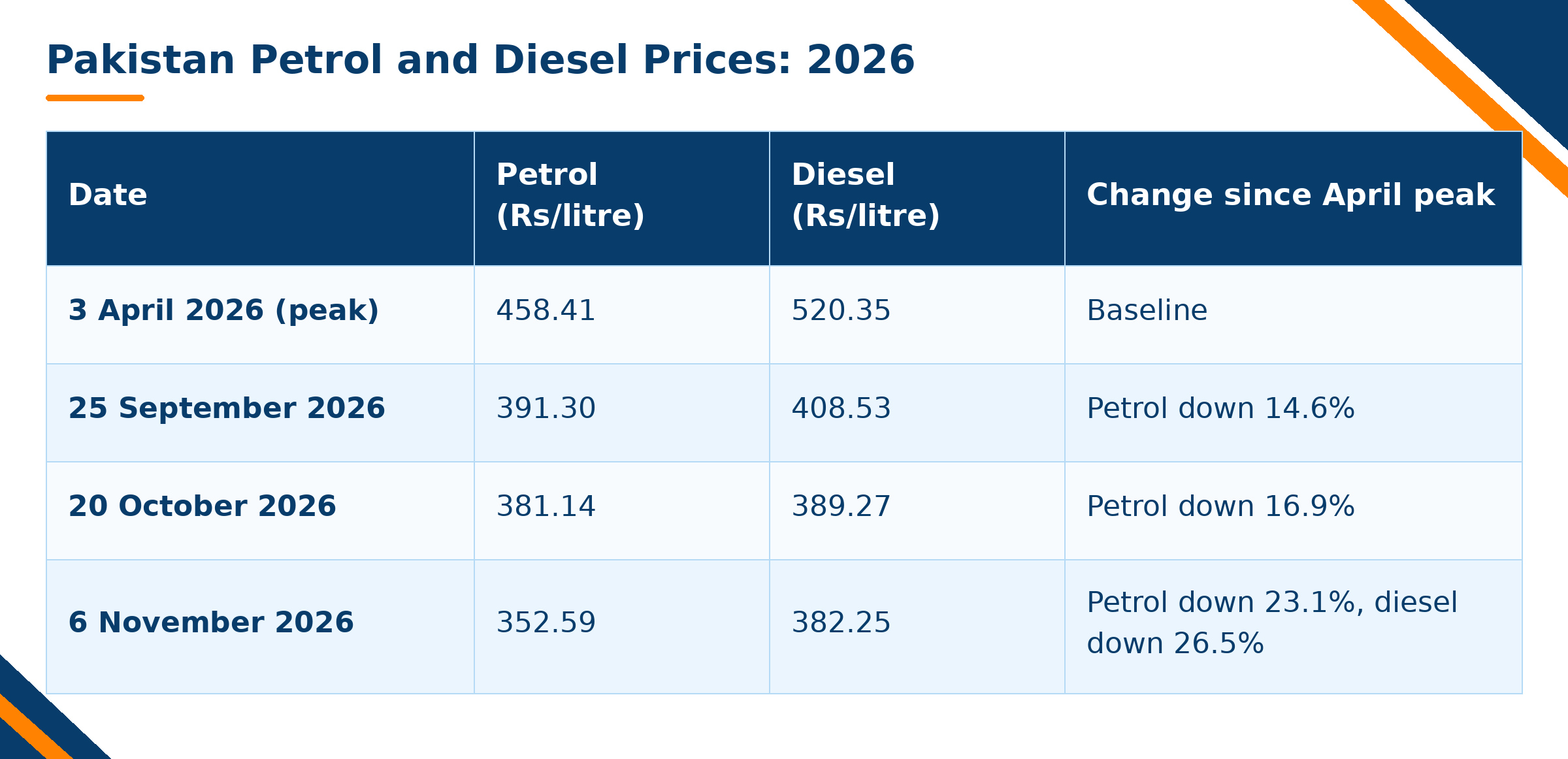
One detail explains why pump prices fall slowly. The government keeps a fixed levy of Rs 114 a litre on petrol and Rs 100 on diesel, whatever the base price does.
On the 6 November petrol price, that levy is about 32% of what you pay, so a fall in global oil only trims the rest. It’s our own calculation, but it’s why a cheaper barrel doesn’t feel cheaper at the pump.
The state has also cut back itself. In September, it announced cuts to fuel for official vehicles (reported as 50% for three months) and bans on state vehicle purchases and foreign trips.
Back in March, it closed schools for two weeks, according to Reuters. For companies, the practical lesson is to stop assuming one fuel will always be available at one price.
Electricity Crisis in Pakistan: Why the Lights Went Out Again
The electricity crisis in Pakistan has two layers. The new layer is LNG. In early September, the power and petroleum ministers apologised publicly for load shedding and said the loss of regasified LNG from QatarEnergy, after its force majeure declaration, had cut generation capacity by around 5,000 MW.
The petroleum minister said one LNG cargo that cost $30 to 35 million before 28 February now costs about $75 million, and the power minister warned that buying on the spot market would add Rs 5 to 6 a unit to bills after two months.
The old layer is structural. Distribution companies often can’t afford to buy all the power available, so they cut supply even when plants can run.
That is why analysts often describe load shedding as a payment problem as much as a capacity problem.
Circular debt, the chain of unpaid bills between utilities, generators and fuel suppliers, runs to trillions of rupees, though published estimates differ widely depending on the source and on whether gas is included, so we haven’t printed a single figure.
Growatt 6 KW on-grid solar inverter can reduce exposure to grid electricity costs, but the right system depends on the site.
An on-grid inverter typically shuts down during a grid outage unless the installation includes compatible backup equipment; it should not be presented as an automatic solution to load shedding.
Buyers can compare equipment specifications, installation requirements, and warranty terms before choosing a system.
For example, review the Growatt 10kW on-grid inverter and confirm suitability with a qualified installer.
The broader solar equipment category shows other equipment options.
There is a catch. Critics warn the shift could widen energy inequality, because wealthier users are shielded while poorer consumers face growing pressure.
Solar is a good private fix for you, but not a complete public one.
Pakistan’s Energy Crisis: The Structural Problems Behind It
Pakistan’s energy crisis didn’t start in February. The war exposed weaknesses that were already there. The country imports most of its oil and a large share of its gas.
Its power sector is weighed down by circular debt and expensive contracts, and its foreign exchange reserves are limited, so every price spike hits the currency and then inflation.
There is a bright side. In FY2025, 53.7% of Pakistan’s 126,705 GWh of electricity came from hydro, nuclear, or renewable sources.
The fastest way to cut fuel risk is to burn less imported fuel, and that means more domestic generation and better efficiency.
Reform of the sector is also tied to the country’s IMF programme, but the political cost of raising tariffs makes it slow.
Is Another Energy Crisis Coming?
The honest answer is that this one hasn’t finished. The IEA’s October report shows supply recovering, up 2.5 million barrels a day in September to 102.3 million, but it still expects an annual fall of 5.8 million barrels a day in 2026, a rebound of 7.7 million in 2027, and warns that heightened Houthi attacks in October make the recovery fragile.
Whether this energy crisis ends or deepens depends on a few signals you can check yourself.
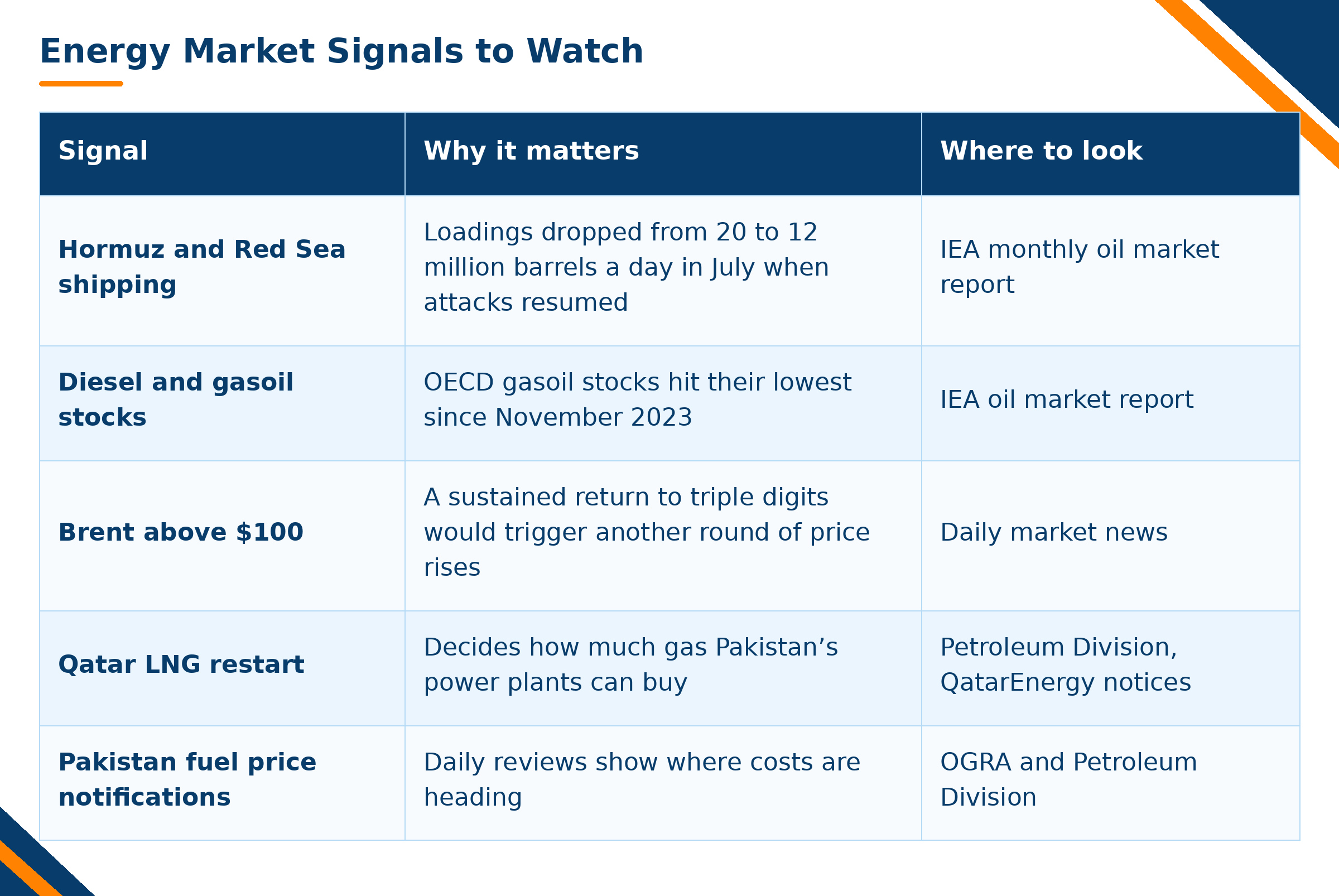
daily price for a practical view of commodity costs, compare current listings and their stated units rather than assuming that every fuel or energy input appears on one price dashboard.
Lessons from the Greatest Energy Crisis in History
Whether 2026 is the greatest energy crisis in history depends on what you measure. By supply lost, it is. By how far prices jumped, 1973 still leads.
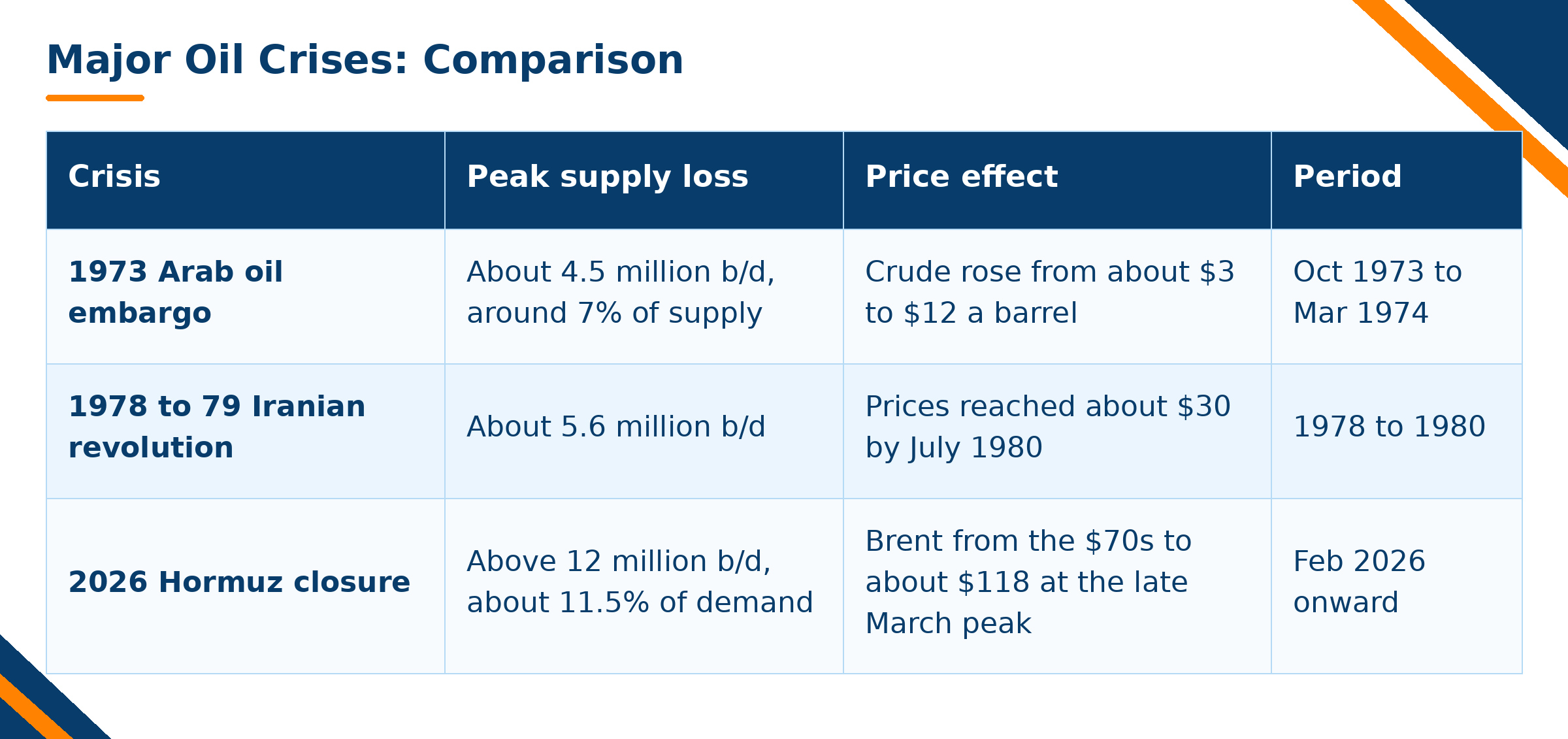
The difference is the cushion. In 1973, the world had little spare capacity and no emergency stocks.
In 2026, the IEA coordinated its largest-ever stock release, nearly 400 million barrels, and those buffers softened the price response.
They are also now depleted, which is why the US reserve is at a 44-year low and why a second shock would hurt more.
What Pakistani Businesses Can Do Now
1) Energy and Petroleum: You cannot control global fuel prices, but you can reduce how exposed your business is. Start with a simple list: which operations depend on diesel, LPG, gas, or grid power? Which could continue if deliveries stopped for two weeks? Check fuel consumption, equipment compatibility, and the full delivered cost before changing suppliers.
2) Biomass Briquettes: Second, investigate an alternative fuel only where the equipment is designed or approved for it. Biomass can be useful for suitable boilers and kilns, but moisture, ash, emissions controls, handling costs, and maintenance all affect the economics.
3) Rice Husk: Third, consider locally available agricultural residues. Rice husk, bagasse, and shells may be useful industrial feedstocks, but their price and suitability depend on local supply, quality, and transport distance. A relevant example is the rice husk product listing; check the moisture and dust specifications against your equipment requirements. For a detailed explanation, read Rice Husk: Uses, Benefits & Industrial Applications.
4) Biomass Boilers: Fourth, ask a boiler specialist to assess fuel compatibility before making a purchase. A fuel switch may require changes to feeding systems, ash handling, and emissions controls. The rice milling process and by-products guide explains where these residues come from.
5) Import and Export: Finally, compare suppliers using written specifications, not price alone. Ask about moisture, calorific value, ash content, delivery units, and lead times. Keep a qualified backup supplier where practical. For solar installations, the trina solar panel listing is another product reference, subject to engineering assessment.
FAQs
Is An Energy Crisis Coming?
One is already underway. The IEA calls the 2026 oil supply disruption the largest in history, and while supply has recovered to 102.3 million barrels a day in September, the recovery is fragile after new attacks in October. The risk now is a longer crisis, not a new one. Watch Hormuz shipping, diesel stocks and Brent prices.
What is the Greatest Energy Crisis in History?
By volume, the 2026 Hormuz closure. The IEA calls it the largest oil supply disruption ever, with a peak loss above 12 million barrels a day, against 4.5 million in the 1973 embargo. By price shock, the 1973 embargo still leads, when crude roughly quadrupled from about $3 to $12 a barrel.
Wrap-Up
The 2026 energy crisis is a supply shock first and a price shock second, and Pakistan sits near the sharp end of both. Fuel prices have come off their peak, but a fixed levy, a fragile ceasefire and an LNG gap keep the risk alive.
The sensible response is dull and practical: know your exposure, keep a second fuel, buy to a spec, and watch the signals above.
Treat every number here as a dated snapshot, and check it before you rely on it. Editorial verification before publishing: confirm the 6 November 2026 pump-price notification and levy amounts; check IEA oil-supply estimates and dates; verify the LNG, solar-capacity and relief-scheme figures against dated primary sources; and add a named author and fact-checking reviewer. Figures in this article are historical snapshots, not live prices.