Rice Milling: Process, Machines, Yield & Byproducts
Rice milling explained: the steps in milling paddy, machines, yields, husk and bran by-products, mill types and costs.
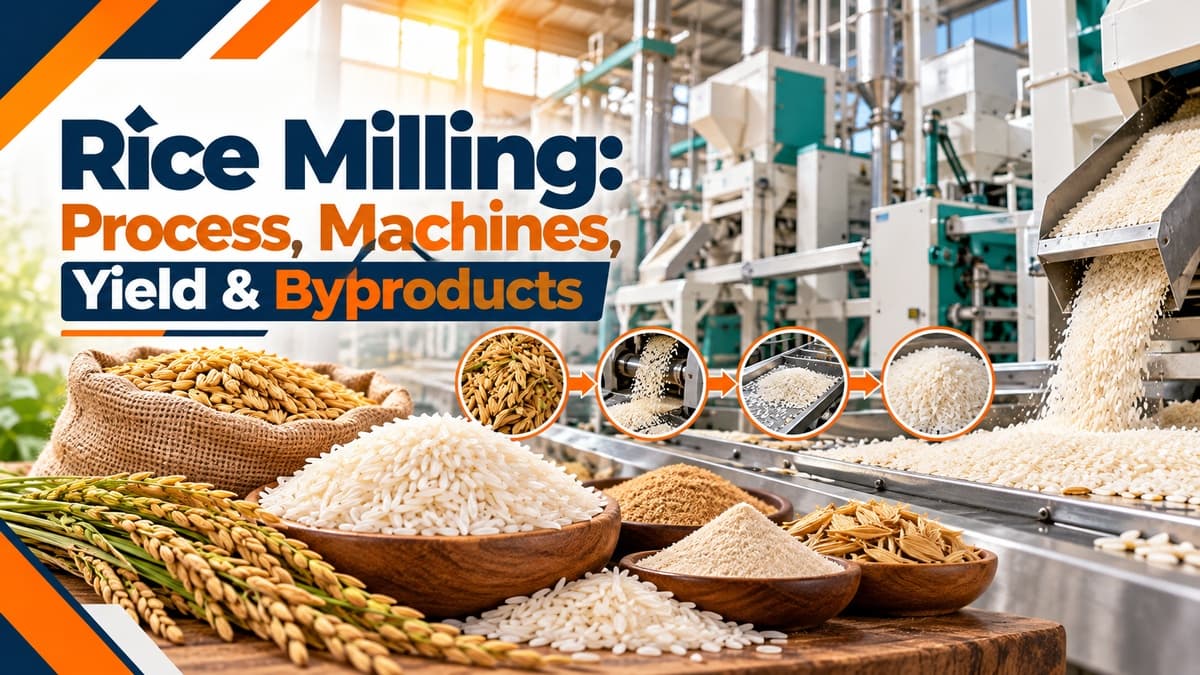
Rice milling turns raw paddy into the white rice you cook. A mill strips off the husk, rubs away the bran layer, polishes the grain, and sorts whole kernels from broken ones.
Along the way, it also produces husk, bran, and broken rice, all of which have buyers. A well-run mill recovers about 68 to 72 kg of milled rice from every 100 kg of paddy, according to the International Rice Research Institute (IRRI).
This guide walks through the steps of milling paddy, the machines in a rice mill, what each part of the kernel becomes, and the types of rice mills. It also covers what it costs to set one up in Pakistan, and whether milled rice is better for you.
Machine prices and costs are dated, and every figure carries its source, so check current quotes before you invest.
Quick answers
Rice milling removes the husk and bran from paddy. The main steps are pre-cleaning, husking, paddy separation, and whitening, polishing, grading, and packing.
From 100 kg of paddy, an efficient mill gives about 20 kg of husk, 8 to 12 kg of bran, and 68 to 72 kg of milled rice (IRRI).
A good mill produces about 50 to 60% head rice (whole grains). Broken rice sells for less.
Rubber-roll mills give better quality than old steel hullers, which IRRI says are no longer acceptable for commercial milling.
SMEDA’s December 2023 pre-feasibility study puts a Pakistani rice processing unit at about Rs 143.6 million, including land, with machinery at about Rs 50 million.
What Is Rice Milling?
Paddy is rice still wrapped in its husk, and nobody can eat it that way. Rice milling is what turns it into something you can cook. The mill takes the husk off first, which leaves brown rice.
Then the bran and germ come off, and you get white rice. IRRI describes the goal as an edible white kernel that’s properly milled and free of impurities. Past that point, it’s all trade-offs.
Mill harder and the rice looks whiter and keeps longer on the shelf, but more grains snap and more nutrients leave with the bran.
What you end up with depends on the variety and how it’s processed. Aromatic basmati, long-grain 1121 and IRRI-6 don’t get milled the same way, and some rice is parboiled or steamed before it ever reaches the mill.
A Kainat 1121 steam rice listing shows what a steam-processed grain looks like when it lands in shops, packed in 25 kg bags. If you’re planning for export, look at which Pakistani rice varieties buyers ask for, and compare grain traits and processing needs before you settle on a milling line.
Key Steps in Modern Rice Milling
A modern rice mill is a sequence of machines, and each one protects the next. IRRI’s guidance splits the process into husking, whitening and polishing, and grading and packing.
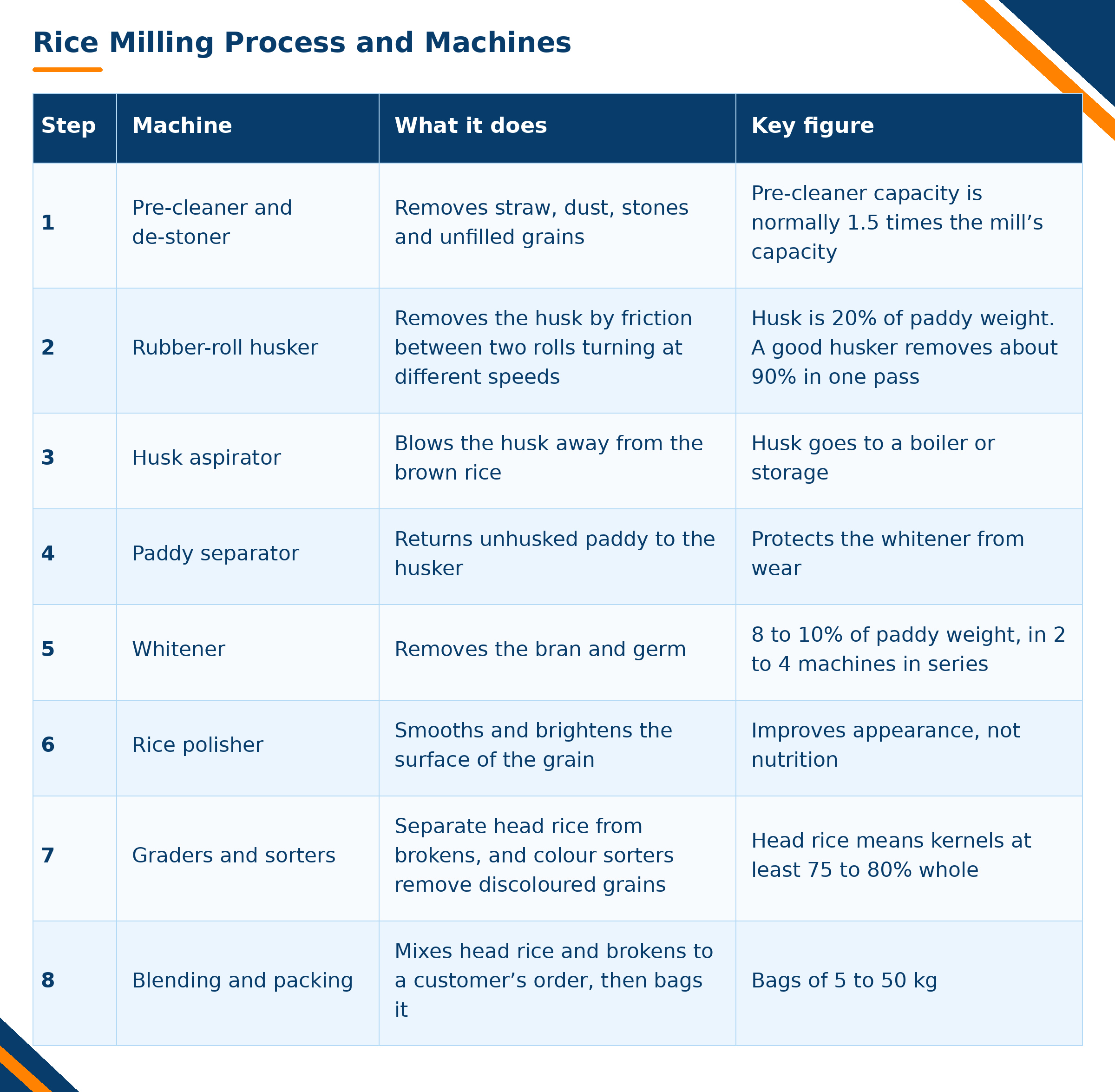
Two details decide the quality. The first is moisture, and IRRI’s milling advice is to mill paddy at about 14% moisture, because drier grain cracks and wetter grain clogs the machines.
The second is order. Cleaning protects the husker, paddy separation protects the whitener, and several gentle whitening passes break fewer grains than one hard pass.
If the grain is coming from different lots, test moisture and milling recovery separately before mixing them; one poorly dried batch can increase breakage across the run.
Rice Milling Machines and What They Cost in Pakistan
SMEDA’s pre-feasibility study lists the machines in a Pakistani rice processing unit with estimated prices from 2023. Treat them as a guide, because machine prices have moved with the exchange rate since then.
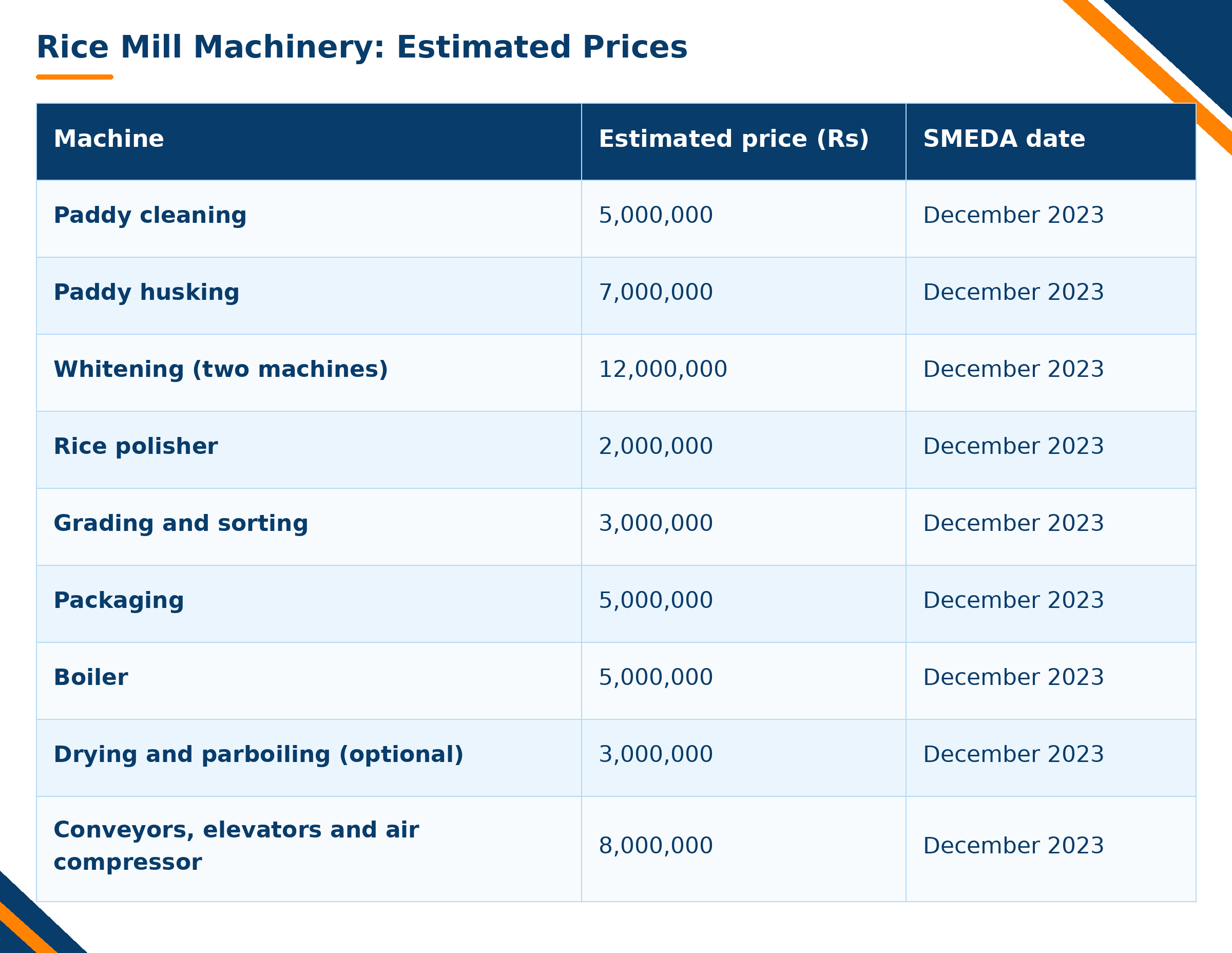
The study totals machinery at about Rs 50 million for a plant with 28 staff, running 330 days a year. It lists machinery suppliers in Karachi and Lahore.
Standard Kernel Composition & By-Products
A paddy grain has four parts: the husk, the bran, the germ, and the starchy endosperm. Milling separates them. In an ideal mill, IRRI says the output is 20% husk, 8 to 12% bran (depending on how far the rice is milled), and 68 to 72% milled rice, which includes whole grains and brokens.
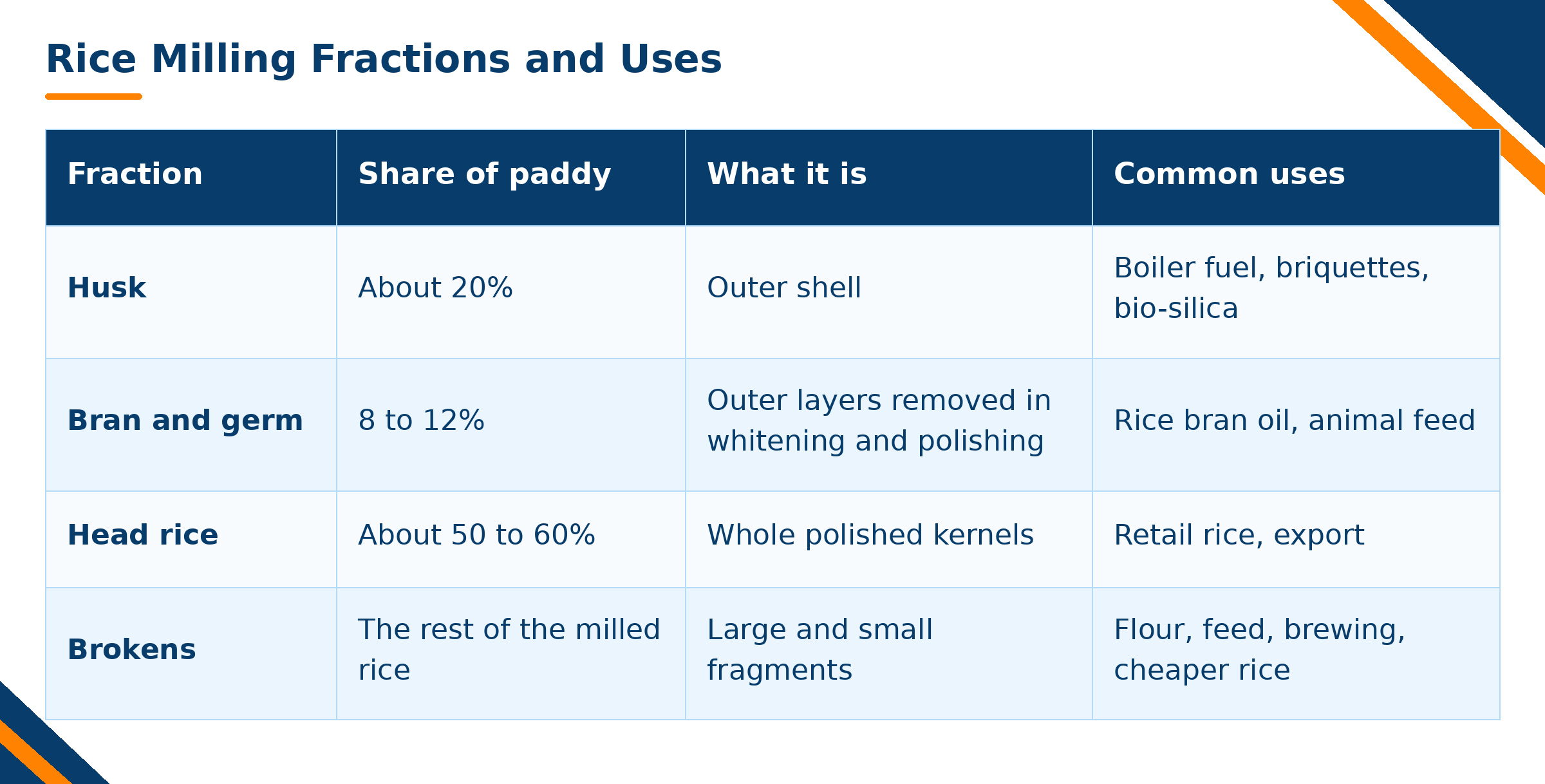
A good mill makes about 50 to 60% head rice, with 5 to 10% large brokens and 10 to 15% small brokens, according to IRRI’s fact sheet. Head rice is what decides a mill’s income, because a mill can show a good total recovery and still lose money if too many grains break.
That is why buyers should ask for the head-rice percentage, not only the total milled-rice weight.
The outer layer taken off during polishing is sold as rice polish, known locally as Nakku. Rice polish on Zarea is listed with 12–14% crude protein, 12–13% crude fat, 10–12% crude fibre, and moisture of 10% or less, and it goes mostly into poultry and livestock feed.
If you want to understand how this differs from the whole grain, our guide to rice bran explains the ingredient and its common uses.
Here is a rough estimate for Pakistan. USDA puts the country’s milled rice at about 9.4 million tonnes. Dividing by a 65% milling recovery implies around 14 million tonnes of paddy, which would leave about 2.8 million tonnes of husk and 1.1 to 1.7 million tonnes of bran. These are our own estimates, not measured figures.
Husk is the biggest by-product, and it can be pressed into fuel. We explain how that works in our guide to biomass briquettes.
Types of Rice Mills
Rice mills fall into two broad groups, conventional and modern. Within them, four designs cover most mills.
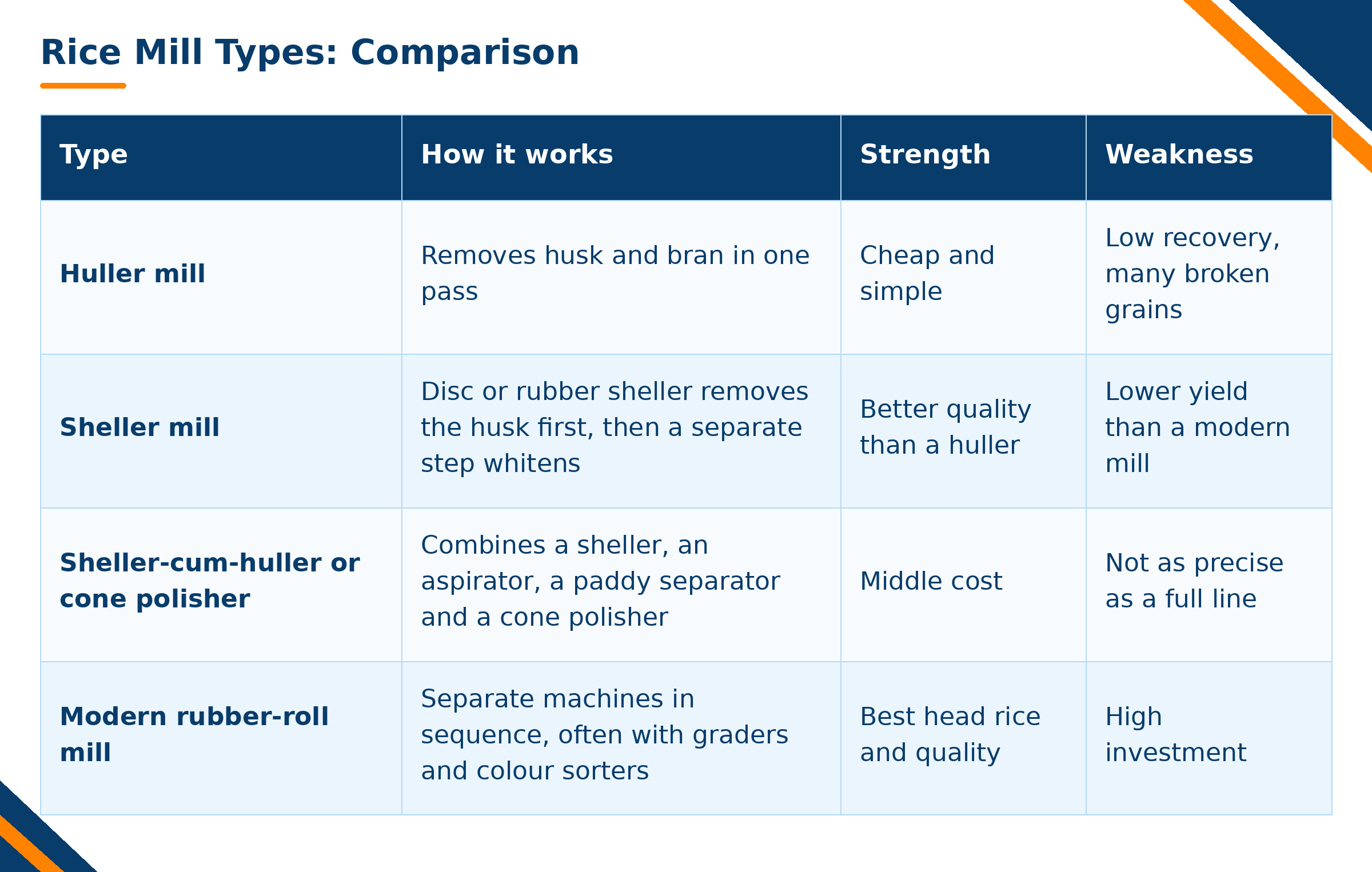
IRRI warns that older Engelberg-type steel hullers usually give lower recovery and more broken grains than modern milling systems. How much whole rice you actually get back (head-rice recovery) comes down to the grain’s condition, its moisture, and how the machine is set.
So don’t trust a generic percentage in a brochure. Ask for a trial run and compare machines on your own paddy. On running costs, published reviews put power use for some modern systems at about 18 to 26 kWh per tonne of raw paddy. Every mill differs, so treat that as a ballpark.
Parboiling and the Mill’s Boiler
Many mills parboil the paddy before milling. The paddy is soaked, steamed, and dried, which hardens the grain so fewer kernels break and pushes some vitamins from the bran into the grain.
Parboiling needs steam, so the boiler is a core part of the plant, and SMEDA’s equipment list includes one. Buyers comparing parboiled products can also read about sella rice, which is prepared through a parboiling process before milling.
Rice husk generated on site can reduce purchased fuel costs, but handling, drying, and boiler operation still have costs. Rice husk is mainly used as fuel for parboiling and drying, as the PMC review notes, so a mill can feed its own boiler.
A rice husk listing on Zarea shows moisture of 12–14% and dust of 6–8%, and our guide to rice husk uses covers what else it is used for.
How to Start a Rice Milling Business in Pakistan
A mill is a food business and a heavy industrial one. Plan for both.
Pick your scale and your rice. Basmati, 1121, and IRRI-6 mills target different buyers, and whether you parboil changes your equipment.
Choose a site near paddy fields, with reliable power and road access. Paddy is bulky, so freight adds up.
Register the business and get an NTN and sales tax registration from FBR. If you plan to export, confirm the current product standards, documentation, and destination-country requirements with the relevant authorities and your shipping partner; association membership and certification requirements depend on the transaction.
Get a food licence. In Punjab, every food business needs a licence under the Punjab Food Authority Act 2011, and the application asks for your machinery details, plant layout, and production capacity. Ask your provincial environmental agency about its approval too.
Buy and install the line, with a boiler if you parboil.
Plan paddy purchases, storage, and sales. Line up buyers for the husk, bran, and polish too, since they are part of the income. An agricultural marketplace can also help mills connect with potential buyers and compare opportunities for rice and by-products.
What it Costs
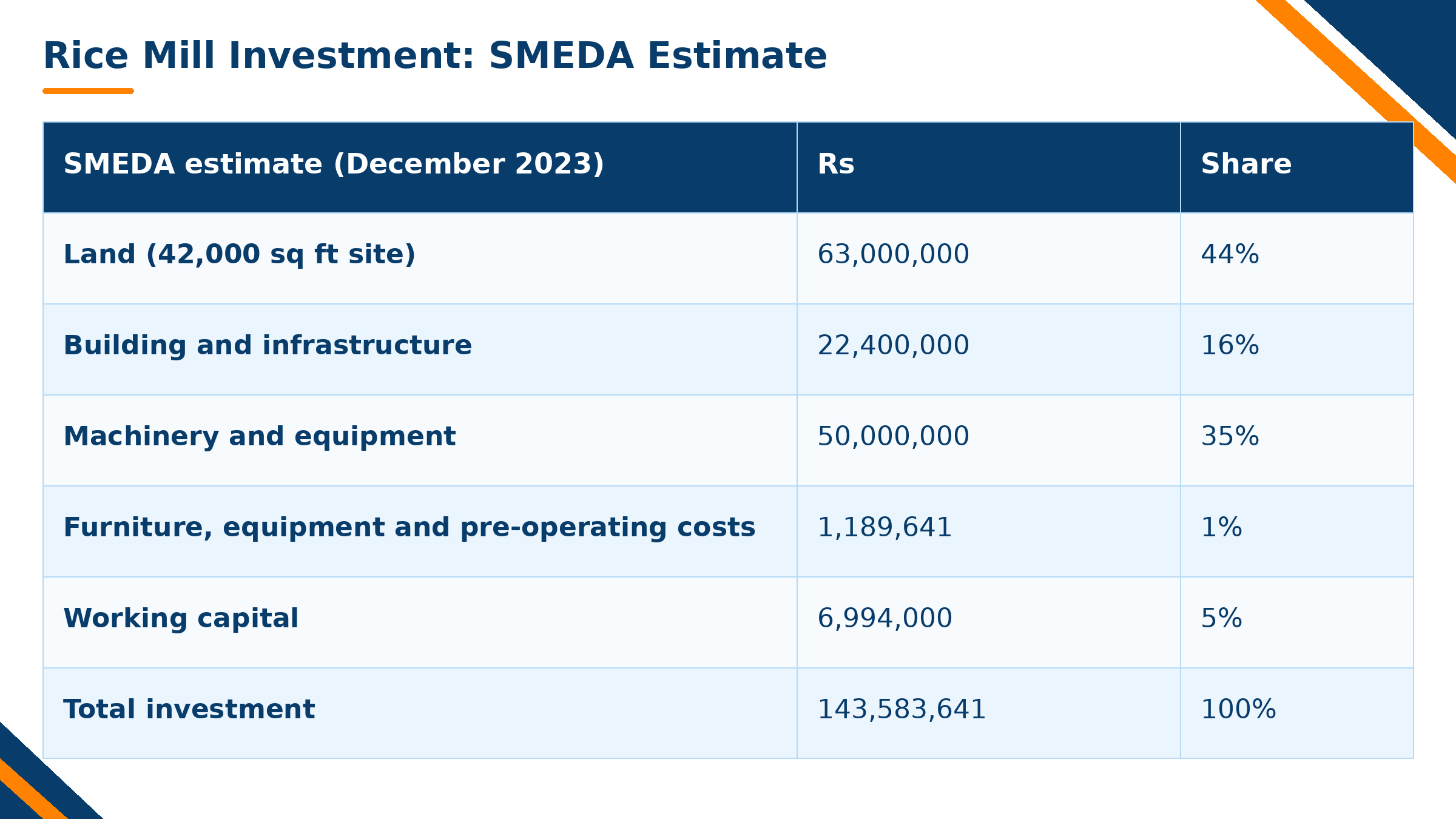
SMEDA assumes 50% bank financing at a 13% markup over 10 years, 28 employees, and 65% capacity utilization in the first year. Its model projects a payback of about 1.4 years using assumptions including a Rs 400 per kg selling price and a Rs 250 per kg cost; those inputs are dated and should not be treated as a current investment forecast.
The study also carries copy-paste errors and says the figures are approximate, so use it for the structure of the costs and make your own forecast with current paddy and rice prices.
For a feel of where the market is, our Pakistan rice sector report covers 2026 numbers. Zarea’s grains and pulses category lists rice and other staples in bulk, and the daily price page tracks commodity prices.
For a wider picture of supply, see the leading rice producers worldwide; production volumes can help explain competition in export markets.
Is Milled Rice Better?
It depends on what you mean by better. White rice is milled rice, with the husk, bran, and germ removed. Brown rice keeps the bran and germ, so it has more fibre, magnesium, and B vitamins, according to Healthline and Live Science, citing Harvard.
The trade-offs go the other way too. White rice cooks faster, keeps longer, and has less arsenic, which collects in the bran, and fortified white rice may have some vitamins and minerals added back, depending on the product, though not the fibre.
Parboiled white rice keeps more of its B vitamins than ordinary milled white rice.
Neither is bad. If fibre is your priority, brown rice generally provides more than ordinary white rice, and cooking preferences, grain origin, and overall diet also matter. This is general information, not medical advice.
Frequently Asked Questions
How to Start Up a Rice Milling Business?
Start by deciding which rice you’ll handle and how big you want to be. Then find a site close to paddy fields with dependable power. You’ll need an NTN and sales tax registration with FBR, plus a food licence, which comes from the Punjab Food Authority if you’re in Punjab.
Buy a milling line next, and add a boiler if you plan to parboil. Sort out paddy supply and your buyers early. For a sense of scale, SMEDA’s December 2023 study puts a mid-sized unit at about Rs 143.6 million, land included. Build your own forecast before you put money in.
What are the Types of Rice Mills?
There are four main kinds: huller mills, sheller mills, sheller-cum-huller mills (also called cone polisher mills), and modern rubber-roll mills. Hullers cost the least, but they break a lot of grains. IRRI says steel hullers are no longer acceptable for commercial milling. Modern mills give you the most head rice, and they use less energy for every tonne.
Can I Mill My Own Rice?
You can. Pound it by hand, or buy a small machine that husks and whitens in one go. Dry the paddy to about 14% moisture first. From 100 kg of paddy you’ll get roughly 65 to 70 kg of rice, and the husk makes decent fuel. Planning to sell it? Check what your province requires for food businesses.
Wrap-Up
Rice milling looks simple on paper, but a lot of small choices sit inside it. Clean the paddy before anything else. Husk it gently. Pull out the grains that didn’t husk, whiten in stages, then grade.
Do it well, and you should get about 68 to 72% of the paddy back as rice. The husk, bran, and brokens aren’t waste either. They sell, so plan for them as products.
Thinking of starting your own mill? Treat SMEDA’s study as a cost checklist and nothing more. Build the forecast yourself with today’s prices, and decide early what you’ll do with the by-products.
And before you pay for any machine, ask the supplier for a trial run on your own paddy. Then compare what you actually get: whole-grain recovery, electricity use, and how much upkeep the machine needs.